|
|
|
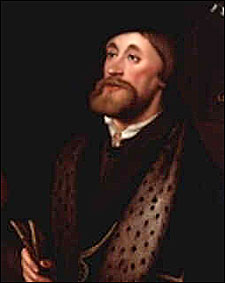
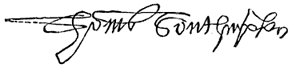

SIR THOMAS WRIOTHESLEY, first Baron Wriothesley of Titchfield and Earl of Southampton (1505-1550), lord chancellor of
England, was eldest son of William Writh or Wriothesley, York herald, who, like his brother, Sir Thomas Wriothesley (d. 1534),
adopted Wriothesley as the spelling of the family name. His mother, who survived until 1538, was Agnes, daughter of James
Drayton of London; and Drayton's notes recording his own and his grandchildren's dates of birth are still extant.1
Thomas, the eldest son, was born on the feast of St. Thomas the Apostle, 21 Dec. 1505; his sisters, Elizabeth and Anne (who
married Thomas Knight of Hook in Hampshire) in 1507 and 1508, and his brother Edward in 1509. At Edward's christening the
godfathers were Edward Stafford, third duke of Buckingham,
and Henry 'Algernon' Percy, fifth earl of Northumberland. Two other sisters, whom Wriothesley
names in his will, were born subsequently.
Thomas was educated at King's Hall or St. John's College, Cambridge, but seems to have left the university without a degree,
and sought employment at court. In a document dated 12 Feb. 1523-4 he refers to Cromwell as his
master, and after that date documents in his handwriting are frequent. In 1529, however, he is described as servant to (Sir)
Edmund Peckham, who, like Wriothesley, married a Cheyne of Chesham Bois, and on 4 May 1530 he appears as clerk of the signet;
on that date he was granted in reversion the office of bailiff in Warwick and Snitterfield, where Shakespeare's father lived.2
He probably ingratiated himself with Henry by his 'labour in the
king's great business,' i.e. the divorce,3 and on 26 Jan. 1530-1 he received a pension of £6 from the lands
of St. Mary's Abbey, York.
In December 1532 he was sent abroad, probably as bearer of despatches for some foreign ambassador. A similar mission followed
in the autumn of 1533. In October he was at Marseilles in financial straits, 'apparel and play sometimes, whereat he was unhappy,'
having 'cost him more than 60 crowns.' Apparently he went on to Rome, where he vainly endeavoured to obtain papal bulls for his
friend John Salcot, bishop-elect of Bangor. He had returned by the summer of 1534, and in that year was admitted a student of
Gray's Inn. On 2 Jan. 1535-6 he was granted in reversion the lucrative office of coroner and attorney in the king's bench,4
and in the same year was appointed 'graver' of the Tower. In the autumn he was required to supply twelve men for service against
the rebels in the north [see Pilgrimage of Grace], and to attend the king thither in person.
He remained, however, with Henry at Windsor, doing an increasing amount of secretarial work, and using his growing influence to
secure large grants out of the lands of the dissolved monasteries.
Early in 1537 he was given various manors previously belonging to Quarr Abbey in the Isle of Wight.5 On 30 Dec. in
the same year he acquired the site of the monastery of Titchfield, on the east side of Southampton Water, and on 29 July 1538
that of Beaulieu Abbey, on the opposite side of the water.6 Wriothesley had previously owned houses near both these
monasteries, with which he appears to have been officially connected, possibly as steward, and also at Micheldever, where his
family resided. He was likewise seneschal of Hyde Abbey, near Winchester, of which his friend Salcot had been abbot; and when
the abbey was surrendered, Wriothesley naturally obtained a grant of its site and of many of its manors. He 'pulled the abbey
down with amazing rapidity and sold the rich materials.'7 With the grant of these abbeys he also received numerous
manors, chiefly in Hampshire and the Isle of Wight, and his acquisition of landed property was naturally followed by his
inclusion in local commissions of the peace and of oyer and terminer, to visit monasteries
and to pull down images and shrines. His active participation in measures of this character, especially at Winchester, brought
on him the hostility of the bishop, Stephen Gardiner, who was
his wife's uncle, but Cromwell's patronage made him secure for the time.
In September 1538 Wriothesley was sent as ambassador to the regent of the Netherlands, Mary, queen of Hungary, to propose marriage
between Henry VIII and the Duchess of Milan, and between the Princess Mary
and Don Luis of Portugal. He arrived at Calais on 28 Sept., and had audience with the regent at Brussels on 6 Oct. During his
residence in the Netherlands he made various efforts to kidnap English refugees, both protestant and Roman catholic, but these
were as unsuccessful as the main objects of his mission. It was, however, intended to be nothing more than an attempt to delay
the threatened coalition of Francis I and Charles V against Henry. In
March 1538-9 war seemed imminent; Chapuys left England, and Wriothesley was in great dread of being
detained a prisoner in Flanders. He obtained the regent's leave to depart on the 19th, and reached Calais just in time to escape
the messengers she had sent after him to effect his arrest.
On 1 April following, in spite of Gardiner's opposition, Wriothesley was returned to parliament as
one of the knights of the shire for the county of Southampton. In December he was sent to Hertford to obtain the consent of the
Princess Mary to negotiations for her marriage with Philip of Bavaria, and about the same time he is
said to have attempted to dissuade Henry from marrying Anne of Cleves. In April 1540 Wriothesley
was appointed joint principal secretary with Sir Ralph Sadleir, with the usual provision of lodging
within the royal palaces 'and like bouge of court in all things as is appointed;' his commission8 dispensed with the
statute (31 Henry VIII, c. 10) providing that both secretaries should sit on one of the woolsacks in the House of Lords, and
directed, in consideration of their usefulness in the House of Commons, that the two secretaries should sit alternate weeks, one
in the lower and one in the upper house.
On the 18th of the same month Wriothesley was knighted at the same time that Cromwell was created Earl of Essex9.
Cromwell's fall two months later made Wriothesley's position perilous, and it was commonly reported that he was about to follow
his patron to the Tower. A series of charges, instigated possibly by Gardiner, and accusing him of unjustly retaining some manors
near Winchester, were brought against him and repeatedly discussed by the privy council. On 27 June, however, Richard Pate wrote
to Wriothesley from Brussels rejoicing 'to hear the common rumours proved false touching his trouble,' and on 29 Dec. the privy
council pronounced the charges against him slanderous. In reality Wriothesley had proved himself useful by the evidence he gave
with respect to Cromwell's case and the repudiation of Anne of Cleves. Apparently, too, he had made his peace with the now powerful
Gardiner, with whom he henceforth acted in concert, and had given sureties against any recurrence of his former religious and
iconoclastic zeal; at any rate, he now became one of the mainstays of the conservative party. On 26 July he was sufficiently in
favour to be granted in fee the great mansion within the close of Austin Friars, London.
On 13 Nov. he 'came to Hampton Court to the Quene [Catherine Howard], and called all the ladies
and gentlewomen and her servauntes into the Great Chamber, and there openlye afore them declared certeine offences that she had
done . . . wherefore he there discharged all her househould.'10 This offensive duty was followed by repeated
examinations of the Duchess of Norfolk and her household, in which Wriothesley also took the principal part, and on 7 Jan. 1540-1
he was appointed constable of Southampton Castle. In the same month at the time of the arrest of his friends
Sir Thomas Wyatt and Sir John Wallop, Wriothesley was again thought by
Marillac to be in great danger,11 and the rumour has led to erroneous statements that he was at this time sent to the
Tower;12 but there is no sign of this in the state papers or in the register of the privy council, where Wriothesley
continued to be an assiduous attendant.
In reality the loss of influence inflicted upon the Howards by the attainder of their relative,
Queen Catherine, opened up for Wriothesley the prospect of greater power than he had hitherto
enjoyed, and in April 1542 Chapuys reported that Wriothesley and the lord privy seal,
William Fitzwilliam, earl of Southampton, were the courtiers who possessed most credit with Henry
VIII.13 In November of the same year he went further and declared that Wriothesley 'almost governed everything' in
England.14 This view of Wriothesley's influence was partly due to the fact that he was working hand in hand with the
imperial party and Chapuys to restore a complete alliance between England and Spain. With this object he was in constant
communication with the imperial ambassador, and on 25 Oct. 1543 he was commissioned with Gardiner and Thirlby to formulate an
offensive and defensive league with Charles V, the outcome of which was the joint invasion of France by the two monarchs in 1544.
As a reward for his efforts Wriothesley was on 1 Jan. of that year created Baron Wriothesley of Titchfield, on 22 April following
he was made keeper of the great seal during Audley's illness, and on his death succeeded him as lord
chancellor (3 May). He was also on 20 June appointed to treat with Matthew Stewart, earl of Lennox, for the delivery of Dumbarton
and Bute into English hands, and on 9 July was named one of the advisers of Queen Catherine Parr
as regent during Henry VIII's absence in France. On 23 April 1545 he was elected knight of the Garter.
The alliance between England and Spain was, however, only part of a general reactionary policy in which Wriothesley was the king's
chief instrument. It extended also to domestic affairs, and the new lord chancellor gained a notoriety by his persecutions which
his legal accomplishments would never have won him. Audley's lenience towards reformers was replaced by frequent sentences to the
pillory and other punishments pronounced by Wriothesley in the Star-chamber. The best known of his
victims was Anne Askew, and there seems no adequate ground for disbelieving the story that the lord
chancellor and Rich racked the unfortunate woman in the Tower with their own hands when the lieutenant
shrank from the task.15 Wriothesley was certainly present at Anne Askew's execution.
The intrigue against Catherine Parr, in which he is said to have participated, is more doubtful,
and it is almost certain that for all his severity Wriothesley had the king's approbation. Probably, too, it was with the king's
sanction that Wriothesley, who sat at Baynard Castle in January 1544-5 as chief commissioner for enforcing payment of the
benevolence, condemned Alderman Rede to be sent to the wars in Scotland for refusal, a violation of law not less glaring than the
torture of Anne Askew.16 His last employment in Henry VIII's reign was in the proceedings against Surrey
and Norfolk; be personally assisted the king to draw up the accusations against Surrey, had the
earl under his custody until he was committed to the Tower, and finally passed sentence upon him.17 Similarly he was
placed at the head of the commissioners appointed to declare to parliament Henry's assent to the bills of attainder
against Surrey and Norfolk. Wriothesley had never been intimately associated with the Howards, but their fall was fatal to his own
position in the new reign and to the policy with which he had been identified. He was possibly conscious of this when 'with tears
in his eyes' he announced to parliament on 31 Jan. 1546-7 the death of Henry VIII.
By his will Henry VIII left Wriothesley £600,18 and appointed him one of his executors and of his son's privy
councillors. There is no authority for the speech in opposition to Somerset's elevation to the
protectorate which Froude attributes to Wriothesley at the meeting of the executors on the afternoon of 31 Jan., but it probably
represents with some accuracy the lord chancellor's sentiments. Cranmer
alone ranked before him in order of precedence, and Wriothesley conceived that his position and abilities entitled him to an
influential if not a preponderating voice in the new government. 'I was afraid,' wrote Sir Richard Morison, 'of a tempest all
the while that Wriothesley was able to raise any. I knew he was an earnest follower of whatsoever he took in hand, and did very
seldom miss where either wit or travail were able to bring his purposes to pass. Most true it is I never was able to persuade
myself that Wriothesley would be great, but the king's majesty must be in greatest danger.'19 This distrust more
than the chancellor's supposed hostility to the religious views of the majority of the executors precipitated his fall.
He had been peculiarly identified with the repressive absolutism of Henry VIII's last years which the Protector
had resolved to sweep away, and his removal was no doubt a popular measure. He was appointed first commissioner of claims for
the coronation of Edward VI on 5 Feb., was created Earl of Southampton on the 16th in accordance
with Henry's intentions as expressed by Paget, and on the 20th bore the sword of state at Edward's
coronation. But on the 18th, ambitious of taking a leading part in politics, he had issued a commission under the great seal
to four civilians to hear chancery cases in his absence, thus relieving himself of a large part
of his legal duties. Thereupon 'divers students of the common law' accused the chancellor of 'amplifying and enlarging the
jurisdiction of the said court of chancery' to the derogation of the common law, and declared the
said commission to be 'made contrary to the common law.' The commission was in fact only a repetition of one the lord chancellor
had taken out three years before; but he had been guilty of a more serious offence, for the commission had been issued without
a warrant and without consulting his fellow executors.
The question was submitted to the judges and law officers of the crown, and they unanimously declared that the lord chancellor
had 'by common law' forfeited his office and rendered himself liable to such fine and imprisonment as the king should impose.
Southampton aggravated his offence by threatening the judges and abusing the Protector; on 5 March the great seal was taken
from him, he was ordered to confine himself to his house in Ely Place, and bound over in four thousand pounds.20 He
was not, strictly speaking, expelled from the council, but his name was not included in the council when it was reconstituted
a few days later on Edward VI's authority instead of on that of Henry VIII. Southampton's fall removed an obstacle from Somerset's
path, but the inference that it was due to the Protector's animosity is hardly warranted. 'Your Grace,' wrote the chancellor's
ally Gardiner, 'showed so much favour to him that all the world commended your gentleness,' and a few weeks later the French
ambassador observed Southampton and Somerset in friendly and confidential conversation.21 He was soon at liberty,
the fine imposed appears to have been remitted, and in 1548, if not earlier, he was re-admitted to the council board.
Southampton, however, nursed his grievance against the Protector, and it is significant that the first occasion on which he again
comes prominently forward was when he joined Warwick and
other enemies of the Protector in the proceedings against his brother Thomas Seymour, baron Seymour of Sudeley,
in January and February 1548-9. He was no less prominent in the intrigues which led to the fall of the Protector himself in the
following October. In September, when the king moved to Hampton Court, Southampton remained in London, and at his house in Ely
Place many of the secret meetings of the councillors were held; Burnet, indeed, represents Southampton as the prime mover in the
conspiracy, and Warwick as merely his accomplice or even his tool. Personal motives as well as antipathy to the Protector's religious
and social policy dictated his action. He was present at all the meetings of the council in London from 6 to 11 Oct., and accompanied
the majority of the councillors to Windsor to arrest Somerset. He was then appointed one of the lords to be in special attendance
upon the young king, and for a time he seemed to have regained all his former influence.
Rumours were everywhere current that the mass was to be restored and the progress of the Reformation stopped. But Southampton was
soon undeceived; after the end of October he ceased to attend the meetings of the privy council, and on 2 Feb. 1549-50 he was struck
off the list of councillors and confined to his house. It may be true, as Burnet states, that, disappointed at not being restored to
the lord chancellorship or made lord great master, Southampton began to intrigue against Warwick, but his second fall is explicable
on other grounds. He had served Warwick's purpose and was now discarded, similar fate attending his associates the Earls of
Shrewsbury and Arundel,
Sir Thomas Arundell and Sir Richard Southwell. So chagrined was
Southampton at this failure of his hopes that, according to Bishop Ponet, 'fearing lest he should come to some open shameful end, he
poisoned himself or pined away for thought.' He died on 30 July 1550 'at his place in Holborne, called Lincolnes Place . . . and the
8 of August in the forenone he was buryed in St. Andrewes church in Holborne at the right hand of the high aulter, Mr. Hooper, Bishopp
of Glocester, preachinge there at the buryall.'22 His body was afterwards removed to Titchfield, where a sumptuous monument
erected to his memory is still extant. A full description with engravings is given in Mr. B. W. Greenfield's 'Wriothesley Tomb,
Titchfield,' reprinted from the 'Proceedings of the Hampshire Field Club.'
It is difficult to trace in Southampton's career any motive beyond that of self-aggrandisement. Trained in the Machiavellian school
of Cromwell, he was without the definite aims and resolute will that to some extent redeemed his master's lack of principle. He won
and retained Henry VIII's favour by his readiness in lending his abilities to the king's most nefarious designs, thereby inspiring
an almost universal distrust. The theological conservatism with which he has always been credited was tempered by a strict regard to
his own interests. Under Cromwell he was an enemy to bishops and a patron of reformers like Richard Taverner and Robert Talbot; he
was thanked by another protestant for bringing him 'out of the blind darkness of our old religion into the light of learning,' and
thought the 'Bishops' Book' of 1537 too reactionary. It was not until Cromwell had fallen and Henry had adopted a more conservative
policy that Wriothesley returned to Catholicism. Even then he sacrificed nothing in its cause, and few profited more extensively by
the spoliation of the monasteries. He racked Anne Askew, it is true, but he also assisted to ruin the
Howards, who alone might have stayed the Reformation after Henry's death. As lord chancellor he made no mark except by his severity
towards the victims of Henry VIII, and his legal training seems to have consisted solely in his admission to Gray's Inn. Leland,
however, wrote a eulogy of him,23 and he is credited with at least two irreproachable sentiments, namely, that he who
sold justice sold the king; and that while force awed, justice governed the world.
There is some obscurity about the identity of Southampton's wife. He was married before 1583 to Jane, niece of Stephen Gardiner,
bishop of Winchester, and sister of the unfortunate Germain Gardiner, the bishop's private secretary, who was executed for denying
the royal supremacy in 1548.24 In all the pedigrees, however, his wife is styled 'Jane daughter of William Cheney or
Cheyne of Chesham Bois, Buckinghamshire,' and there is no trace of his having had two wives. The inference is that the Countess of
Southampton's mother married first a brother of Bishop Gardiner, and secondly William Cheney, being mother of Germain Gardiner by
her first husband, and of the Countess of Southampton by her second. The countess survived until 16 Sept. 1574, and was buried at
Titchfield, where her monument is still extant. A manuscript book of prayers dedicated to her by Roger Welden, apart from its
interest as a collection, contains some curious notes on the family history. It belonged to Sir Thomas Phillipps, and in 1895 to
Bernard Quaritch.
By his countess Wriothesley had issue a son, who died in August 1537;25 another son, Anthony, who died about 1542,26
and his only surviving son and successor, Henry. He had also five daughters: (1) Elizabeth, who was
sufficiently old to have married Thomas Radcliffe (afterwards third Earl of Sussex) before 1550, and
died without issue in 1554-5; (2) Mary, who married, first, William Shelley of Michelgrove, and secondly Richard, son of Sir
Michael and grandson of Sir Richard Lyster; (3) Catherine, who married Thomas Cornwallis of East Horsley, Surrey, groom-porter to
Queen Elizabeth; (4) Mabel, who married (Sir) Walter Sandys, grandson of
William, baron Sandys of the Vyne; and (5) Anne, who was intended by her father to be the third wife of
Sir John Wallop. Wallop, however, died before the marriage took place, and Anne seems to have died unmarried.27
1. Brit. Mus. Add. Charters, 16194
2. Letters and Papers of Henry VIII, iv. 6600 [11].
3. ib. XIV. i. 190.
4. ib. X. 12.
5. ib. XII. i. 539 [45], 662, ii. 1150 [77].
6. ib. XIII. i. 1519 [67].
7. Liber Monasterii de Hyda, Rolls Ser. Introd. pp. lxxi-lxxiii; Leland, Itinerary, iii. 86.
8. Stowe MS. 141, f. 78.
9. Letters and Papers, xv. 437, 541. Wriothesley, Chronicle. i. 115.
10. Wriothesley's Chronicle, i. 130-1; Lord Herbert, Reign of Henry VIII, pp. 635-6.
11. Correspondance Politique, éd. Kaulek, pp. 261-262.
12. Calendar of State Papers, Spanish, vol. vi. pt. i. index.
13. ib. vi. i. 493.
14. ib. vi. ii. 167.
15. See Narratives of the Reformation, Camden Soc. pp. 303-8; Bale, Works, Parker Soc. pp. 142 sqq.
16. Hallam, Const. Hist. i. 25; Lodge, Illustrations of British History, i. 98; Wriothesley, Chron. i. 151.
17. Wriothesley, Chron. i. 176.
18. Roughly equivalent to £207,000 in 2008 pounds. Source: Measuring Worth.
19. Calendar of State Papers, Foreign 1547-53, No. 491.
20. Acts of the Privy Council 1547-50, pp. 48-57; Harleian MS. 284, art. 7. £4,000 in 1547 was roughly the equivalent of £1.4 million in 2008. Source: Measuring Worth.
21. Correspondance politique de Odet de Selve, p. 147. link.
22. Wriothesley, Chron. ii. 41; Henry Machyn, Diary, pp. 1, 313.
23. Encomia, p. 102.
24. Letters and Papers, XII. i. 1209, ii. 47, 546, 634, 825.
25. ib. XII. ii. 546.
26. The consolatory letter to Lady Wriothesley in Lansdowne MS. 76, art. 81, apparently refers to this event, though it is endorsed '1594'.
27. Trevelyan Papers, i. 206-16; Harleian MSS. 806 f. 45, 1529 f. 25, 2043 ff. 68-9.
Source:
Pollard, A. F. "Sir Thomas Wriothesley, Earl of Southampton."
The Dictionary of National Biography. Vol XXI. Sidney Lee, Ed.
New York: The Macmillan Co., 1909. 1063-1067.
Other Local Resources:
Web Links:
 | to Luminarium Encyclopedia |
Site ©1996-2022 Anniina Jokinen. All rights reserved.
This page was created on August 14, 2009. Last updated October 16, 2022.
|
Index of Encyclopedia Entries:
Medieval Cosmology
Prices of Items in Medieval England
Edward II
Isabella of France, Queen of England
Piers Gaveston
Thomas of Brotherton, E. of Norfolk
Edmund of Woodstock, E. of Kent
Thomas, Earl of Lancaster
Henry of Lancaster, Earl of Lancaster
Henry of Grosmont, Duke of Lancaster
Roger Mortimer, Earl of March
Hugh le Despenser the Younger
Bartholomew, Lord Burghersh, elder
Hundred Years' War (1337-1453)
Edward III
Philippa of Hainault, Queen of England
Edward, Black Prince of Wales
John of Eltham, Earl of Cornwall
The Battle of Crécy, 1346
The Siege of Calais, 1346-7
The Battle of Poitiers, 1356
Lionel of Antwerp, Duke of Clarence
John of Gaunt, Duke of Lancaster
Edmund of Langley, Duke of York
Thomas of Woodstock, Gloucester
Richard of York, E. of Cambridge
Richard Fitzalan, 3. Earl of Arundel
Roger Mortimer, 2nd Earl of March
The Good Parliament, 1376
Richard II
The Peasants' Revolt, 1381
Lords Appellant, 1388
Richard Fitzalan, 4. Earl of Arundel
Archbishop Thomas Arundel
Thomas de Beauchamp, E. Warwick
Robert de Vere, Earl of Oxford
Ralph Neville, E. of Westmorland
Thomas Mowbray, Duke of Norfolk
Edmund Mortimer, 3. Earl of March
Roger Mortimer, 4. Earl of March
John Holland, Duke of Exeter
Michael de la Pole, E. Suffolk
Hugh de Stafford, 2. E. Stafford
Henry IV
Edward, Duke of York
Edmund Mortimer, 5. Earl of March
Henry Percy, Earl of Northumberland
Sir Henry Percy, "Harry Hotspur"
Thomas Percy, Earl of Worcester
Owen Glendower
The Battle of Shrewsbury, 1403
Archbishop Richard Scrope
Thomas Mowbray, 3. E. Nottingham
John Mowbray, 2. Duke of Norfolk
Thomas Fitzalan, 5. Earl of Arundel
Henry V
Thomas, Duke of Clarence
John, Duke of Bedford
Humphrey, Duke of Gloucester
John Talbot, Earl of Shrewsbury
Richard, Earl of Cambridge
Henry, Baron Scrope of Masham
William de la Pole, Duke of Suffolk
Thomas Montacute, E. Salisbury
Richard Beauchamp, E. of Warwick
Henry Beauchamp, Duke of Warwick
Thomas Beaufort, Duke of Exeter
Cardinal Henry Beaufort
John Beaufort, Earl of Somerset
Sir John Fastolf
John Holland, 2. Duke of Exeter
Archbishop John Stafford
Archbishop John Kemp
Catherine of Valois
Owen Tudor
John Fitzalan, 7. Earl of Arundel
John, Lord Tiptoft
Charles VII, King of France
Joan of Arc
Louis XI, King of France
Charles the Bold, Duke of Burgundy
The Battle of Agincourt, 1415
The Battle of Castillon, 1453
The Wars of the Roses 1455-1485
Causes of the Wars of the Roses
The House of Lancaster
The House of York
The House of Beaufort
The House of Neville
The First Battle of St. Albans, 1455
The Battle of Blore Heath, 1459
The Rout of Ludford, 1459
The Battle of Northampton, 1460
The Battle of Wakefield, 1460
The Battle of Mortimer's Cross, 1461
The 2nd Battle of St. Albans, 1461
The Battle of Towton, 1461
The Battle of Hedgeley Moor, 1464
The Battle of Hexham, 1464
The Battle of Edgecote, 1469
The Battle of Losecoat Field, 1470
The Battle of Barnet, 1471
The Battle of Tewkesbury, 1471
The Treaty of Pecquigny, 1475
The Battle of Bosworth Field, 1485
The Battle of Stoke Field, 1487
Henry VI
Margaret of Anjou
Richard Plantagenet, Duke of York
Edward IV
Elizabeth Woodville
Richard Woodville, 1. Earl Rivers
Anthony Woodville, 2. Earl Rivers
Jane Shore
Edward V
Richard III
George, Duke of Clarence
Ralph Neville, 2. Earl of Westmorland
Richard Neville, Earl of Salisbury
Richard Neville, Earl of Warwick
Edward Neville, Baron Bergavenny
William Neville, Lord Fauconberg
Robert Neville, Bishop of Salisbury
John Neville, Marquis of Montagu
George Neville, Archbishop of York
John Beaufort, 1. Duke Somerset
Edmund Beaufort, 2. Duke Somerset
Henry Beaufort, 3. Duke of Somerset
Edmund Beaufort, 4. Duke Somerset
Margaret Beaufort
Edmund Tudor, Earl of Richmond
Jasper Tudor, Earl of Pembroke
Humphrey Stafford, D. Buckingham
Henry Stafford, Duke of Buckingham
Humphrey Stafford, E. of Devon
Thomas, Lord Stanley, Earl of Derby
Sir William Stanley
Archbishop Thomas Bourchier
Henry Bourchier, Earl of Essex
John Mowbray, 3. Duke of Norfolk
John Mowbray, 4. Duke of Norfolk
John Howard, Duke of Norfolk
Henry Percy, 2. E. Northumberland
Henry Percy, 3. E. Northumberland
Henry Percy, 4. E. Northumberland
William, Lord Hastings
Henry Holland, Duke of Exeter
William Fitzalan, Earl of Arundel
William Herbert, 1. Earl of Pembroke
John de Vere, 12th Earl of Oxford
John de Vere, 13th Earl of Oxford
Thomas de Clifford, 8. Baron Clifford
John de Clifford, 9. Baron Clifford
John Tiptoft, Earl of Worcester
Thomas Grey, 1. Marquis Dorset
Sir Andrew Trollop
Archbishop John Morton
Edward Plantagenet, E. of Warwick
John Talbot, 2. E. Shrewsbury
John Talbot, 3. E. Shrewsbury
John de la Pole, 2. Duke of Suffolk
John de la Pole, E. of Lincoln
Edmund de la Pole, E. of Suffolk
Richard de la Pole
John Sutton, Baron Dudley
James Butler, 5. Earl of Ormonde
Sir James Tyrell
Edmund Grey, first Earl of Kent
George Grey, 2nd Earl of Kent
John, 5th Baron Scrope of Bolton
James Touchet, 7th Baron Audley
Walter Blount, Lord Mountjoy
Robert Hungerford, Lord Moleyns
Thomas, Lord Scales
John, Lord Lovel and Holand
Francis Lovell, Viscount Lovell
Sir Richard Ratcliffe
William Catesby
Ralph, 4th Lord Cromwell
Jack Cade's Rebellion, 1450
Tudor Period
King Henry VII
Queen Elizabeth of York
Arthur, Prince of Wales
Lambert Simnel
Perkin Warbeck
The Battle of Blackheath, 1497
King Ferdinand II of Aragon
Queen Isabella of Castile
Maximilian I, Holy Roman Emperor
King Henry VIII
Queen Catherine of Aragon
Queen Anne Boleyn
Queen Jane Seymour
Queen Anne of Cleves
Queen Catherine Howard
Queen Katherine Parr
King Edward VI
Queen Mary I
Queen Elizabeth I
Henry Fitzroy, Duke of Richmond
Margaret Tudor, Queen of Scotland
James IV, King of Scotland
The Battle of Flodden Field, 1513
James V, King of Scotland
Mary of Guise, Queen of Scotland
Mary Tudor, Queen of France
Louis XII, King of France
Francis I, King of France
The Battle of the Spurs, 1513
Field of the Cloth of Gold, 1520
Charles V, Holy Roman Emperor
Eustace Chapuys, Imperial Ambassador
The Siege of Boulogne, 1544
Cardinal Thomas Wolsey
Archbishop Thomas Cranmer
Thomas Cromwell, Earl of Essex
Thomas, Lord Audley
Thomas Wriothesley, E. Southampton
Sir Richard Rich
Edward Stafford, D. of Buckingham
Thomas Howard, 2nd Duke of Norfolk
Thomas Howard, 3rd Duke of Norfolk
John Dudley, Duke of Northumberland
Charles Brandon, Duke of Suffolk
Thomas Boleyn, Earl of Wiltshire
George Boleyn, Viscount Rochford
John Russell, Earl of Bedford
Thomas Grey, 2. Marquis of Dorset
Henry Grey, D. of Suffolk
Charles Somerset, Earl of Worcester
George Talbot, 4. E. Shrewsbury
Francis Talbot, 5. E. Shrewsbury
Henry Algernon Percy,
5th Earl of Northumberland
Henry Algernon Percy,
6th Earl of Northumberland
Ralph Neville, 4. E. Westmorland
Henry Neville, 5. E. Westmorland
William Paulet, Marquis of Winchester
Sir Francis Bryan
Sir Nicholas Carew
John de Vere, 15th Earl of Oxford
John de Vere, 16th Earl of Oxford
Thomas Seymour, Lord Admiral
Edward Seymour, Protector Somerset
Margaret Pole, Countess of Salisbury
Henry Pole, Lord Montague
Sir Geoffrey Pole
Thomas Manners, Earl of Rutland
Henry Manners, Earl of Rutland
Henry Bourchier, 2. Earl of Essex
Robert Radcliffe, 1. Earl of Sussex
Henry Radcliffe, 2. Earl of Sussex
George Hastings, Earl of Huntingdon
Henry Courtenay, Marquis of Exeter
George Neville, Baron Bergavenny
Sir Edward Neville
William, Lord Paget
William Sandys, Baron Sandys
William Fitzwilliam, E. Southampton
Sir Anthony Browne
Sir Thomas Wriothesley
Sir William Kingston
George Brooke, Lord Cobham
Sir Richard Southwell
Thomas Fiennes, 9th Lord Dacre
Sir Francis Weston
Henry Norris
Lady Jane Grey
Sir Thomas Arundel
Sir Richard Sackville
Sir William Petre
Sir John Cheke
Walter Haddon, L.L.D
Sir Peter Carew
Sir John Mason
Nicholas Wotton
John Taylor
Sir Thomas Wyatt, the Younger
Cardinal Lorenzo Campeggio
Cardinal Reginald Pole
Stephen Gardiner, Bishop of Winchester
Edmund Bonner, Bishop of London
Nicholas Ridley, Bishop of London
John Hooper, Bishop of Gloucester
John Aylmer, Bishop of London
Thomas Linacre
William Grocyn
Archbishop William Warham
Cuthbert Tunstall, Bishop of Durham
Richard Fox, Bishop of Winchester
Edward Fox, Bishop of Hereford
Pope Julius II
Pope Leo X
Pope Clement VII
Pope Paul III
Pope Pius V
Pico della Mirandola
Desiderius Erasmus
Martin Bucer
Richard Pace
Christopher Saint-German
Thomas Tallis
Elizabeth Barton, the Nun of Kent
Hans Holbein, the Younger
The Sweating Sickness
Dissolution of the Monasteries
Pilgrimage of Grace, 1536
Robert Aske
Anne Askew
Lord Thomas Darcy
Sir Robert Constable
Oath of Supremacy
The Act of Supremacy, 1534
The First Act of Succession, 1534
The Third Act of Succession, 1544
The Ten Articles, 1536
The Six Articles, 1539
The Second Statute of Repeal, 1555
The Act of Supremacy, 1559
Articles Touching Preachers, 1583
Queen Elizabeth I
William Cecil, Lord Burghley
Robert Cecil, 1st Earl of Salisbury
Sir Francis Walsingham
Sir Nicholas Bacon
Sir Thomas Bromley
Robert Dudley, Earl of Leicester
Ambrose Dudley, Earl of Warwick
Henry Carey, Lord Hunsdon
Sir Thomas Egerton, Viscount Brackley
Sir Francis Knollys
Katherine "Kat" Ashley
Lettice Knollys, Countess of Leicester
George Talbot, 6. E. of Shrewsbury
Elizabeth, Countess of Shrewsbury
Gilbert Talbot, 7. E. of Shrewsbury
Sir Henry Sidney
Sir Robert Sidney
Archbishop Matthew Parker
Walter Devereux, 1st Earl of Essex
Robert Devereux, 2nd Earl of Essex
Penelope Devereux, Lady Rich
Sir Christopher Hatton
Edward Courtenay, E. Devonshire
Edward Manners, 3rd Earl of Rutland
Thomas Radcliffe, 3. Earl of Sussex
Henry Radcliffe, 4. Earl of Sussex
Robert Radcliffe, 5. Earl of Sussex
William Parr, Marquis of Northampton
Henry Wriothesley, 2. Southampton
Henry Wriothesley, 3. Southampton
Charles Neville, 6. E. Westmorland
Thomas Percy, 7. E. Northumberland
Henry Percy, 8. E. Northumberland
Henry Percy, 9. E. Nothumberland
William Herbert, 1. Earl of Pembroke
Charles, Lord Howard of Effingham
Thomas Howard, 4th Duke of Norfolk
Henry Howard, 1. Earl of Northampton
Thomas Howard, 1. Earl of Suffolk
Henry Hastings, 3. E. of Huntingdon
Edward Manners, 3rd Earl of Rutland
Roger Manners, 5th Earl of Rutland
Francis Manners, 6th Earl of Rutland
Henry FitzAlan, 12. Earl of Arundel
Thomas, Earl Arundell of Wardour
Edward Somerset, E. of Worcester
William Davison
Sir Walter Mildmay
Sir Ralph Sadler
Sir Amyas Paulet
Gilbert Gifford
Anthony Browne, Viscount Montague
François, Duke of Alençon & Anjou
Mary, Queen of Scots
Henry Stuart, Lord Darnley
James Hepburn, Earl of Bothwell
Anthony Babington and the Babington Plot
John Knox
Philip II of Spain
The Spanish Armada, 1588
Sir Francis Drake
Sir John Hawkins
William Camden
Archbishop Whitgift
Martin Marprelate Controversy
John Penry (Martin Marprelate)
Richard Bancroft, Archbishop of Canterbury
John Dee, Alchemist
Philip Henslowe
Edward Alleyn
The Blackfriars Theatre
The Fortune Theatre
The Rose Theatre
The Swan Theatre
Children's Companies
The Admiral's Men
The Lord Chamberlain's Men
Citizen Comedy
The Isle of Dogs, 1597
Common Law
Court of Common Pleas
Court of King's Bench
Court of Star Chamber
Council of the North
Fleet Prison
Assize
Attainder
First Fruits & Tenths
Livery and Maintenance
Oyer and terminer
Praemunire
The Stuarts
King James I of England
Anne of Denmark
Henry, Prince of Wales
The Gunpowder Plot, 1605
George Villiers, 1st Duke of Buckingham
Robert Carr, Earl of Somerset
Arabella Stuart, Lady Lennox
William Alabaster
Bishop Hall
Bishop Thomas Morton
Archbishop William Laud
John Selden
Lucy Harington, Countess of Bedford
Henry Lawes
King Charles I
Queen Henrietta Maria
Long Parliament
Rump Parliament
Kentish Petition, 1642
Thomas Wentworth, Earl of Strafford
John Digby, Earl of Bristol
George Digby, 2nd Earl of Bristol
Thomas Fairfax, 3rd Lord Fairfax
Robert Devereux, 3rd E. of Essex
Robert Sidney, 2. E. of Leicester
Algernon Percy, E. of Northumberland
Henry Montagu, Earl of Manchester
Edward Montagu, 2. Earl of Manchester
The Restoration
King Charles II
King James II
Test Acts
Greenwich Palace
Hatfield House
Richmond Palace
Windsor Palace
Woodstock Manor
The Cinque Ports
Mermaid Tavern
Malmsey Wine
Great Fire of London, 1666
Merchant Taylors' School
Westminster School
The Sanctuary at Westminster
"Sanctuary"
Images:
Chart of the English Succession from William I through Henry VII
Medieval English Drama
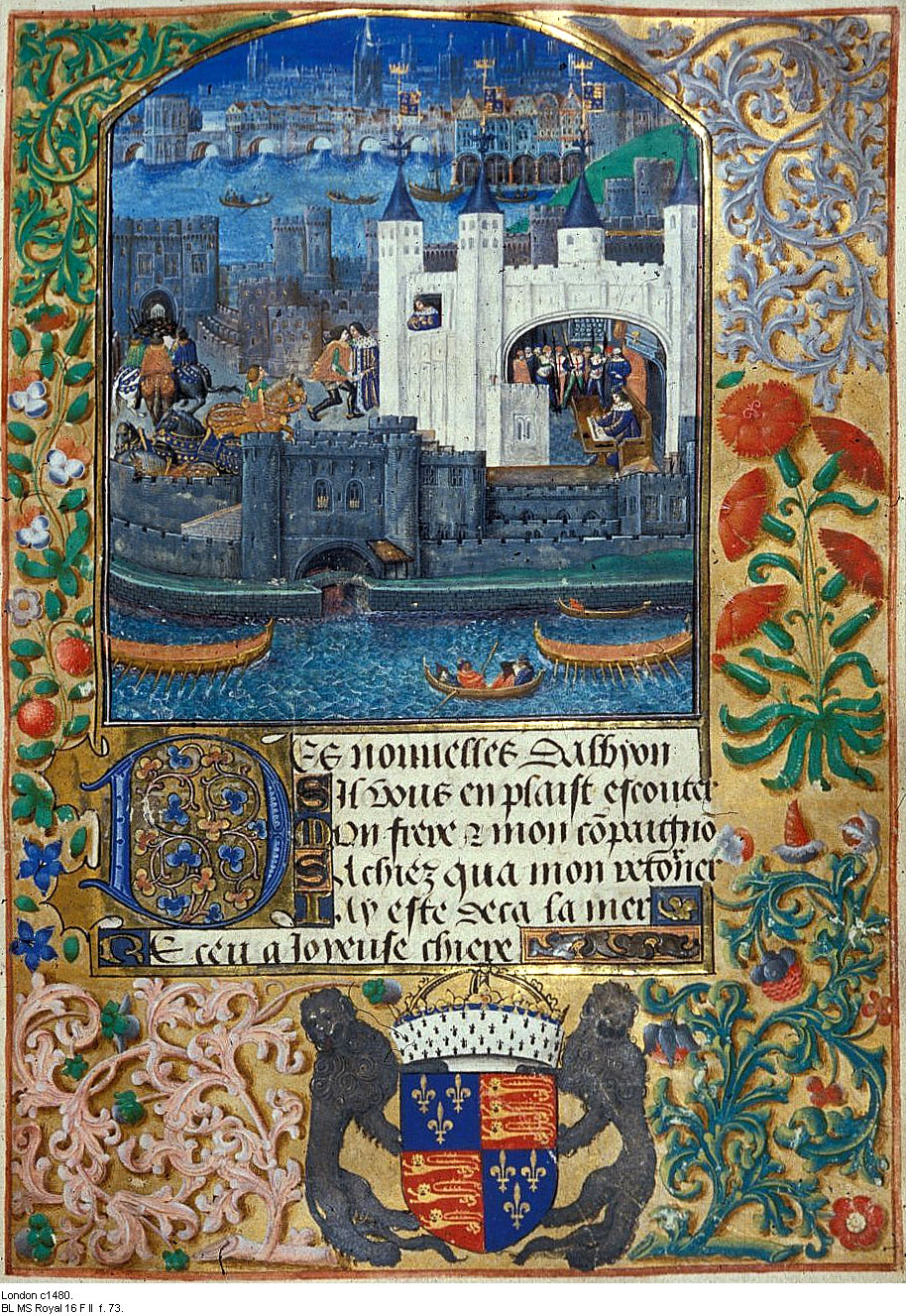
London c1480, MS Royal 16
London, 1510, the earliest view in print
Map of England from Saxton's Descriptio Angliae, 1579
London in late 16th century
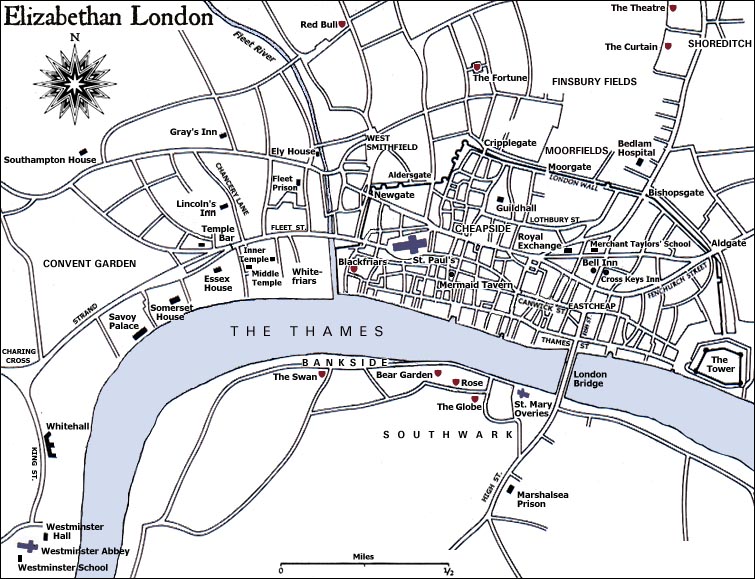
Location Map of Elizabethan London
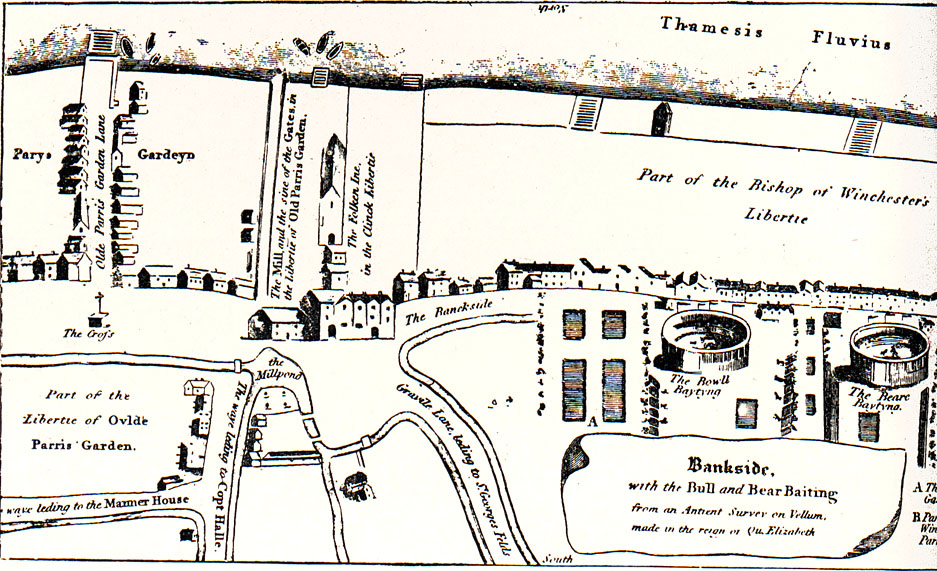
Plan of the Bankside, Southwark, in Shakespeare's time
Detail of Norden's Map of the Bankside, 1593
Bull and Bear Baiting Rings from the Agas Map (1569-1590, pub. 1631)
Sketch of the Swan Theatre, c. 1596
Westminster in the Seventeenth Century, by Hollar
Visscher's View of London, 1616
Larger Visscher's View in Sections
c. 1690. View of London Churches, after the Great Fire
The Yard of the Tabard Inn from Thornbury, Old and New London
|
|

 England under the Tudors