|
|
|

ANNE ASKEW (1521-1546), protestant martyr, was the second daughter of Sir William Askew, or Ayscough, knight, who is
generally stated to be of Kelsey in Lincolnshire. But according to family and local tradition she was born at Stallingborough,
near Grimsby, where the site of her father's house is still pointed out.1 The Askews were an old Lincolnshire family,
and the consciousness of this fact may have had something to do with the formation of Anne's character. She was highly educated
and much devoted to biblical study. When she stayed at Lincoln she was seen daily in the cathedral reading the Bible, and engaging
the clergy in discussions on the meaning of particular texts. According to her own account she was superior to them all in argument,
and those who wished to answer her commonly retired without a word.
At a time when she was probably still a girl a marriage was arranged by her parents for her elder sister, who was to be the wife
of one Thomas Kyme of Kelsey. It was one of those feudal bargains which were of constant occurrence in the domestic life of those
days. But the intended bride died before it was fulfilled, and her father, 'to save the money,' as we are expressly told, caused
Anne to supply her place against her own will. She accordingly married Kyme, and had two children by him. But having, as it is
said, offended the priests, her husband put her out of his house, on which she, for her part, was glad to leave him, and was
supposed to have sought a divorce. Whether it was with this view that she came to London does not appear; but in March 1545 she
underwent some examinations for heresy, of which she herself has left us an account, first at Sadler's Hall2 by one
Christopher Dare, then before the lord mayor of London, who committed her to the Counter,3 and afterwards before
Bishop Bonner and a number of other divines. It is unfortunate that we have no other record of these
proceedings than her own,4 which though honest was undoubtedly one-sided, and is not likely to have been improved in the
direction of impartiality by having been first edited by John Bale,
afterwards bishop of Ossory, during his exile in Germany.
The subject on which she lay under suspicion of heresy was the sacrament. The severe Act of the Six Articles,
passed some years before, had produced such a crop of ecclesiastical prosecutions that parliament had been already obliged to
restrict its operation by another statute, and Henry VIII himself at
the end of this very year thought it well to deliver an exhortation to parliament on the subject of christian charity. In such
a state of matters Anne Askew had little chance of mercy. It is, however, tolerably clear, notwithstanding the gloss which
Bale, and Fox
after him, endeavoured to put upon it, that one man who sincerely tried to befriend her was the much-abused
Bishop Bonner. He did his utmost to conquer her distrust and get her to talk with him familiarly,
promising that no advantage should be taken of unwary words; and he actually succeeded in extracting from her a perfectly orthodox
confession (according to the standard then acknowledged), with which he sought to protect her from further molestation. But when it
was read over to her, and she was asked to sign, although she had acknowledged every word of it before, instead of her simple
signature she added, 'I, Anne Askew, do believe all manner of things contained in the faith of the Catholic Church, and not
otherwise.' The bishop was quite disconcerted. In Anne's own words, 'he flung into his chamber in a great fury.' He had told her
that she might thank others, and not herself, for the favour he had shown her, as she was so well connected. Now she seemed anxious
to undo all his efforts on her behalf. Dr. Weston, however (afterwards Queen Mary's dean of Westminster),
contrived at this point to save her from her own indiscretion, representing to the bishop that she had not taken sufficient notice
of the reference actually made to the church in the written form of the confession, and thought she was supplying an omission. The
bishop was accordingly persuaded to come out again, and after some further explanations Anne was at length liberated upon sureties
for her forthcoming whenever she should be further called in question. She had still to appear before the lord mayor, and did so on
13 June following, when she and two other persons, one being of her own sex, were arraigned under the act as sacramentaries; but no
witnesses appeared against her or either of the others, except one against the man, and they were all three acquitted and set at
liberty.
The accusers of Anne had for the time been put to silence, but unfortunately within a year new grounds of complaint were urged, and
she was examined a second time before the council at Greenwich. Her opinions meanwhile seem to have been growing more decidedly
heretical, and her old assurance in the face of learned disputants was stronger than ever. She was first asked some questions about
her husband, and refused to reply except before the king himself. She was then asked her opinion of the sacrament, and, being
admonished to speak directly to the point, said she would not sing a new song of the Lord in a strange land. Bishop Gardiner
told her she spoke in parables. She replied that it was best for him, for if she showed him the open truth he would not accept it.
He then told her that she was a parrot, and she declared herself ready to suffer not only rebuke but everything else at his hands.
She had an answer ready for each of the council that examined her. Indeed, she sometimes seemed to be examining them, for she asked
the lord chancellor himself how long he would halt on both sides.
Nevertheless, she was more closely questioned this time than she had been the year before. She was five hours before the council at
Greenwich, and was examined again on the following day, being meantime conveyed to Lady Garnish.5 On the following Sunday
she was very ill and desired to speak with Latimer, but was not allowed,
let in the extremity of her illness she was sent to Newgate in such pain as she had never suffered in her
life. But worse awaited her. On Tuesday following she was conveyed from Newgate to the sign of the Crown, where
Sir Richard Rich endeavoured to persuade her to abandon her heresy. Dr. Shaxton, also, late bishop of
Salisbury, urged her to make a recantation, as he had just lately done himself, but all to no purpose. Rich accordingly sent her to
the Tower, where a new set of inquiries were addressed to her, for it seems some members of the council suspected that she received
secret encouragement from persons of great influence. She denied, however, that she knew any man or woman of her sect, and explained
that during her last year's imprisonment in the Counter she had been maintained by the efforts of her maid, who 'made moan' for her
to the prentices in the street, and collected money from them. She did not know the name of any one who had given her money, but
acknowledged that a man in a blue coat had given her ten shillings, and said it was from my lady Hertford. More than this even the
rack could not get from her, which by her own statement afterwards (if we may trust a narrative which could scarcely in such a case
have been actually penned by herself) was applied by Lord Chancellor Wriothesley himself and
Sir Richard Rich, turning the screws with their own hands. Yet even after being released from this
torture she 'sat two long hours reasoning with my lord chancellor upon the bare floor,' but could not be induced to change her opinion.
So far we have followed the account given as that of the sufferer herself. But it should be noticed that on 18 June 1546 she was
arraigned for heresy at the Guildhall along with Dr. Shaxton and two others, all of whom confessed the indictment, and were sentenced
to the fire. Dr. Shaxton and one of the others recanted next day, and it was either that day or a few days later that Anne Askew was
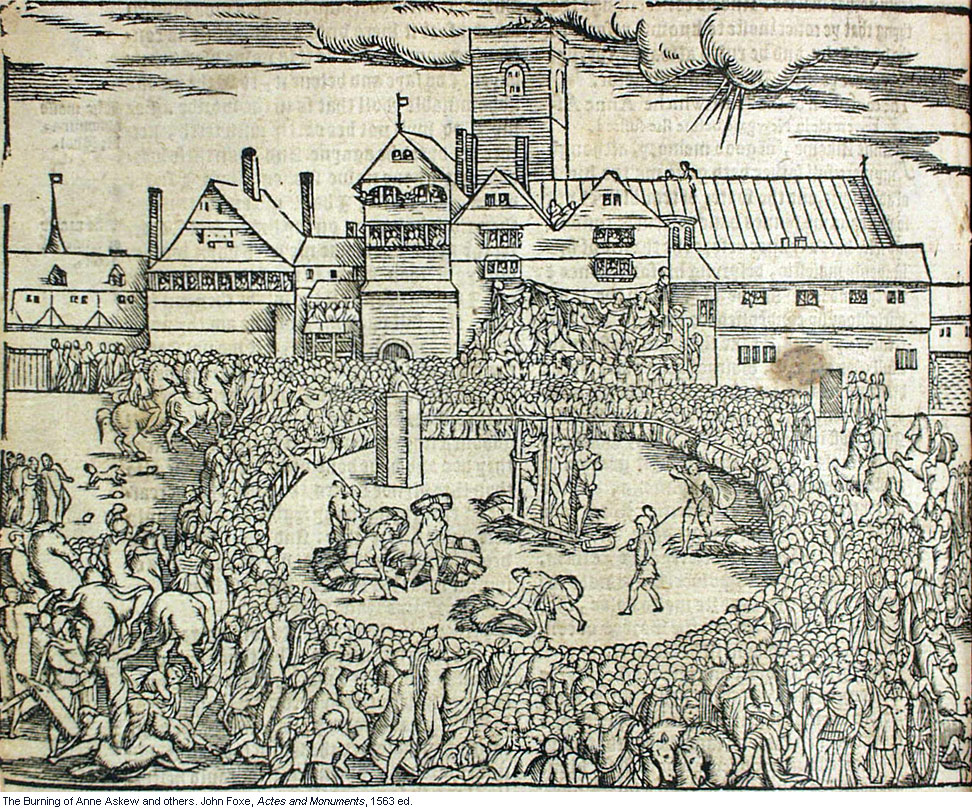
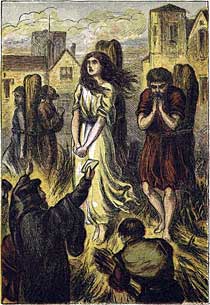
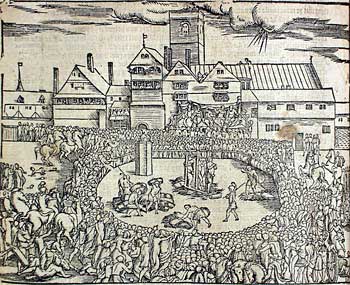
racked in the Tower. On 16 July she and three others guilty of the same heresy were brought to the stake in Smithfield, she being so
weak from the torture she had already undergone that she had to be carried in a chair.6 She was tied to the stake by a chain
round the waist which supported her body. On a bench under St. Bartholomew's Church sat Lord Chancellor Wriothesley,
the Dukes of Norfolk and Bedford,
the lord mayor, and others, to witness the shameful tragedy; and, to complete the matter, Dr. Shaxton, who had so recently recanted the
same heresy, was appointed to preach to the victims. Anne still preserved her marvellous self-possession, and made passing comments on
the preacher's words, confirming them where she agreed with him, and at other times saying 'There he misseth and speaketh without the
book.' After the sermon the martyrs began to pray. The titled spectators on the bench were more discomposed, knowing that there was some
gunpowder near the faggots, which they feared might send them flying about their ears. But the Earl of Bedford
reassured them. The gunpowder was not under the faggots, but laid about the bodies of the victims to rid them the sooner of their pain.
Finally Lord Chancellor Wriothesley sent Anne Askew letters with an assurance of the king's pardon if she would even now recant. She
refused to look at them, saying she came not thither to deny her Master. A like refusal was made by the other sufferers. The lord mayor
then cried out 'Fiat justitia!' and ordered the fire to be laid to the faggots. Soon afterwards all was over.7
Anne is said by Bale to have been twenty-five years old when she suffered.
She must therefore have been born in the year 1521.
There cannot be a doubt that the memory of this woman's sufferings and of her extraordinary fortitude and heroism added
strength to the protestant reaction under Edward VI. The account of her martyrdom published by
Bale in Germany, Strype tells us, was publicly exposed to sale at Winchester in
1549, in reproach of Bishop Gardiner, who was believed (whether justly or not is another question) to have been
a great cause of her death. 'Four of these books,' says Strype, 'came to that bishop's own eyes, being then at Winchester; they had leaves
put in as additions to the book, some glued and some unglued, which probably contained some further intelligences that the author had gathered
since his first writing of the book. And herein some reflections were made freely, according to Bale's talent, upon some of the court, not
sparing Paget himself, though then secretary of state.'8 We ought certainly to make some allowance for
bias in testimony that could be manipulated after such a fashion, but we need not be sparing in sympathy for the devoted sufferer.
— James Gairdner.
[AJ Notes:]
1. It is to be noted that Gairdner's article was written in 1885; whether the house's location is still commonly pointed out is not known to this editor.
2. Saddler's Hall was the guildhall of the Saddle-makers' Guild.
3. The Counter Prison, or the Compter, was located in Bread Street until 1555.
4. See: The First Examination of Anne Askew from Foxe's Book of Martyrs.
5. Prison.
6. Gairdner here supposes Askew merely weak; if she was racked, chances are her legs and arms had been dislocated and pulled out of their sockets, making standing or walking impossible.
7. See: The Death of Anne Askew from Foxe's Book of Martyrs.
8. Memorials of Cranmer, 294.
Source:
Gairdner, James. "Anne Askew."
The Dictionary of National Biography. Vol II. Leslie Stephen, Ed.
London: Smith, Elder, & Co., 1885. 190-192.
Other Local Resources:
Books for further study:
Beilin, Elaine V., ed. The Examinations of Anne Askew.
New York: Oxford University Press, 1996.
Zahl, Paul F. M. Five Women of the English Reformation.
Cambridge: Wm. B. Eerdmans Publishing, 2001.
Web Links:
 | to Luminarium Encyclopedia |
Site ©1996-2023 Anniina Jokinen. All rights reserved.
This page was created on July 16, 2010. Last updated February 25, 2023.
|
Index of Encyclopedia Entries:
Medieval Cosmology
Prices of Items in Medieval England
Edward II
Isabella of France, Queen of England
Piers Gaveston
Thomas of Brotherton, E. of Norfolk
Edmund of Woodstock, E. of Kent
Thomas, Earl of Lancaster
Henry of Lancaster, Earl of Lancaster
Henry of Grosmont, Duke of Lancaster
Roger Mortimer, Earl of March
Hugh le Despenser the Younger
Bartholomew, Lord Burghersh, elder
Hundred Years' War (1337-1453)
Edward III
Philippa of Hainault, Queen of England
Edward, Black Prince of Wales
John of Eltham, Earl of Cornwall
The Battle of Crécy, 1346
The Siege of Calais, 1346-7
The Battle of Poitiers, 1356
Lionel of Antwerp, Duke of Clarence
John of Gaunt, Duke of Lancaster
Edmund of Langley, Duke of York
Thomas of Woodstock, Gloucester
Richard of York, E. of Cambridge
Richard Fitzalan, 3. Earl of Arundel
Roger Mortimer, 2nd Earl of March
The Good Parliament, 1376
Richard II
The Peasants' Revolt, 1381
Lords Appellant, 1388
Richard Fitzalan, 4. Earl of Arundel
Archbishop Thomas Arundel
Thomas de Beauchamp, E. Warwick
Robert de Vere, Earl of Oxford
Ralph Neville, E. of Westmorland
Thomas Mowbray, Duke of Norfolk
Edmund Mortimer, 3. Earl of March
Roger Mortimer, 4. Earl of March
John Holland, Duke of Exeter
Michael de la Pole, E. Suffolk
Hugh de Stafford, 2. E. Stafford
Henry IV
Edward, Duke of York
Edmund Mortimer, 5. Earl of March
Henry Percy, Earl of Northumberland
Sir Henry Percy, "Harry Hotspur"
Thomas Percy, Earl of Worcester
Owen Glendower
The Battle of Shrewsbury, 1403
Archbishop Richard Scrope
Thomas Mowbray, 3. E. Nottingham
John Mowbray, 2. Duke of Norfolk
Thomas Fitzalan, 5. Earl of Arundel
Henry V
Thomas, Duke of Clarence
John, Duke of Bedford
Humphrey, Duke of Gloucester
John Talbot, Earl of Shrewsbury
Richard, Earl of Cambridge
Henry, Baron Scrope of Masham
William de la Pole, Duke of Suffolk
Thomas Montacute, E. Salisbury
Richard Beauchamp, E. of Warwick
Henry Beauchamp, Duke of Warwick
Thomas Beaufort, Duke of Exeter
Cardinal Henry Beaufort
John Beaufort, Earl of Somerset
Sir John Fastolf
John Holland, 2. Duke of Exeter
Archbishop John Stafford
Archbishop John Kemp
Catherine of Valois
Owen Tudor
John Fitzalan, 7. Earl of Arundel
John, Lord Tiptoft
Charles VII, King of France
Joan of Arc
Louis XI, King of France
Charles the Bold, Duke of Burgundy
The Battle of Agincourt, 1415
The Battle of Castillon, 1453
The Wars of the Roses 1455-1485
Causes of the Wars of the Roses
The House of Lancaster
The House of York
The House of Beaufort
The House of Neville
The First Battle of St. Albans, 1455
The Battle of Blore Heath, 1459
The Rout of Ludford, 1459
The Battle of Northampton, 1460
The Battle of Wakefield, 1460
The Battle of Mortimer's Cross, 1461
The 2nd Battle of St. Albans, 1461
The Battle of Towton, 1461
The Battle of Hedgeley Moor, 1464
The Battle of Hexham, 1464
The Battle of Edgecote, 1469
The Battle of Losecoat Field, 1470
The Battle of Barnet, 1471
The Battle of Tewkesbury, 1471
The Treaty of Pecquigny, 1475
The Battle of Bosworth Field, 1485
The Battle of Stoke Field, 1487
Henry VI
Margaret of Anjou
Richard Plantagenet, Duke of York
Edward IV
Elizabeth Woodville
Richard Woodville, 1. Earl Rivers
Anthony Woodville, 2. Earl Rivers
Jane Shore
Edward V
Richard III
George, Duke of Clarence
Ralph Neville, 2. Earl of Westmorland
Richard Neville, Earl of Salisbury
Richard Neville, Earl of Warwick
Edward Neville, Baron Bergavenny
William Neville, Lord Fauconberg
Robert Neville, Bishop of Salisbury
John Neville, Marquis of Montagu
George Neville, Archbishop of York
John Beaufort, 1. Duke Somerset
Edmund Beaufort, 2. Duke Somerset
Henry Beaufort, 3. Duke of Somerset
Edmund Beaufort, 4. Duke Somerset
Margaret Beaufort
Edmund Tudor, Earl of Richmond
Jasper Tudor, Earl of Pembroke
Humphrey Stafford, D. Buckingham
Henry Stafford, Duke of Buckingham
Humphrey Stafford, E. of Devon
Thomas, Lord Stanley, Earl of Derby
Sir William Stanley
Archbishop Thomas Bourchier
Henry Bourchier, Earl of Essex
John Mowbray, 3. Duke of Norfolk
John Mowbray, 4. Duke of Norfolk
John Howard, Duke of Norfolk
Henry Percy, 2. E. Northumberland
Henry Percy, 3. E. Northumberland
Henry Percy, 4. E. Northumberland
William, Lord Hastings
Henry Holland, Duke of Exeter
William Fitzalan, Earl of Arundel
William Herbert, 1. Earl of Pembroke
John de Vere, 12th Earl of Oxford
John de Vere, 13th Earl of Oxford
Thomas de Clifford, 8. Baron Clifford
John de Clifford, 9. Baron Clifford
John Tiptoft, Earl of Worcester
Thomas Grey, 1. Marquis Dorset
Sir Andrew Trollop
Archbishop John Morton
Edward Plantagenet, E. of Warwick
John Talbot, 2. E. Shrewsbury
John Talbot, 3. E. Shrewsbury
John de la Pole, 2. Duke of Suffolk
John de la Pole, E. of Lincoln
Edmund de la Pole, E. of Suffolk
Richard de la Pole
John Sutton, Baron Dudley
James Butler, 5. Earl of Ormonde
Sir James Tyrell
Edmund Grey, first Earl of Kent
George Grey, 2nd Earl of Kent
John, 5th Baron Scrope of Bolton
James Touchet, 7th Baron Audley
Walter Blount, Lord Mountjoy
Robert Hungerford, Lord Moleyns
Thomas, Lord Scales
John, Lord Lovel and Holand
Francis Lovell, Viscount Lovell
Sir Richard Ratcliffe
William Catesby
Ralph, 4th Lord Cromwell
Jack Cade's Rebellion, 1450
Tudor Period
King Henry VII
Queen Elizabeth of York
Arthur, Prince of Wales
Lambert Simnel
Perkin Warbeck
The Battle of Blackheath, 1497
King Ferdinand II of Aragon
Queen Isabella of Castile
Maximilian I, Holy Roman Emperor
King Henry VIII
Queen Catherine of Aragon
Queen Anne Boleyn
Queen Jane Seymour
Queen Anne of Cleves
Queen Catherine Howard
Queen Katherine Parr
King Edward VI
Queen Mary I
Queen Elizabeth I
Henry Fitzroy, Duke of Richmond
Margaret Tudor, Queen of Scotland
James IV, King of Scotland
The Battle of Flodden Field, 1513
James V, King of Scotland
Mary of Guise, Queen of Scotland
Mary Tudor, Queen of France
Louis XII, King of France
Francis I, King of France
The Battle of the Spurs, 1513
Field of the Cloth of Gold, 1520
Charles V, Holy Roman Emperor
Eustace Chapuys, Imperial Ambassador
The Siege of Boulogne, 1544
Cardinal Thomas Wolsey
Archbishop Thomas Cranmer
Thomas Cromwell, Earl of Essex
Thomas, Lord Audley
Thomas Wriothesley, E. Southampton
Sir Richard Rich
Edward Stafford, D. of Buckingham
Thomas Howard, 2nd Duke of Norfolk
Thomas Howard, 3rd Duke of Norfolk
John Dudley, Duke of Northumberland
Charles Brandon, Duke of Suffolk
Thomas Boleyn, Earl of Wiltshire
George Boleyn, Viscount Rochford
John Russell, Earl of Bedford
Thomas Grey, 2. Marquis of Dorset
Henry Grey, D. of Suffolk
Charles Somerset, Earl of Worcester
George Talbot, 4. E. Shrewsbury
Francis Talbot, 5. E. Shrewsbury
Henry Algernon Percy,
5th Earl of Northumberland
Henry Algernon Percy,
6th Earl of Northumberland
Ralph Neville, 4. E. Westmorland
Henry Neville, 5. E. Westmorland
William Paulet, Marquis of Winchester
Sir Francis Bryan
Sir Nicholas Carew
John de Vere, 15th Earl of Oxford
John de Vere, 16th Earl of Oxford
Thomas Seymour, Lord Admiral
Edward Seymour, Protector Somerset
Margaret Pole, Countess of Salisbury
Henry Pole, Lord Montague
Sir Geoffrey Pole
Thomas Manners, Earl of Rutland
Henry Manners, Earl of Rutland
Henry Bourchier, 2. Earl of Essex
Robert Radcliffe, 1. Earl of Sussex
Henry Radcliffe, 2. Earl of Sussex
George Hastings, Earl of Huntingdon
Henry Courtenay, Marquis of Exeter
George Neville, Baron Bergavenny
Sir Edward Neville
William, Lord Paget
William Sandys, Baron Sandys
William Fitzwilliam, E. Southampton
Sir Anthony Browne
Sir Thomas Wriothesley
Sir William Kingston
George Brooke, Lord Cobham
Sir Richard Southwell
Thomas Fiennes, 9th Lord Dacre
Sir Francis Weston
Henry Norris
Lady Jane Grey
Sir Thomas Arundel
Sir Richard Sackville
Sir William Petre
Sir John Cheke
Walter Haddon, L.L.D
Sir Peter Carew
Sir John Mason
Nicholas Wotton
John Taylor
Sir Thomas Wyatt, the Younger
Cardinal Lorenzo Campeggio
Cardinal Reginald Pole
Stephen Gardiner, Bishop of Winchester
Edmund Bonner, Bishop of London
Nicholas Ridley, Bishop of London
John Hooper, Bishop of Gloucester
John Aylmer, Bishop of London
Thomas Linacre
William Grocyn
Archbishop William Warham
Cuthbert Tunstall, Bishop of Durham
Richard Fox, Bishop of Winchester
Edward Fox, Bishop of Hereford
Pope Julius II
Pope Leo X
Pope Clement VII
Pope Paul III
Pope Pius V
Pico della Mirandola
Desiderius Erasmus
Martin Bucer
Richard Pace
Christopher Saint-German
Thomas Tallis
Elizabeth Barton, the Nun of Kent
Hans Holbein, the Younger
The Sweating Sickness
Dissolution of the Monasteries
Pilgrimage of Grace, 1536
Robert Aske
Anne Askew
Lord Thomas Darcy
Sir Robert Constable
Oath of Supremacy
The Act of Supremacy, 1534
The First Act of Succession, 1534
The Third Act of Succession, 1544
The Ten Articles, 1536
The Six Articles, 1539
The Second Statute of Repeal, 1555
The Act of Supremacy, 1559
Articles Touching Preachers, 1583
Queen Elizabeth I
William Cecil, Lord Burghley
Robert Cecil, 1st Earl of Salisbury
Sir Francis Walsingham
Sir Nicholas Bacon
Sir Thomas Bromley
Robert Dudley, Earl of Leicester
Ambrose Dudley, Earl of Warwick
Henry Carey, Lord Hunsdon
Sir Thomas Egerton, Viscount Brackley
Sir Francis Knollys
Katherine "Kat" Ashley
Lettice Knollys, Countess of Leicester
George Talbot, 6. E. of Shrewsbury
Elizabeth, Countess of Shrewsbury
Gilbert Talbot, 7. E. of Shrewsbury
Sir Henry Sidney
Sir Robert Sidney
Archbishop Matthew Parker
Walter Devereux, 1st Earl of Essex
Robert Devereux, 2nd Earl of Essex
Penelope Devereux, Lady Rich
Sir Christopher Hatton
Edward Courtenay, E. Devonshire
Edward Manners, 3rd Earl of Rutland
Thomas Radcliffe, 3. Earl of Sussex
Henry Radcliffe, 4. Earl of Sussex
Robert Radcliffe, 5. Earl of Sussex
William Parr, Marquis of Northampton
Henry Wriothesley, 2. Southampton
Henry Wriothesley, 3. Southampton
Charles Neville, 6. E. Westmorland
Thomas Percy, 7. E. Northumberland
Henry Percy, 8. E. Northumberland
Henry Percy, 9. E. Nothumberland
William Herbert, 1. Earl of Pembroke
Charles, Lord Howard of Effingham
Thomas Howard, 4th Duke of Norfolk
Henry Howard, 1. Earl of Northampton
Thomas Howard, 1. Earl of Suffolk
Henry Hastings, 3. E. of Huntingdon
Edward Manners, 3rd Earl of Rutland
Roger Manners, 5th Earl of Rutland
Francis Manners, 6th Earl of Rutland
Henry FitzAlan, 12. Earl of Arundel
Thomas, Earl Arundell of Wardour
Edward Somerset, E. of Worcester
William Davison
Sir Walter Mildmay
Sir Ralph Sadler
Sir Amyas Paulet
Gilbert Gifford
Anthony Browne, Viscount Montague
François, Duke of Alençon & Anjou
Mary, Queen of Scots
Henry Stuart, Lord Darnley
James Hepburn, Earl of Bothwell
Anthony Babington and the Babington Plot
John Knox
Philip II of Spain
The Spanish Armada, 1588
Sir Francis Drake
Sir John Hawkins
William Camden
Archbishop Whitgift
Martin Marprelate Controversy
John Penry (Martin Marprelate)
Richard Bancroft, Archbishop of Canterbury
John Dee, Alchemist
Philip Henslowe
Edward Alleyn
The Blackfriars Theatre
The Fortune Theatre
The Rose Theatre
The Swan Theatre
Children's Companies
The Admiral's Men
The Lord Chamberlain's Men
Citizen Comedy
The Isle of Dogs, 1597
Common Law
Court of Common Pleas
Court of King's Bench
Court of Star Chamber
Council of the North
Fleet Prison
Assize
Attainder
First Fruits & Tenths
Livery and Maintenance
Oyer and terminer
Praemunire
The Stuarts
King James I of England
Anne of Denmark
Henry, Prince of Wales
The Gunpowder Plot, 1605
George Villiers, 1st Duke of Buckingham
Robert Carr, Earl of Somerset
Arabella Stuart, Lady Lennox
William Alabaster
Bishop Hall
Bishop Thomas Morton
Archbishop William Laud
John Selden
Lucy Harington, Countess of Bedford
Henry Lawes
King Charles I
Queen Henrietta Maria
Long Parliament
Rump Parliament
Kentish Petition, 1642
Thomas Wentworth, Earl of Strafford
John Digby, Earl of Bristol
George Digby, 2nd Earl of Bristol
Thomas Fairfax, 3rd Lord Fairfax
Robert Devereux, 3rd E. of Essex
Robert Sidney, 2. E. of Leicester
Algernon Percy, E. of Northumberland
Henry Montagu, Earl of Manchester
Edward Montagu, 2. Earl of Manchester
The Restoration
King Charles II
King James II
Test Acts
Greenwich Palace
Hatfield House
Richmond Palace
Windsor Palace
Woodstock Manor
The Cinque Ports
Mermaid Tavern
Malmsey Wine
Great Fire of London, 1666
Merchant Taylors' School
Westminster School
The Sanctuary at Westminster
"Sanctuary"
Images:
Chart of the English Succession from William I through Henry VII
Medieval English Drama
London c1480, MS Royal 16
London, 1510, the earliest view in print
Map of England from Saxton's Descriptio Angliae, 1579
London in late 16th century
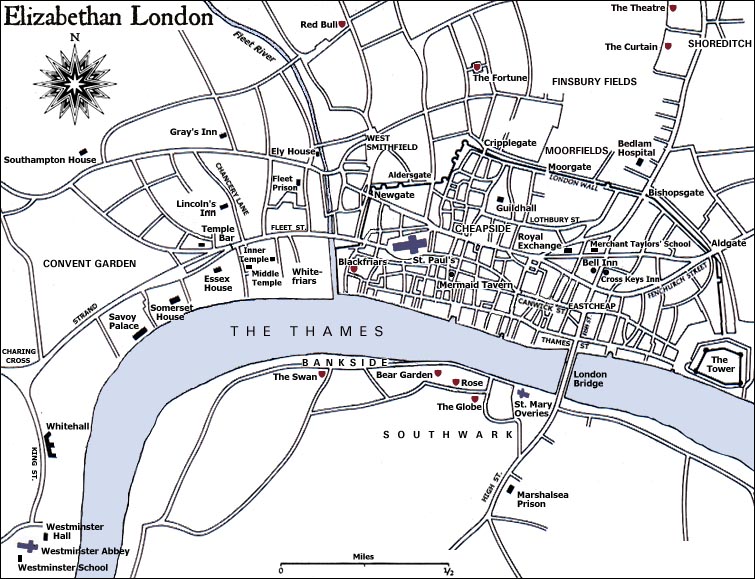
Location Map of Elizabethan London
Plan of the Bankside, Southwark, in Shakespeare's time
Detail of Norden's Map of the Bankside, 1593
Bull and Bear Baiting Rings from the Agas Map (1569-1590, pub. 1631)
Sketch of the Swan Theatre, c. 1596
Westminster in the Seventeenth Century, by Hollar
Visscher's View of London, 1616
Larger Visscher's View in Sections
c. 1690. View of London Churches, after the Great Fire
The Yard of the Tabard Inn from Thornbury, Old and New London
|
|

 England under the Tudors