|
|
|
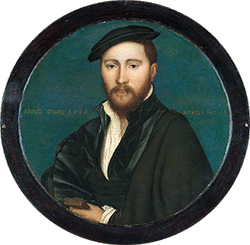

SIR RALPH SADLER, SADLEIR, or SADLEYER (1507-1587), diplomatist, born in 1607 at Hackney, Middlesex, was the eldest
son of Henry Sadleir, who held a situation of trust in the household of a nobleman at Cillney, Essex. The son, as is shown
by his correspondence, received a good education, and knew Greek as well as Latin. At an early age he was received into
the family of Thomas Cromwell, afterwards Earl of Essex, whose increasing favour with
Henry VIII proved highly beneficial to his ward's fortunes.
It was probably soon after Cromwell's elevation to the peerage, 9 July 1536, that Sadler was named gentleman of the king's
privy chamber; for on his tombstone he is stated to have entered the king's service 'about the twenty-six year of his reign',
not the tenth, as Sir Walter Scott erroneously relates. So high an opinion did the king form of his ability and character
that in 1537 he sent him to Scotland — during the absence of James in France — to
inquire into the complaints of the Queen-dowager Margaret against the Scots and her son,
and to discover, if possible, the exact character of the relations of the king of Scots with France. Shortly after his
return to England he was also sent to the king of Scots, who was then at Rouen, preparing to
return to Scotland with his young French bride. His
object was to bring about an understanding between the Scottish king and his mother. He was so far successful that,
shortly afterwards, the Queen-dowager Margaret informed her brother that her 'son had written affectionately to the lords
of his council to do her iustice with expedition.'1
In January 1540 Sadler was again despatched to Scotland on a mission of greater importance. Although his ostensible errand
was merely to convey a present of horses to King James, he was specially directed to make use of the opportunity to instil
into him distrust of the designs of Cardinal Beaton, and his ambition to arrogate to himself supreme political power; and
to advise the king to follow the example of his uncle, and, instead of 'trafficking in cattle and sheep,' to increase his
revenues by taking such 'of the possessions ' of the monks — who 'occupy a great part of his realm to the maintenance
of their voluptie, and the continual decay of his estate and honour' — as 'might best be spared.'2 The
young king seems to have been perfectly frank. He was sincerely desirous to be on friendly terms with his uncle of England;
but he had no intention whatever of adopting his ecclesiastical policy.
Shortly after his return to England Sadler was appointed one of the king's two principal secretaries of state, the other
being Thomas Wriothesley. He was knighted probably on the anniversary of the king's coronation,
and on 14 May 1542 he was granted armorial bearings.
After the rout of Solway Moss, which was followed by the death of James V on 16 Dec. 1542, Sadler was sent by Henry to
reside in Edinburgh, with a view to preventing the revival of the influence of Beaton by arranging for the marriage of
the young Princess Mary of Scotland with Prince Edward
of England. When the Scottish parliament agreed that a 'noble English knight and lady' should be established at the
Scottish court — for the training of the young princess for her future position — Henry proposed that Sir
Ralph Sadler and his lady should undertake this duty. To Sadler the proposal was probably the reverse of agreeable, and
he represented to the king not only that a journey to Scotland would be dangerous to his wife in her then delicate
condition, but that, not having 'been brought up at court,' she was unfitted for the duties with which it was proposed
to honour her. Other arrangements were therefore made; but it was soon found impossible to carry them out. All along
the Scots had been influenced more by considerations of expediency than by a sincere desire for an English alliance;
and Sadler discovered that no absolute trust could be placed in any of the rival parties, who were only sincere in
their desires for each other's downfall. 'There never was (he lamented) so noble a prince's servant as I am so evil
intreated as I am among these unreasonable people; nor do I think never man had to do with so rude, so inconsistent,
and beastly a nation as this is.'3
Beaton's influence, which he endeavoured to overthrow, revived. The seizure of certain Scottish merchantmen and the
confiscation of their cargoes by Henry, on the ground that they were carrying provisions to France, roused the
slumbering antipathies of the nation, and compelled the governor to save himself by an alliance with the cardinal.
The house of Sadler was surrounded by the populace of Edinburgh, and he was threatened with death in case the ships
were not restored. While walking in his garden he narrowly escaped a musket-bullet; and, having prayed Henry either
to recall him or permit him to retire to a stronghold of the Douglases, leave was granted him in November to go to
Tantallon Castle, and in December he was escorted by Sir George Douglas, with four hundred horsemen, across the border.
On the outbreak of hostilities he accompanied the Earl of Hertford in his devastating
raid against Scotland, as treasurer of the navy; and he also accompanied the expedition to the borders in the following
spring.
In accordance with the directions of Henry VIII, who died on 28 Jan. 1547, Sadler was appointed one of a council of
twelve to assist the sixteen executors to whom was entrusted the government of the kingdom and the guardianship of
the young king, Edward VI. Having been already intimately associated with Hertford,
afterwards duke of Somerset, it was only natural that he should favour his claims
to the protectorate of the realm; and he again accompanied him in his expedition against Scotland as high treasurer
of the army. At the battle of Pinkie, 10 Sept. 1647, he displayed great gallantry in rallying the English cavalry
after the first repulse by the Scottish spearmen, and he was made, on the field, one of three knight bannerets.
On the succession of Queen Mary Sadler retired to his country house at Standon, not
intermeddling with state matters until her death; but though not a member of the privy council, he attended the
meeting at Hatfield, 20 Nov. 1558, at which arrangements were made for
Elizabeth's state entry, and issued the summons to the
nobility and gentry to attend it. A keen protestant, like Elizabeth's minister, Cecil,
and of similarly puritanic temper, he became one of Cecil's most trusted agents. With the
Earl of Northumberland and Sir James Crofts, he was in August 1559 appointed
a commissioner to settle the border disputes with Scotland; but the appointment of the commission was merely
intended to veil purposes of higher moment, of which Sadler's fellow-commissioners knew nothing.
Sadler was entrusted by Cecil with secret instructions to enter into communication with the protestant party in
Scotland with a view to an alliance between them and Elizabeth, and, in order that the support of the leading
protestant nobles might be assured, was empowered to reward 'any persons in Scotland with such sums of money'
as he deemed advisable to the amount of £3,000.4 When the arrival of the French auxiliaries
to the aid of the Scottish queen regent compelled Elizabeth to take an avowed and
active part in support of the protestant party, the Duke of Norfolk was instructed
to guide himself by the advice of Sadler in the arrangements he made with the Scots. At a later period Sadler
was sent to the camp at Leith, and thus had a principal share in arranging the treaty of peace and of alliance
with England signed at Edinburgh on 6 July 1560.
On 5 Nov. 1559 he had been appointed warden of the east and middle marches, in succession to the
Earl of Northumberland, but with the termination of his secret mission to
Scotland, he ceased for some years to be engaged in any formal state duties. On 10 May 1568 he, however,
received the office of chancellor of the duchy of Lancaster; and in the same year the startling flight of
the queen of Scots to England gave occasion for the employment of his special services. Much against his
inclination ('He had liever, he said, serve her majesty where he might adventure his life for her than among
subjects so difficult '), he was appointed one of the English commissioners — the others being the
Duke of Norfolk and the Earl of Sussex to meet with
the Scottish commissioners at York to 'treat of the great matter of the Queen of Scots.'
There can scarcely be a doubt that of the three commissioners, Sadler was the one specially trusted by Cecil.
On 29 Oct. 1568 he sent to Cecil (from whom he doubtless had private advice) a précis of the contents
of the casket letters, under three heads : '(1) the special words in the Queen of Scots' letters, written with
her own hand to Bothwell, declaring the inordinate and filthy love between her and him ; (2) the special words
in the said letters declaring her hatred and detestation of her husband; and (3) the special words of the said
letters touching and declaring the conspiracy of her husband's death.'5 When the conference was in
November transferred to Westminster, Sadler was also appointed a member of the enlarged commission. On the
discovery of the Duke of Norfolk's intrigues with the Queen of Scots,
Sadler was entrusted with the duty of arresting him and conveying him to the Tower. He also, nominally as
paymaster-general, but really both as adviser and superintendent, accompanied Sussex
in his expedition to quell the rebellion on behalf of Norfolk and the Queen of Scots in the north of England;
and after its suppression he was one of the commissioners appointed to examine witnesses in connection with the
inquiry into the conspiracy.
Shortly after Norfolk's execution he was sent to Mary Queen of Scots 'to expostulate with her by way of accusation'
and on subsequent occasions he was sent on other errands to her. During the temporary absence of the
Earl of Shrewsbury in 1580 he was, with Sir Ralph Mildmay,
appointed one of her guardians at Sheffield; and when Shrewsbury, on account of the accusations of the
Countess of Shrewsbury of a criminal intrigue between him and the Queen of Scots,
was permitted, much to his relief, to resign his charge, Sadler was on 26 Aug. appointed to succeed him, the Queen
of Scots being on 3 Sept. removed from Sheffield to Wingfield. He undertook the duty with reluctance, and on 2 Sept.
wrote to the secretary, Walsingham, beseeching him to apply his 'good helping hand to
help to relieve' him 'of his charge as soon as it may stand with the queens good pleasure to have consideration of'
his 'years and the cold weather now at hand';6 but it was not till 3 Dec. that she promised shortly to
relieve him, and effect was not given to the promise till the following April, when it was expressly intimated to
him that one reason for the change of guardianship was that the Queen of Scots — whose more lenient treatment
Sadler had repeatedly advocated —might 'hereafter receive more harder usage than heretofore she hath done.'7
Sadler's last employment on matters of state was a mission in 1587 to James VI of Scotland
to endeavour to reconcile him — not a difficult task —to the execution of his mother. He died shortly
after his return from Scotland, 30 May 1587, and was buried under a splendid monument, with recumbent effigy, in
Standon church.
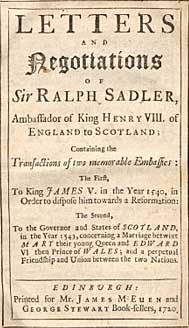 Sadler 'was at once a most exquisite writer and a most valiant and experienced soldier, qualifications that seldom meet....
Little was his body, but great his soul.'8 He excelled rather as subordinate than an independent statesman.
Although he did not attain to the highest offices of state, he amassed such wealth as caused him to be reputed the
richest commoner of England; and, according to Fuller, the great estate which 'he got honestly, he spent nobly; knowing
that princes honour them most that have most, and the people them only that employ most.' His despatches are written
with such minute attention to details that they are among the most interesting and valuable of contemporary historical
records.
Sadler 'was at once a most exquisite writer and a most valiant and experienced soldier, qualifications that seldom meet....
Little was his body, but great his soul.'8 He excelled rather as subordinate than an independent statesman.
Although he did not attain to the highest offices of state, he amassed such wealth as caused him to be reputed the
richest commoner of England; and, according to Fuller, the great estate which 'he got honestly, he spent nobly; knowing
that princes honour them most that have most, and the people them only that employ most.' His despatches are written
with such minute attention to details that they are among the most interesting and valuable of contemporary historical
records.
Sadler married Margaret Mitchell or Barré. According to catholic writers she was a laundress, and he married her
during the lifetime of her husband, Ralph Barré. The accusation seems to have been substantially correct; but when
the marriage took place the husband, who had gone abroad, was supposed to be dead. In 1546 a private act of parliament was
passed on Sir Ralph Sadler's behalf, apparently to legitimise his children. He had three sons: Thomas, who succeeded him;
Edward of Temple Dinsley, Hertfordshire, and Henry of Everley, Wiltshire; and four daughters, who all married. There is
a portrait of Sadler at Everley.
1. State Papers, During the Reigns of Henry VIII, Edward VI, and Elizabeth, v. 74.
2. Instructions to Sadler, Sadler's State Papers, ed. by Walter Scott, 2 vols. 1809. pp. 3-13.
3. State Papers, Henry VIII, v. 355.
4. Sadler, Sadler's State Papers, i. 392.
5. ib. ii.337-40.
6. ib. ii. 384.
7. ib. ii. 644
8. Lloyd, State Worthies.
Source:
Henderson, T. F. "Sir Ralph Sadler."
Dictionary of National Biography. Vol XVII. Sidney Lee, Ed.
New York: The Macmillan Co., 1909. 598-601.
Other Local Resources:
 | to Renaissance English Literature
|
|
| to Luminarium Encyclopedia |
Site ©1996-2023 Anniina Jokinen. All rights reserved.
This page was created on April 18, 2009. Last updated February 17, 2023.
|
Index of Encyclopedia Entries:
Medieval Cosmology
Prices of Items in Medieval England
Edward II
Isabella of France, Queen of England
Piers Gaveston
Thomas of Brotherton, E. of Norfolk
Edmund of Woodstock, E. of Kent
Thomas, Earl of Lancaster
Henry of Lancaster, Earl of Lancaster
Henry of Grosmont, Duke of Lancaster
Roger Mortimer, Earl of March
Hugh le Despenser the Younger
Bartholomew, Lord Burghersh, elder
Hundred Years' War (1337-1453)
Edward III
Philippa of Hainault, Queen of England
Edward, Black Prince of Wales
John of Eltham, Earl of Cornwall
The Battle of Crécy, 1346
The Siege of Calais, 1346-7
The Battle of Poitiers, 1356
Lionel of Antwerp, Duke of Clarence
John of Gaunt, Duke of Lancaster
Edmund of Langley, Duke of York
Thomas of Woodstock, Gloucester
Richard of York, E. of Cambridge
Richard Fitzalan, 3. Earl of Arundel
Roger Mortimer, 2nd Earl of March
The Good Parliament, 1376
Richard II
The Peasants' Revolt, 1381
Lords Appellant, 1388
Richard Fitzalan, 4. Earl of Arundel
Archbishop Thomas Arundel
Thomas de Beauchamp, E. Warwick
Robert de Vere, Earl of Oxford
Ralph Neville, E. of Westmorland
Thomas Mowbray, Duke of Norfolk
Edmund Mortimer, 3. Earl of March
Roger Mortimer, 4. Earl of March
John Holland, Duke of Exeter
Michael de la Pole, E. Suffolk
Hugh de Stafford, 2. E. Stafford
Henry IV
Edward, Duke of York
Edmund Mortimer, 5. Earl of March
Henry Percy, Earl of Northumberland
Sir Henry Percy, "Harry Hotspur"
Thomas Percy, Earl of Worcester
Owen Glendower
The Battle of Shrewsbury, 1403
Archbishop Richard Scrope
Thomas Mowbray, 3. E. Nottingham
John Mowbray, 2. Duke of Norfolk
Thomas Fitzalan, 5. Earl of Arundel
Henry V
Thomas, Duke of Clarence
John, Duke of Bedford
Humphrey, Duke of Gloucester
John Talbot, Earl of Shrewsbury
Richard, Earl of Cambridge
Henry, Baron Scrope of Masham
William de la Pole, Duke of Suffolk
Thomas Montacute, E. Salisbury
Richard Beauchamp, E. of Warwick
Henry Beauchamp, Duke of Warwick
Thomas Beaufort, Duke of Exeter
Cardinal Henry Beaufort
John Beaufort, Earl of Somerset
Sir John Fastolf
John Holland, 2. Duke of Exeter
Archbishop John Stafford
Archbishop John Kemp
Catherine of Valois
Owen Tudor
John Fitzalan, 7. Earl of Arundel
John, Lord Tiptoft
Charles VII, King of France
Joan of Arc
Louis XI, King of France
Charles the Bold, Duke of Burgundy
The Battle of Agincourt, 1415
The Battle of Castillon, 1453
The Wars of the Roses 1455-1485
Causes of the Wars of the Roses
The House of Lancaster
The House of York
The House of Beaufort
The House of Neville
The First Battle of St. Albans, 1455
The Battle of Blore Heath, 1459
The Rout of Ludford, 1459
The Battle of Northampton, 1460
The Battle of Wakefield, 1460
The Battle of Mortimer's Cross, 1461
The 2nd Battle of St. Albans, 1461
The Battle of Towton, 1461
The Battle of Hedgeley Moor, 1464
The Battle of Hexham, 1464
The Battle of Edgecote, 1469
The Battle of Losecoat Field, 1470
The Battle of Barnet, 1471
The Battle of Tewkesbury, 1471
The Treaty of Pecquigny, 1475
The Battle of Bosworth Field, 1485
The Battle of Stoke Field, 1487
Henry VI
Margaret of Anjou
Richard Plantagenet, Duke of York
Edward IV
Elizabeth Woodville
Richard Woodville, 1. Earl Rivers
Anthony Woodville, 2. Earl Rivers
Jane Shore
Edward V
Richard III
George, Duke of Clarence
Ralph Neville, 2. Earl of Westmorland
Richard Neville, Earl of Salisbury
Richard Neville, Earl of Warwick
Edward Neville, Baron Bergavenny
William Neville, Lord Fauconberg
Robert Neville, Bishop of Salisbury
John Neville, Marquis of Montagu
George Neville, Archbishop of York
John Beaufort, 1. Duke Somerset
Edmund Beaufort, 2. Duke Somerset
Henry Beaufort, 3. Duke of Somerset
Edmund Beaufort, 4. Duke Somerset
Margaret Beaufort
Edmund Tudor, Earl of Richmond
Jasper Tudor, Earl of Pembroke
Humphrey Stafford, D. Buckingham
Henry Stafford, Duke of Buckingham
Humphrey Stafford, E. of Devon
Thomas, Lord Stanley, Earl of Derby
Sir William Stanley
Archbishop Thomas Bourchier
Henry Bourchier, Earl of Essex
John Mowbray, 3. Duke of Norfolk
John Mowbray, 4. Duke of Norfolk
John Howard, Duke of Norfolk
Henry Percy, 2. E. Northumberland
Henry Percy, 3. E. Northumberland
Henry Percy, 4. E. Northumberland
William, Lord Hastings
Henry Holland, Duke of Exeter
William Fitzalan, Earl of Arundel
William Herbert, 1. Earl of Pembroke
John de Vere, 12th Earl of Oxford
John de Vere, 13th Earl of Oxford
Thomas de Clifford, 8. Baron Clifford
John de Clifford, 9. Baron Clifford
John Tiptoft, Earl of Worcester
Thomas Grey, 1. Marquis Dorset
Sir Andrew Trollop
Archbishop John Morton
Edward Plantagenet, E. of Warwick
John Talbot, 2. E. Shrewsbury
John Talbot, 3. E. Shrewsbury
John de la Pole, 2. Duke of Suffolk
John de la Pole, E. of Lincoln
Edmund de la Pole, E. of Suffolk
Richard de la Pole
John Sutton, Baron Dudley
James Butler, 5. Earl of Ormonde
Sir James Tyrell
Edmund Grey, first Earl of Kent
George Grey, 2nd Earl of Kent
John, 5th Baron Scrope of Bolton
James Touchet, 7th Baron Audley
Walter Blount, Lord Mountjoy
Robert Hungerford, Lord Moleyns
Thomas, Lord Scales
John, Lord Lovel and Holand
Francis Lovell, Viscount Lovell
Sir Richard Ratcliffe
William Catesby
Ralph, 4th Lord Cromwell
Jack Cade's Rebellion, 1450
Tudor Period
King Henry VII
Queen Elizabeth of York
Arthur, Prince of Wales
Lambert Simnel
Perkin Warbeck
The Battle of Blackheath, 1497
King Ferdinand II of Aragon
Queen Isabella of Castile
Maximilian I, Holy Roman Emperor
King Henry VIII
Queen Catherine of Aragon
Queen Anne Boleyn
Queen Jane Seymour
Queen Anne of Cleves
Queen Catherine Howard
Queen Katherine Parr
King Edward VI
Queen Mary I
Queen Elizabeth I
Henry Fitzroy, Duke of Richmond
Margaret Tudor, Queen of Scotland
James IV, King of Scotland
The Battle of Flodden Field, 1513
James V, King of Scotland
Mary of Guise, Queen of Scotland
Mary Tudor, Queen of France
Louis XII, King of France
Francis I, King of France
The Battle of the Spurs, 1513
Field of the Cloth of Gold, 1520
Charles V, Holy Roman Emperor
Eustace Chapuys, Imperial Ambassador
The Siege of Boulogne, 1544
Cardinal Thomas Wolsey
Archbishop Thomas Cranmer
Thomas Cromwell, Earl of Essex
Thomas, Lord Audley
Thomas Wriothesley, E. Southampton
Sir Richard Rich
Edward Stafford, D. of Buckingham
Thomas Howard, 2nd Duke of Norfolk
Thomas Howard, 3rd Duke of Norfolk
John Dudley, Duke of Northumberland
Charles Brandon, Duke of Suffolk
Thomas Boleyn, Earl of Wiltshire
George Boleyn, Viscount Rochford
John Russell, Earl of Bedford
Thomas Grey, 2. Marquis of Dorset
Henry Grey, D. of Suffolk
Charles Somerset, Earl of Worcester
George Talbot, 4. E. Shrewsbury
Francis Talbot, 5. E. Shrewsbury
Henry Algernon Percy,
5th Earl of Northumberland
Henry Algernon Percy,
6th Earl of Northumberland
Ralph Neville, 4. E. Westmorland
Henry Neville, 5. E. Westmorland
William Paulet, Marquis of Winchester
Sir Francis Bryan
Sir Nicholas Carew
John de Vere, 15th Earl of Oxford
John de Vere, 16th Earl of Oxford
Thomas Seymour, Lord Admiral
Edward Seymour, Protector Somerset
Margaret Pole, Countess of Salisbury
Henry Pole, Lord Montague
Sir Geoffrey Pole
Thomas Manners, Earl of Rutland
Henry Manners, Earl of Rutland
Henry Bourchier, 2. Earl of Essex
Robert Radcliffe, 1. Earl of Sussex
Henry Radcliffe, 2. Earl of Sussex
George Hastings, Earl of Huntingdon
Henry Courtenay, Marquis of Exeter
George Neville, Baron Bergavenny
Sir Edward Neville
William, Lord Paget
William Sandys, Baron Sandys
William Fitzwilliam, E. Southampton
Sir Anthony Browne
Sir Thomas Wriothesley
Sir William Kingston
George Brooke, Lord Cobham
Sir Richard Southwell
Thomas Fiennes, 9th Lord Dacre
Sir Francis Weston
Henry Norris
Lady Jane Grey
Sir Thomas Arundel
Sir Richard Sackville
Sir William Petre
Sir John Cheke
Walter Haddon, L.L.D
Sir Peter Carew
Sir John Mason
Nicholas Wotton
John Taylor
Sir Thomas Wyatt, the Younger
Cardinal Lorenzo Campeggio
Cardinal Reginald Pole
Stephen Gardiner, Bishop of Winchester
Edmund Bonner, Bishop of London
Nicholas Ridley, Bishop of London
John Hooper, Bishop of Gloucester
John Aylmer, Bishop of London
Thomas Linacre
William Grocyn
Archbishop William Warham
Cuthbert Tunstall, Bishop of Durham
Richard Fox, Bishop of Winchester
Edward Fox, Bishop of Hereford
Pope Julius II
Pope Leo X
Pope Clement VII
Pope Paul III
Pope Pius V
Pico della Mirandola
Desiderius Erasmus
Martin Bucer
Richard Pace
Christopher Saint-German
Thomas Tallis
Elizabeth Barton, the Nun of Kent
Hans Holbein, the Younger
The Sweating Sickness
Dissolution of the Monasteries
Pilgrimage of Grace, 1536
Robert Aske
Anne Askew
Lord Thomas Darcy
Sir Robert Constable
Oath of Supremacy
The Act of Supremacy, 1534
The First Act of Succession, 1534
The Third Act of Succession, 1544
The Ten Articles, 1536
The Six Articles, 1539
The Second Statute of Repeal, 1555
The Act of Supremacy, 1559
Articles Touching Preachers, 1583
Queen Elizabeth I
William Cecil, Lord Burghley
Robert Cecil, 1st Earl of Salisbury
Sir Francis Walsingham
Sir Nicholas Bacon
Sir Thomas Bromley
Robert Dudley, Earl of Leicester
Ambrose Dudley, Earl of Warwick
Henry Carey, Lord Hunsdon
Sir Thomas Egerton, Viscount Brackley
Sir Francis Knollys
Katherine "Kat" Ashley
Lettice Knollys, Countess of Leicester
George Talbot, 6. E. of Shrewsbury
Elizabeth, Countess of Shrewsbury
Gilbert Talbot, 7. E. of Shrewsbury
Sir Henry Sidney
Sir Robert Sidney
Archbishop Matthew Parker
Walter Devereux, 1st Earl of Essex
Robert Devereux, 2nd Earl of Essex
Penelope Devereux, Lady Rich
Sir Christopher Hatton
Edward Courtenay, E. Devonshire
Edward Manners, 3rd Earl of Rutland
Thomas Radcliffe, 3. Earl of Sussex
Henry Radcliffe, 4. Earl of Sussex
Robert Radcliffe, 5. Earl of Sussex
William Parr, Marquis of Northampton
Henry Wriothesley, 2. Southampton
Henry Wriothesley, 3. Southampton
Charles Neville, 6. E. Westmorland
Thomas Percy, 7. E. Northumberland
Henry Percy, 8. E. Northumberland
Henry Percy, 9. E. Nothumberland
William Herbert, 1. Earl of Pembroke
Charles, Lord Howard of Effingham
Thomas Howard, 4th Duke of Norfolk
Henry Howard, 1. Earl of Northampton
Thomas Howard, 1. Earl of Suffolk
Henry Hastings, 3. E. of Huntingdon
Edward Manners, 3rd Earl of Rutland
Roger Manners, 5th Earl of Rutland
Francis Manners, 6th Earl of Rutland
Henry FitzAlan, 12. Earl of Arundel
Thomas, Earl Arundell of Wardour
Edward Somerset, E. of Worcester
William Davison
Sir Walter Mildmay
Sir Ralph Sadler
Sir Amyas Paulet
Gilbert Gifford
Anthony Browne, Viscount Montague
François, Duke of Alençon & Anjou
Mary, Queen of Scots
Henry Stuart, Lord Darnley
James Hepburn, Earl of Bothwell
Anthony Babington and the Babington Plot
John Knox
Philip II of Spain
The Spanish Armada, 1588
Sir Francis Drake
Sir John Hawkins
William Camden
Archbishop Whitgift
Martin Marprelate Controversy
John Penry (Martin Marprelate)
Richard Bancroft, Archbishop of Canterbury
John Dee, Alchemist
Philip Henslowe
Edward Alleyn
The Blackfriars Theatre
The Fortune Theatre
The Rose Theatre
The Swan Theatre
Children's Companies
The Admiral's Men
The Lord Chamberlain's Men
Citizen Comedy
The Isle of Dogs, 1597
Common Law
Court of Common Pleas
Court of King's Bench
Court of Star Chamber
Council of the North
Fleet Prison
Assize
Attainder
First Fruits & Tenths
Livery and Maintenance
Oyer and terminer
Praemunire
The Stuarts
King James I of England
Anne of Denmark
Henry, Prince of Wales
The Gunpowder Plot, 1605
George Villiers, 1st Duke of Buckingham
Robert Carr, Earl of Somerset
Arabella Stuart, Lady Lennox
William Alabaster
Bishop Hall
Bishop Thomas Morton
Archbishop William Laud
John Selden
Lucy Harington, Countess of Bedford
Henry Lawes
King Charles I
Queen Henrietta Maria
Long Parliament
Rump Parliament
Kentish Petition, 1642
Thomas Wentworth, Earl of Strafford
John Digby, Earl of Bristol
George Digby, 2nd Earl of Bristol
Thomas Fairfax, 3rd Lord Fairfax
Robert Devereux, 3rd E. of Essex
Robert Sidney, 2. E. of Leicester
Algernon Percy, E. of Northumberland
Henry Montagu, Earl of Manchester
Edward Montagu, 2. Earl of Manchester
The Restoration
King Charles II
King James II
Test Acts
Greenwich Palace
Hatfield House
Richmond Palace
Windsor Palace
Woodstock Manor
The Cinque Ports
Mermaid Tavern
Malmsey Wine
Great Fire of London, 1666
Merchant Taylors' School
Westminster School
The Sanctuary at Westminster
"Sanctuary"
Images:
Chart of the English Succession from William I through Henry VII
Medieval English Drama
London c1480, MS Royal 16
London, 1510, the earliest view in print
Map of England from Saxton's Descriptio Angliae, 1579
London in late 16th century
Location Map of Elizabethan London
Plan of the Bankside, Southwark, in Shakespeare's time
Detail of Norden's Map of the Bankside, 1593
Bull and Bear Baiting Rings from the Agas Map (1569-1590, pub. 1631)
Sketch of the Swan Theatre, c. 1596
Westminster in the Seventeenth Century, by Hollar
Visscher's View of London, 1616
Larger Visscher's View in Sections
c. 1690. View of London Churches, after the Great Fire
The Yard of the Tabard Inn from Thornbury, Old and New London
|
|

 England under the Tudors