|
|
|
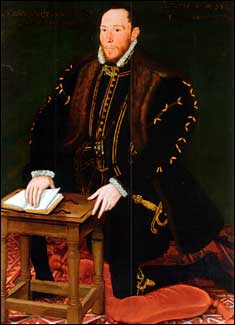
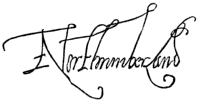

THOMAS PERCY, seventh Earl of Northumberland (1528-1572), born in 1528, was elder son of Sir Thomas Percy, by his wife Eleanor,
daughter of Guiscard Harbottal of Beamish, Durham. The father, a younger son of Henry Algernon Percy, fifth earl of Northumberland, took
a prominent part with his brother Ingelram in the Yorkshire rebellion of 1536 (the 'Pilgrimage of Grace'),
was attainted, and was executed at Tyburn on 2 June 1537, being buried in the Crutched Friars' Church, London.
Thereupon his elder brother, Henry Algernon Percy, sixth earl, fearing the effect of the attainder on the fortunes of the family, voluntarily
surrendered his estates to the crown, and on his death, on 29 June 1537, the title fell into abeyance. Sir Thomas's widow married Sir
Richard Holland of Denton, Lancashire, and died in 1567.
Young Thomas and his brother Henry were entrusted, as boys, to the care of a Yorkshire squire, Sir Thomas Tempest of Tong Hall. They were
restored in blood on 14 March 1549. Soon afterwards Thomas was permitted to inherit a little property destined for him by his uncle, the
sixth earl. A catholic by conviction, he was favourably noticed by Queen Mary,
who made him governor of Prudhoe Castle. In 1557 he displayed much courage in recapturing Scarborough, which had been seized by Sir Thomas
Stafford, who was acting in collusion with the French. On 30 April 1557 he was knighted and created Baron Percy, and on the day following
was promoted to the earldom of Northumberland, in consideration of 'his noble descent, constancy, virtue, and value in arms, and other
strong qualifications.' Failing heirs male of his own, the title was to devolve on his brother Henry. A further portion of the estates
attaching to the earldom was made over to him. A few weeks later he was nominated a member of the council of the north
and high marshal of the army in the north.
Other honours quickly followed. He was elected a member of Gray's Inn in June, and became bailiff of the liberty of Richmond (June 26),
and chief keeper of Richmond forest, and constable of Richmond and Middleham castles (26 July). On 2 Aug. 1557 he was appointed joint
lord-warden-general of the east and middle marches towards Scotland, and captain of Berwick, and a week later lord-warden-general of the
middle marches (Tynedile and Riddesdale). The general protection of the borders from the raids of the Scots was thus entrusted to his care.
He performed his duties with much vigilance, and in August 1558 he anticipated a project of the Scots for surprising Norham and Wark castles.
In January 1558-9 he raised a thousand men to garrison Berwick against the threatened invasion of the French.
His avowed catholic sympathies did not, however, commend him to Queen Elizabeth and
her advisers. It is true that on her accession he was again nominated lord-warden-general of the east and middle marches, and was made lord-lieutenant
of Northumberland, and, as chief commissioner to treat with Scotland respecting the boundaries of the two kingdoms, signed a treaty at
Upsettington on 31 May 1559. But the borderers sent to London complaints of his rule: Ralph Sadler was ordered to inquire into the alleged
grievances, and in his despatches expressed doubt of the wisdom or loyalty both of Northumberland and of his brother Henry. In 1560 the earl,
smarting under Sadler's comments, resigned his office. Lord Grey, his wife's uncle, was appointed in his place. But Northumberland peremptorily
refused to receive his successor at Alnwick Castle, and he raised objections when it was proposed in 1562 that he should invite the
Queen of Scots there, so that she might have an interview in the
castle with Queen Elizabeth. None the less he was elected K.G. on 22 April 1563. In
1565 Lord Burghley's agents reported that he was 'dangerously obstinate in
religion.'
In 1567 he was exasperated hy a claim preferred by the crown to a newly discovered copper-mine on his estate of Newland in Cumberland; the
authorities ignored his demand for compensation.
On 16 May 1508 Mary Queen of Scots landed at Workington in Cumberland,
and was conducted by the deputy-warden of the marches, Sir Richard Lowther, to Carlisle two days later. Northumberland asserted that the custody
of the fugitive queen should by right be entrusted to him, as the chief magnate of the district. The council of the north
seems to have given some recognition to his claim. Leaving his house at Topcliffe, he arrived at Carlisle, and was admitted to an interview with
Mary Stuart. He expressed the fullest sympathy with her in her misfortunes.
His friendly bearing was hotly resented by the government. Orders were at once sent from London that he should leave Carlisle forthwith. He obeyed
with reluctance, and, meeting Sir Francis Knollys, Queen Mary's new keeper,
at Boroughbridge, bitterly complained that he had been treated with gross disrespect.
Northumberland's dissatisfaction with Elizabeth's government now reached a crisis. Simple-minded by nature, he had no political ambitions, but he
was devoted to the religion of his fathers, and had inherited a strong sense of his own and his family's importance in the border country. Had no
efforts been made to thwart the peaceful exercise of his family's traditional authority, he would doubtless have spent his life in the sports of
hunting and hawking, which he loved, and in exchanging hospitalities with his neighbours. But the imprisonment of Queen Mary
— a champion of his faith — in his neighbourhood, and the rejection of his pretensions to hold free communication with her, roused in
him a spirit of rebellion which his catholic friends and neighbours, who avowedly hated protestant rule, fanned into flame. Emissaries from Spain
were aware of the discontent with the government which was current among the northern catholics, and they entered into communication with Northumberland,
and promised him the aid of Spanish troops if any widespread insurrection could be arranged. An army of Spaniards would be sent over by the Duke
of Alva. During 1569 Vitelli, marques of Catena, arrived in London under pretence of conducting an embassy, in order to be in readiness to take
the command of a Spanish force on its landing.
Thus encouraged, Northumberland allied himself with Charles Neville, ninth earl of Westmorland, and together they
resolved to set Queen Mary free by force, and to restore the catholic
religion. A benediction on the enterprise was pronounced by Pius V. The Earl of Sussex,
president of the council of the north, was on friendly terms with both the
earls, and in September 1569 sumptuously entertained them and their retainers. He soon saw grounds for suspecting their loyalty; but they had
formulated no plan of campaign, and there were no open signs of coming trouble. At Sussex's suggestion, the two earls were suddenly summoned to
London early in November 1570. Northumberland excused himself in a letter, in which he declared his fidelity to the crown (14 Nov.) But the ruse
of the government created a panic among the conspirators, and hurried them prematurely into action.
On 15 Nov. some soldiers arrived at Northumberland's house at Topcliffe, bearing orders for his arrest as a precautionary measure. He succeeded in
eluding the troops, and joined Westmorland at his house at Brancepeth. There they set up their standard and issued
a proclamation announcing their intention to restore the catholic religion, and inviting assistance. Another proclamation followed, promising the
release of Queen Mary, who was in confinement at Tutbury. The earls and
their retainers were immediately joined by many of the neighbouring gentry, and they soon found themselves at the head of a force of seventeen
hundred horse and four thousand foot. The cavalry was a well-trained body; the infantry was an undisciplined rabble. The next day (15 Nov.) the
rebels marched to Durham, where they destroyed the service-books and set up the mass in the minster. On the 17th they moved south to Darlington;
between the 18th and the 20th Northumberland visited Richmond, Northallerton, and Boroughbridge, appealing to the inhabitants to join him. On the
20th the two earls, with the Countess of Northumberland, celebrated mass at Ripon.
On Tuesday, 22 Nov., the whole body of rebels mustered under the two earls on Clifford Moor. Sir George Bowes, who had thrown himself into Barnard
Castle, assembled an army in their rear, while Sir John Forster and Sir Henry Percy, Northumberland's brother,
were collecting troops for the queen on the borders. The government published answers to the two earls' proclamation, and Northumberland was, with
much ceremony, expelled at Windsor from the order of the Garter. From Clifford Moor the earls at first resolved to march on York, where the
Earl of Sussex lay. But they suddenly changed their plans, and determined to besiege Bowes in Barnard Castle. Bowes held
the fortress gallantly against them for eleven days, and then marched out with the honours of war and joined Sussex. In the meantime Sir John Forster
and Sir Henry Percy pursued Westmorland, who had retired to Durham and 'did give to the said earle a great skirmish.' Northumberland withdrew to
Topcliffe, and on 11 Dec. Sussex marched thither from York. As Sussex advanced to the north the two earls reunited their forces and retreated towards
the borders. At Hexham on 16 Dec. they disbanded their followers, who dispersed 'every man to save himself as he could' (Stowe). The rising thus came,
after a month, to a very impotent conclusion, and the government treated with the utmost rigour all the actors in it who fell into their hands.
Northumberland and his wife, with Westmorland and his chief followers, arrived in Lidderdale and took refuge with Hector Graham of Harlaw, a robber-chieftain
who infested the district. Thence Westmorland escaped to the Low Countries. But the Earl of Moray, the regent of Scotland, obtained from Graham of Harlaw,
for a pecuniary consideration, the surrender of Northumberland, and in January 1569 he was carried to Edinburgh with seven of his adherents. At first he
was not kept in custody, though a guard of the regent's men was set to watch his movements; but he was subsequently committed to the care of Sir William
Douglas at Lochleven Castle. His wife remained on the borders, first at Ferniehurst, but subsequently at Hume Castle. She declined an offer of permission
to join her husband at Edinburgh, on the ground that she might thus imperil her liberty and could be of greater assistance to her husband at a distance.
She corresponded with sympathisers in the Low Countries, and made every effort to raise money in order to ransom her husband. In August 1570 she arrived
at Antwerp. Philip II sent her six thousand marks and the pope [Pius V]
four thousand crowns, and she and her friends devised a plan bv which Northumberland might be sent into Flanders. But her energetic endeavours to purchase
his liberty failed.
The English government negotiated with the Scottish government for his surrender with greater effect. Neither the regent Moray nor his successor,the Earl
of Lennox, showed, it is true, any readiness to comply with the English government's demand, and Northumberland's brother recommended him to confess his
offence and throw himself upon Queen Elizabeth's mercy. But in August 1572 the Earl of Mar, who had become regent in the previous year, finally decided to
hand him over to Queen Elizabeth's officers on payment of £2,000. Northumberland arrived at Berwick on 15 Aug. and was committed to the care of Lord
Hunsdon. On 17 Aug. Hunsdon delivered him at Alnwick to Sir John Forster, who brought him to York. He was beheaded there on 22 Aug. on a scaffold erected
in 'the l'avement,' or chief market-place. With his last breath he declared his faith in the catholic church, adding 'I am a Percy in life and death.' His
head was placed on a pole above Micklegate Bar, but his body was buried in Crux church in the presence of two men and three maidservants and 'a stranger in
disguise, who, causing suspicion, immediately fled.'
There is an entry recording his execution in the parish register of St. Margaret's, Walmgate, York. A ballad on his delivery to the English is in Percy's
'Reliques.' In Cotton MS. Calig. B, iv. 243, are pathetic verses by a partisan, 'one Singleton, a gentleman of Lancashire, now prisoner at York for religion.'
They are printed by Wright and in ' Notes and Queries' (7th ser. vii. 264). Queen Mary had given him a relic — a thorn of Christ's crown, which was set
in a golden cross. This he wore on the day of his death, and bequeathed to his daughter Elizabeth. It is now in Stonyhurst College. A copy by Phillips of an
old portrait, representing him in the robes of the Garter, is at Alnwick. Another, dated 1566, is at Petworth, and is engraved in Sharpe's 'Memorials.' A third
portrait, painted on panel, belonged to Sir Charles Slingsby of Scriven.
His widow, Anne, third daughter of Henry Somerset, second earl of Worcester, resided for a time at Liege on a small pension from the king of Spain. She seems
to have written and circulated there a 'Discours des troubles du Comte de Northumberland.' Of a very managing disposition, she endeavoured to arrange a match
between Don John of Austria and Queen Mary Stuart. In 1573 English agents described her as 'one of the principal practitioners at Mechlin;' subsequently she
removed to Brussels, and entertained many English catholic exiles. In 1570 the Spanish government agreed, at Queen Elizabeth's request, to expel her from
Spanish territory. Her exile was not, however, permanent. She died of smallpox in a convent at Namur in 1591.
Four daughters survived her: Elizabeth, wife of Richard Woodruffe of Woolley, Yorkshire; Mary, prioress of a convent of English Benedictine dames at Brussels,
afterwards removed to Winchester; Lucy, wife of Sir Edward Stanley, K.B., of Lynsham, Oxfordshire, whose second daughter, Venetia, married Sir Kenelm Digby;
Jane, wife of Lord Henry Seymour, younger son of Edward, earl of Hertford. A son Thomas had died young in 1560. Northumberland's title passed by virtue of the
reversionary clause in his patent of creation, and despite his attainder, to his brother Henry, eighth earl.
S. L.
Source:
Dictionary of National Biography. Vol XLIV. Sidney Lee, Ed.
New York: Macmillan and Co., 1895. 433-436.
Other Local Resources:
- Queen Elizabeth I
- Henry Percy, 1st Earl of Northumberland
- Sir Henry Percy, "Harry Hotspur"
- Thomas Percy, Earl of Worcester
- Henry Percy, 2nd Earl of Northumberland
- Henry Percy, 3rd Earl of Northumberland
- Henry Percy, 4th Earl of Northumberland
- Henry Algernon Percy, 5th Earl of Northumberland
- Henry Algernon Percy, 6th Earl of Northumberland
- Henry Percy, 8th Earl of Northumberland
- Henry Percy, 9th Earl of Northumberland
- Algernon Percy, 10th Earl of Northumberland
Books for further study:
Brenan, Gerald. A History of the House of Percy.
Fremantle & Co., 1902.
Collins, Arthur. An History of the Ancient and Illustrious Family of the Percys.
Gale ECCO, 2010. (Reprint from 1750)
De Fonblanque, E. Barrington. Annals of the House of Percy.
London: Richard Clay & Sons, 1887.
Lomas, Richard. A Power in the Land: The Percys.
East Linton: Tuckwell Press, Ltd., 1999.
Merrick, M. M. Thomas Percy: Seventh Earl.
Duckett, 1949.
Rose, Alexander. Kings in the North: The House of Percy in British History.
Phoenix Press, 2003.
Web Links:
 | to Renaissance English Literature
|
|
| to Luminarium Encyclopedia |
Site ©1996-2023 Anniina Jokinen. All rights reserved.
This page was created on April 15, 2009. Last updated April 26, 2023.
|
Index of Encyclopedia Entries:
Medieval Cosmology
Prices of Items in Medieval England
Edward II
Isabella of France, Queen of England
Piers Gaveston
Thomas of Brotherton, E. of Norfolk
Edmund of Woodstock, E. of Kent
Thomas, Earl of Lancaster
Henry of Lancaster, Earl of Lancaster
Henry of Grosmont, Duke of Lancaster
Roger Mortimer, Earl of March
Hugh le Despenser the Younger
Bartholomew, Lord Burghersh, elder
Hundred Years' War (1337-1453)
Edward III
Philippa of Hainault, Queen of England
Edward, Black Prince of Wales
John of Eltham, Earl of Cornwall
The Battle of Crécy, 1346
The Siege of Calais, 1346-7
The Battle of Poitiers, 1356
Lionel of Antwerp, Duke of Clarence
John of Gaunt, Duke of Lancaster
Edmund of Langley, Duke of York
Thomas of Woodstock, Gloucester
Richard of York, E. of Cambridge
Richard Fitzalan, 3. Earl of Arundel
Roger Mortimer, 2nd Earl of March
The Good Parliament, 1376
Richard II
The Peasants' Revolt, 1381
Lords Appellant, 1388
Richard Fitzalan, 4. Earl of Arundel
Archbishop Thomas Arundel
Thomas de Beauchamp, E. Warwick
Robert de Vere, Earl of Oxford
Ralph Neville, E. of Westmorland
Thomas Mowbray, Duke of Norfolk
Edmund Mortimer, 3. Earl of March
Roger Mortimer, 4. Earl of March
John Holland, Duke of Exeter
Michael de la Pole, E. Suffolk
Hugh de Stafford, 2. E. Stafford
Henry IV
Edward, Duke of York
Edmund Mortimer, 5. Earl of March
Henry Percy, Earl of Northumberland
Sir Henry Percy, "Harry Hotspur"
Thomas Percy, Earl of Worcester
Owen Glendower
The Battle of Shrewsbury, 1403
Archbishop Richard Scrope
Thomas Mowbray, 3. E. Nottingham
John Mowbray, 2. Duke of Norfolk
Thomas Fitzalan, 5. Earl of Arundel
Henry V
Thomas, Duke of Clarence
John, Duke of Bedford
Humphrey, Duke of Gloucester
John Talbot, Earl of Shrewsbury
Richard, Earl of Cambridge
Henry, Baron Scrope of Masham
William de la Pole, Duke of Suffolk
Thomas Montacute, E. Salisbury
Richard Beauchamp, E. of Warwick
Henry Beauchamp, Duke of Warwick
Thomas Beaufort, Duke of Exeter
Cardinal Henry Beaufort
John Beaufort, Earl of Somerset
Sir John Fastolf
John Holland, 2. Duke of Exeter
Archbishop John Stafford
Archbishop John Kemp
Catherine of Valois
Owen Tudor
John Fitzalan, 7. Earl of Arundel
John, Lord Tiptoft
Charles VII, King of France
Joan of Arc
Louis XI, King of France
Charles the Bold, Duke of Burgundy
The Battle of Agincourt, 1415
The Battle of Castillon, 1453
The Wars of the Roses 1455-1485
Causes of the Wars of the Roses
The House of Lancaster
The House of York
The House of Beaufort
The House of Neville
The First Battle of St. Albans, 1455
The Battle of Blore Heath, 1459
The Rout of Ludford, 1459
The Battle of Northampton, 1460
The Battle of Wakefield, 1460
The Battle of Mortimer's Cross, 1461
The 2nd Battle of St. Albans, 1461
The Battle of Towton, 1461
The Battle of Hedgeley Moor, 1464
The Battle of Hexham, 1464
The Battle of Edgecote, 1469
The Battle of Losecoat Field, 1470
The Battle of Barnet, 1471
The Battle of Tewkesbury, 1471
The Treaty of Pecquigny, 1475
The Battle of Bosworth Field, 1485
The Battle of Stoke Field, 1487
Henry VI
Margaret of Anjou
Richard Plantagenet, Duke of York
Edward IV
Elizabeth Woodville
Richard Woodville, 1. Earl Rivers
Anthony Woodville, 2. Earl Rivers
Jane Shore
Edward V
Richard III
George, Duke of Clarence
Ralph Neville, 2. Earl of Westmorland
Richard Neville, Earl of Salisbury
Richard Neville, Earl of Warwick
Edward Neville, Baron Bergavenny
William Neville, Lord Fauconberg
Robert Neville, Bishop of Salisbury
John Neville, Marquis of Montagu
George Neville, Archbishop of York
John Beaufort, 1. Duke Somerset
Edmund Beaufort, 2. Duke Somerset
Henry Beaufort, 3. Duke of Somerset
Edmund Beaufort, 4. Duke Somerset
Margaret Beaufort
Edmund Tudor, Earl of Richmond
Jasper Tudor, Earl of Pembroke
Humphrey Stafford, D. Buckingham
Henry Stafford, Duke of Buckingham
Humphrey Stafford, E. of Devon
Thomas, Lord Stanley, Earl of Derby
Sir William Stanley
Archbishop Thomas Bourchier
Henry Bourchier, Earl of Essex
John Mowbray, 3. Duke of Norfolk
John Mowbray, 4. Duke of Norfolk
John Howard, Duke of Norfolk
Henry Percy, 2. E. Northumberland
Henry Percy, 3. E. Northumberland
Henry Percy, 4. E. Northumberland
William, Lord Hastings
Henry Holland, Duke of Exeter
William Fitzalan, Earl of Arundel
William Herbert, 1. Earl of Pembroke
John de Vere, 12th Earl of Oxford
John de Vere, 13th Earl of Oxford
Thomas de Clifford, 8. Baron Clifford
John de Clifford, 9. Baron Clifford
John Tiptoft, Earl of Worcester
Thomas Grey, 1. Marquis Dorset
Sir Andrew Trollop
Archbishop John Morton
Edward Plantagenet, E. of Warwick
John Talbot, 2. E. Shrewsbury
John Talbot, 3. E. Shrewsbury
John de la Pole, 2. Duke of Suffolk
John de la Pole, E. of Lincoln
Edmund de la Pole, E. of Suffolk
Richard de la Pole
John Sutton, Baron Dudley
James Butler, 5. Earl of Ormonde
Sir James Tyrell
Edmund Grey, first Earl of Kent
George Grey, 2nd Earl of Kent
John, 5th Baron Scrope of Bolton
James Touchet, 7th Baron Audley
Walter Blount, Lord Mountjoy
Robert Hungerford, Lord Moleyns
Thomas, Lord Scales
John, Lord Lovel and Holand
Francis Lovell, Viscount Lovell
Sir Richard Ratcliffe
William Catesby
Ralph, 4th Lord Cromwell
Jack Cade's Rebellion, 1450
Tudor Period
King Henry VII
Queen Elizabeth of York
Arthur, Prince of Wales
Lambert Simnel
Perkin Warbeck
The Battle of Blackheath, 1497
King Ferdinand II of Aragon
Queen Isabella of Castile
Maximilian I, Holy Roman Emperor
King Henry VIII
Queen Catherine of Aragon
Queen Anne Boleyn
Queen Jane Seymour
Queen Anne of Cleves
Queen Catherine Howard
Queen Katherine Parr
King Edward VI
Queen Mary I
Queen Elizabeth I
Henry Fitzroy, Duke of Richmond
Margaret Tudor, Queen of Scotland
James IV, King of Scotland
The Battle of Flodden Field, 1513
James V, King of Scotland
Mary of Guise, Queen of Scotland
Mary Tudor, Queen of France
Louis XII, King of France
Francis I, King of France
The Battle of the Spurs, 1513
Field of the Cloth of Gold, 1520
Charles V, Holy Roman Emperor
Eustace Chapuys, Imperial Ambassador
The Siege of Boulogne, 1544
Cardinal Thomas Wolsey
Archbishop Thomas Cranmer
Thomas Cromwell, Earl of Essex
Thomas, Lord Audley
Thomas Wriothesley, E. Southampton
Sir Richard Rich
Edward Stafford, D. of Buckingham
Thomas Howard, 2nd Duke of Norfolk
Thomas Howard, 3rd Duke of Norfolk
John Dudley, Duke of Northumberland
Charles Brandon, Duke of Suffolk
Thomas Boleyn, Earl of Wiltshire
George Boleyn, Viscount Rochford
John Russell, Earl of Bedford
Thomas Grey, 2. Marquis of Dorset
Henry Grey, D. of Suffolk
Charles Somerset, Earl of Worcester
George Talbot, 4. E. Shrewsbury
Francis Talbot, 5. E. Shrewsbury
Henry Algernon Percy,
5th Earl of Northumberland
Henry Algernon Percy,
6th Earl of Northumberland
Ralph Neville, 4. E. Westmorland
Henry Neville, 5. E. Westmorland
William Paulet, Marquis of Winchester
Sir Francis Bryan
Sir Nicholas Carew
John de Vere, 15th Earl of Oxford
John de Vere, 16th Earl of Oxford
Thomas Seymour, Lord Admiral
Edward Seymour, Protector Somerset
Margaret Pole, Countess of Salisbury
Henry Pole, Lord Montague
Sir Geoffrey Pole
Thomas Manners, Earl of Rutland
Henry Manners, Earl of Rutland
Henry Bourchier, 2. Earl of Essex
Robert Radcliffe, 1. Earl of Sussex
Henry Radcliffe, 2. Earl of Sussex
George Hastings, Earl of Huntingdon
Henry Courtenay, Marquis of Exeter
George Neville, Baron Bergavenny
Sir Edward Neville
William, Lord Paget
William Sandys, Baron Sandys
William Fitzwilliam, E. Southampton
Sir Anthony Browne
Sir Thomas Wriothesley
Sir William Kingston
George Brooke, Lord Cobham
Sir Richard Southwell
Thomas Fiennes, 9th Lord Dacre
Sir Francis Weston
Henry Norris
Lady Jane Grey
Sir Thomas Arundel
Sir Richard Sackville
Sir William Petre
Sir John Cheke
Walter Haddon, L.L.D
Sir Peter Carew
Sir John Mason
Nicholas Wotton
John Taylor
Sir Thomas Wyatt, the Younger
Cardinal Lorenzo Campeggio
Cardinal Reginald Pole
Stephen Gardiner, Bishop of Winchester
Edmund Bonner, Bishop of London
Nicholas Ridley, Bishop of London
John Hooper, Bishop of Gloucester
John Aylmer, Bishop of London
Thomas Linacre
William Grocyn
Archbishop William Warham
Cuthbert Tunstall, Bishop of Durham
Richard Fox, Bishop of Winchester
Edward Fox, Bishop of Hereford
Pope Julius II
Pope Leo X
Pope Clement VII
Pope Paul III
Pope Pius V
Pico della Mirandola
Desiderius Erasmus
Martin Bucer
Richard Pace
Christopher Saint-German
Thomas Tallis
Elizabeth Barton, the Nun of Kent
Hans Holbein, the Younger
The Sweating Sickness
Dissolution of the Monasteries
Pilgrimage of Grace, 1536
Robert Aske
Anne Askew
Lord Thomas Darcy
Sir Robert Constable
Oath of Supremacy
The Act of Supremacy, 1534
The First Act of Succession, 1534
The Third Act of Succession, 1544
The Ten Articles, 1536
The Six Articles, 1539
The Second Statute of Repeal, 1555
The Act of Supremacy, 1559
Articles Touching Preachers, 1583
Queen Elizabeth I
William Cecil, Lord Burghley
Robert Cecil, 1st Earl of Salisbury
Sir Francis Walsingham
Sir Nicholas Bacon
Sir Thomas Bromley
Robert Dudley, Earl of Leicester
Ambrose Dudley, Earl of Warwick
Henry Carey, Lord Hunsdon
Sir Thomas Egerton, Viscount Brackley
Sir Francis Knollys
Katherine "Kat" Ashley
Lettice Knollys, Countess of Leicester
George Talbot, 6. E. of Shrewsbury
Elizabeth, Countess of Shrewsbury
Gilbert Talbot, 7. E. of Shrewsbury
Sir Henry Sidney
Sir Robert Sidney
Archbishop Matthew Parker
Walter Devereux, 1st Earl of Essex
Robert Devereux, 2nd Earl of Essex
Penelope Devereux, Lady Rich
Sir Christopher Hatton
Edward Courtenay, E. Devonshire
Edward Manners, 3rd Earl of Rutland
Thomas Radcliffe, 3. Earl of Sussex
Henry Radcliffe, 4. Earl of Sussex
Robert Radcliffe, 5. Earl of Sussex
William Parr, Marquis of Northampton
Henry Wriothesley, 2. Southampton
Henry Wriothesley, 3. Southampton
Charles Neville, 6. E. Westmorland
Thomas Percy, 7. E. Northumberland
Henry Percy, 8. E. Northumberland
Henry Percy, 9. E. Nothumberland
William Herbert, 1. Earl of Pembroke
Charles, Lord Howard of Effingham
Thomas Howard, 4th Duke of Norfolk
Henry Howard, 1. Earl of Northampton
Thomas Howard, 1. Earl of Suffolk
Henry Hastings, 3. E. of Huntingdon
Edward Manners, 3rd Earl of Rutland
Roger Manners, 5th Earl of Rutland
Francis Manners, 6th Earl of Rutland
Henry FitzAlan, 12. Earl of Arundel
Thomas, Earl Arundell of Wardour
Edward Somerset, E. of Worcester
William Davison
Sir Walter Mildmay
Sir Ralph Sadler
Sir Amyas Paulet
Gilbert Gifford
Anthony Browne, Viscount Montague
François, Duke of Alençon & Anjou
Mary, Queen of Scots
Henry Stuart, Lord Darnley
James Hepburn, Earl of Bothwell
Anthony Babington and the Babington Plot
John Knox
Philip II of Spain
The Spanish Armada, 1588
Sir Francis Drake
Sir John Hawkins
William Camden
Archbishop Whitgift
Martin Marprelate Controversy
John Penry (Martin Marprelate)
Richard Bancroft, Archbishop of Canterbury
John Dee, Alchemist
Philip Henslowe
Edward Alleyn
The Blackfriars Theatre
The Fortune Theatre
The Rose Theatre
The Swan Theatre
Children's Companies
The Admiral's Men
The Lord Chamberlain's Men
Citizen Comedy
The Isle of Dogs, 1597
Common Law
Court of Common Pleas
Court of King's Bench
Court of Star Chamber
Council of the North
Fleet Prison
Assize
Attainder
First Fruits & Tenths
Livery and Maintenance
Oyer and terminer
Praemunire
The Stuarts
King James I of England
Anne of Denmark
Henry, Prince of Wales
The Gunpowder Plot, 1605
George Villiers, 1st Duke of Buckingham
Robert Carr, Earl of Somerset
Arabella Stuart, Lady Lennox
William Alabaster
Bishop Hall
Bishop Thomas Morton
Archbishop William Laud
John Selden
Lucy Harington, Countess of Bedford
Henry Lawes
King Charles I
Queen Henrietta Maria
Long Parliament
Rump Parliament
Kentish Petition, 1642
Thomas Wentworth, Earl of Strafford
John Digby, Earl of Bristol
George Digby, 2nd Earl of Bristol
Thomas Fairfax, 3rd Lord Fairfax
Robert Devereux, 3rd E. of Essex
Robert Sidney, 2. E. of Leicester
Algernon Percy, E. of Northumberland
Henry Montagu, Earl of Manchester
Edward Montagu, 2. Earl of Manchester
The Restoration
King Charles II
King James II
Test Acts
Greenwich Palace
Hatfield House
Richmond Palace
Windsor Palace
Woodstock Manor
The Cinque Ports
Mermaid Tavern
Malmsey Wine
Great Fire of London, 1666
Merchant Taylors' School
Westminster School
The Sanctuary at Westminster
"Sanctuary"
Images:
Chart of the English Succession from William I through Henry VII
Medieval English Drama
London c1480, MS Royal 16
London, 1510, the earliest view in print
Map of England from Saxton's Descriptio Angliae, 1579
London in late 16th century
Location Map of Elizabethan London
Plan of the Bankside, Southwark, in Shakespeare's time
Detail of Norden's Map of the Bankside, 1593
Bull and Bear Baiting Rings from the Agas Map (1569-1590, pub. 1631)
Sketch of the Swan Theatre, c. 1596
Westminster in the Seventeenth Century, by Hollar
Visscher's View of London, 1616
Larger Visscher's View in Sections
c. 1690. View of London Churches, after the Great Fire
The Yard of the Tabard Inn from Thornbury, Old and New London
|
|