|
|
|


GEORGE TALBOT, sixth Earl of Shrewsbury (1528?-1590), elder son of Francis Talbot, fifth earl,
by his first wife, Mary (d. 1538), daughter of Thomas Dacre, second lord Dacre de Gillesland, was born about 1528. He was present at the
coronation of Edward VI, took part in the invasion of Scotland under
the Protector, Somerset, was sent by his father in October 1557 to
the relief of the Earl of Northumberland pent up in Alnwick Castle, and would seem to have remained for
some months in service upon the border. Camden states that he had a force of five hundred horsemen under his command. He succeeded to the
earldom on 25 Sept. 1560, was elected K.G. on 22 April 1561, and was appointed lord-lieutenant of Yorkshire, Nottinghamshire, Derbyshire,
and Staffordshire, some four years later.
Upon the death of his first wife, Gertrude, eldest daughter of Thomas Manners, first earl of Rutland, he
allowed himself, in 'an evil hour,' to be fascinated by the charms of the celebrated 'Bess of Hardwick',
whom he married in the early part of 1568. In the latter part of the same year the earl repaired to the court, where, in November,
the queen assured him that 'er it were longe he shuld well perseve she dyd so
trust him as she dyd few." This assurance assumed a concrete form in December, on the 13th of which month Shrewsbury wrote to his wife,
'Now it is sarten the Scotes quene cumes to Tutburye to my
charge.'
In the choice of Shrewsbury, Elizabeth evinced her usual good judgment. He was a nobleman of the very first rank, of good character, and
'half a catholic.' There was therefore an appearance of respect to Mary in the choice of such a man to
be her keeper. He had several houses and castles in the interior of the kingdom, in any of which she might be kept with little danger. His
immense property would minimise the demands upon the roval treasury — some £2,000 a year being all that was allowed the earl
for maintenance; and finally he 'had a spirit neither to be overawed nor corrupted.' Sixteen years of service, during which he combined
an absolute loyalty to Elizabeth with an avoidance of unnecessary sternness
towards his captive, approved the choice.
Shrewsbury received his ward at Tutbury on 2 Feb. 1569, but in the following June he removed to Wingfield Manor, whence a rescue was
attempted by Leonard Dacre. In September the household was back again at Tutbury, where an additional guard, or rather spy, temporarily
joined the family in the person of the Earl of Huntingdon. In November took place the revolt of the Earls
of Northumberland and Westmorland, who purposed to march upon Tutbury,
whereupon Mary was for the time being removed to Coventry, and
did not return until the following January. In May 1570 Shrewsbury conducted her to Chatsworth, where he foiled another cabal for her
release. Cecil and Mildmay visited Chatsworth
in October, and the removal to Sheffield Castle (Shrewsbury's principal seat), which took place shortly afterwards, was then concerted.
At Sheffield, apart from occasional visits to the baths at Buxton, to Chatsworth, or to the old hall at Hardwick, she remained under
Shrewsbury's guardianship for the next fourteen years.
During the winter 1571-2 the earl was in London, the queen
during his absence being left in charge of Sir Ralph Sadler. He had been created a privy councillor in 1571,
and he was appointed high steward for the trial of the Duke of Norfolk, whose sentence to death he pronounced
'with weeping eyes' on 16 Jan. 1572; Shrewsbury succeeded the duke as earl marshal. By 1574 he was already anxious to be released from
his post as keeper, but Elizabeth would not hear of his request. He was greatly perturbed by the reports which reached the queen from
spies in his household and by the conflicting instructions which he received. The regulations which he drew up from time to time for
the conduct of the Scottish queen's attendants (who varied in number from about thirty to fifty) were, however, generally approved.
In 1577 the Countess of Shrewsbury was very desirous that her husband should move permanently with his
captive from Sheffield to Chatsworth, where she was engaged upon her usual building and planting operations. From about this date the
altercation with his wife which embittered the remainder of the earl's life seems to have commenced. In 1579 his allowance from the
treasury was reduced by about a quarter. A report had been rife among his enemies that he had amassed an enormous sum (Mauvissiere named
two hundred thousand crowns) by his custodianship. In August 1584 he was vastly relieved upon being allowed to hand over his charge to
Sir Ralph Sadler. On 6 Sept. he took leave of Mary. He did not see her again until October 1586, when he went
to her trial at Fotheringay; and afterwards in February 1587, when he was appointed to preside at her execution.
From Sheffield he went straight to the court, where he was seen for the first time after an absence of many years. On 15 Sept. a minute
of the council expressed the queen's satisfaction with the manner in which he had borne his trust, and shortly afterwards he obtained
his complete discharge. The Spanish ambassador, Bernardino de Mendoza, detailed to Philip
the earl's expressions of gratitude to Elizabeth 'de l'avoir delivre de deux
demons, savoir, sa femme et la reine d'Ecosse.'1
The complicated quarrel between the earl and his second wife had by now reached an acute stage. It seems to have been due, in part at
least, to a refusal of the earl to listen to some plan for the better disposition of his property, in the interest, no doubt, of his
wife's children by her former husband, Sir William Cavendish. Matters came to a head in 1583, when the countess caused to be repeated
by her sons and by her agent, Henry Beresford, a scandal to the effect that an improper intimacy existed between Shrewsbury and the
Queen of Scots. These calumnies so enraged Mary that in
November 1584, after several menaces, she wrote Elizabeth a letter in which she boldly charged Lady Shrewsbury
with having uttered a number of the coarsest and most outrageous scandals that were current about the English queen; but it is probable
that this curious epistle, if it were ever despatched, was intercepted by Walsingham. Eventually Lady
Shrewsbury thought fit to repudiate any knowledge of or connection with the scandal against the Scottish queen. In the meantime,
towards the close of 1583, she definitely left her husband and settled at Chatsworth, where she continued to intrigue against her
husband's influence at court.
Writing to Walsingham in July 1584, the earl complained that she had
carried off a large amount of his property from Chatsworth, and had conveyed it to her son's house at Hardwick. He endeavoured at the
same time, though without much success, to prevent his own children from obtaining access to her. The climax was not arrived at until
1586. On 8 May in that year the queen, by the advice of Leicester and
the lord chancellor, drew up articles of a composition between the earl and his wife, but neither party was
inclined to submit. Next month the earl wrote to Walsingham urging
his suit for the banishment of his wife, 'now that she hath so openly manifested her devilish disposition . . .' in the defamation of
his house and name. He also forwarded some notes of evidence to the effect that his countess had 'called him knave, fool, and beast to
his face, and had mocked and mowed at him.'2 In a bitter letter to his wife, in strains far different from those of his early
letters, he reminds her how, when, as 'St. Loo's widow,' she was a byword for rapacity, he had covered those 'imperfections (by my
intermarriage with you), and brought you to all the honours you now have.' Shortly after this the queen seems to have ultimately succeeded
in patching up a kind of agreement between the pair.
The earl returned from London to Sheffield in July 1585, and thenceforth spent most of his time at his quiet manor of Hansworth, which
stood within the boundary of Sheffield Park. There the queen wrote to him at the close of 1589 in terms of greater affection than it was
her wont to use. After calling him her 'very good old man,' she desired to hear of his health, especially at the time of the fall of the
leaf, and hoped that he might escape his accustomed enemy, the gout. At the same time she urged him to permit his wife 'some time to have
access to him, which she hath now of a long time wanted.'3 It is not probable that he complied with this suggestion, as
it appears that he had for some time past been in a 'doating condition,' having fallen under the absolute sway of one of his servants,
Eleanor Britton, whose rapacity, says Hunter, 'equalled anything we have ever read of.'4
Shrewsbury died at Sheffield Manor on Wednesday, 18 Nov. 1590, at seven in the morning. He was buried in Sheffield parish church on 10 Jan. 1591.
Twenty thousand persons are said to have attended the funeral, at which three lost their lives. A sumptuous monument had been erected during
the earl's lifetime, with a long Latin inscription by Foxe the martyrologist. The
date and year of the earl's death are lacking, having never been supplied by the executors, 'whose neglect therein,' said Dugdale,
'he did prophetically foretel.'5
By his first wife Shrewsbury had issue: Francis, lord Talbot, who married, in 1562, Anne, daughter of
William Herbert, first earl of Pembroke, but died in his father's lifetime;
Gilbert Talbot, seventh earl; Henry; and Edward, who succeeded Gilbert as eighth earl; and three daughters;
of these, Catherine (to whom Queen Elizabeth gave many tokens of friendship) married, in 1563, Henry, lord Herbert (afterwards second
Earl of Pembroke); Mary married Sir George Savile of Barrowby, Lincolnshire; and Grace married Henry, son and heir of Sir William Cavendish
of Chatsworth. By his second wife Shrewsbury had no issue.
1. cf. Teulet, Relations Politiquet, 1862, v. 344; Labanoff, i. 108.
[AJ Transl. — "For having delivered him from two demons, that is to say, his wife and the Queen of Scots."]
2. Calendar of State Papers, Domestic 1581-90, pp. 451-55.
3. Ibid, p. 636.
4. Hunter's Hallamshire, ed. Gatty, 1869, p. 97.
5. Dugdale's Baronage, i. 334, where the inscription is given in full,
together with the provisions of the will, dated 24 June 1590.
Source:
Seccombe, Thomas. "George Talbot, sixth Earl of Shrewsbury."
Dictionary of National Biography. Vol LV. Sidney Lee, Ed.
New York: The Macmillan Co., 1898. 314-316.
Other Local Resources:
Web Links:
 | to Renaissance English Literature
|
|
| to Luminarium Encyclopedia |
Site ©1996-2023 Anniina Jokinen. All rights reserved.
This page was created on April 16, 2009. Last updated February 21, 2023.
|
Index of Encyclopedia Entries:
Medieval Cosmology
Prices of Items in Medieval England
Edward II
Isabella of France, Queen of England
Piers Gaveston
Thomas of Brotherton, E. of Norfolk
Edmund of Woodstock, E. of Kent
Thomas, Earl of Lancaster
Henry of Lancaster, Earl of Lancaster
Henry of Grosmont, Duke of Lancaster
Roger Mortimer, Earl of March
Hugh le Despenser the Younger
Bartholomew, Lord Burghersh, elder
Hundred Years' War (1337-1453)
Edward III
Philippa of Hainault, Queen of England
Edward, Black Prince of Wales
John of Eltham, Earl of Cornwall
The Battle of Crécy, 1346
The Siege of Calais, 1346-7
The Battle of Poitiers, 1356
Lionel of Antwerp, Duke of Clarence
John of Gaunt, Duke of Lancaster
Edmund of Langley, Duke of York
Thomas of Woodstock, Gloucester
Richard of York, E. of Cambridge
Richard Fitzalan, 3. Earl of Arundel
Roger Mortimer, 2nd Earl of March
The Good Parliament, 1376
Richard II
The Peasants' Revolt, 1381
Lords Appellant, 1388
Richard Fitzalan, 4. Earl of Arundel
Archbishop Thomas Arundel
Thomas de Beauchamp, E. Warwick
Robert de Vere, Earl of Oxford
Ralph Neville, E. of Westmorland
Thomas Mowbray, Duke of Norfolk
Edmund Mortimer, 3. Earl of March
Roger Mortimer, 4. Earl of March
John Holland, Duke of Exeter
Michael de la Pole, E. Suffolk
Hugh de Stafford, 2. E. Stafford
Henry IV
Edward, Duke of York
Edmund Mortimer, 5. Earl of March
Henry Percy, Earl of Northumberland
Sir Henry Percy, "Harry Hotspur"
Thomas Percy, Earl of Worcester
Owen Glendower
The Battle of Shrewsbury, 1403
Archbishop Richard Scrope
Thomas Mowbray, 3. E. Nottingham
John Mowbray, 2. Duke of Norfolk
Thomas Fitzalan, 5. Earl of Arundel
Henry V
Thomas, Duke of Clarence
John, Duke of Bedford
Humphrey, Duke of Gloucester
John Talbot, Earl of Shrewsbury
Richard, Earl of Cambridge
Henry, Baron Scrope of Masham
William de la Pole, Duke of Suffolk
Thomas Montacute, E. Salisbury
Richard Beauchamp, E. of Warwick
Henry Beauchamp, Duke of Warwick
Thomas Beaufort, Duke of Exeter
Cardinal Henry Beaufort
John Beaufort, Earl of Somerset
Sir John Fastolf
John Holland, 2. Duke of Exeter
Archbishop John Stafford
Archbishop John Kemp
Catherine of Valois
Owen Tudor
John Fitzalan, 7. Earl of Arundel
John, Lord Tiptoft
Charles VII, King of France
Joan of Arc
Louis XI, King of France
Charles the Bold, Duke of Burgundy
The Battle of Agincourt, 1415
The Battle of Castillon, 1453
The Wars of the Roses 1455-1485
Causes of the Wars of the Roses
The House of Lancaster
The House of York
The House of Beaufort
The House of Neville
The First Battle of St. Albans, 1455
The Battle of Blore Heath, 1459
The Rout of Ludford, 1459
The Battle of Northampton, 1460
The Battle of Wakefield, 1460
The Battle of Mortimer's Cross, 1461
The 2nd Battle of St. Albans, 1461
The Battle of Towton, 1461
The Battle of Hedgeley Moor, 1464
The Battle of Hexham, 1464
The Battle of Edgecote, 1469
The Battle of Losecoat Field, 1470
The Battle of Barnet, 1471
The Battle of Tewkesbury, 1471
The Treaty of Pecquigny, 1475
The Battle of Bosworth Field, 1485
The Battle of Stoke Field, 1487
Henry VI
Margaret of Anjou
Richard Plantagenet, Duke of York
Edward IV
Elizabeth Woodville
Richard Woodville, 1. Earl Rivers
Anthony Woodville, 2. Earl Rivers
Jane Shore
Edward V
Richard III
George, Duke of Clarence
Ralph Neville, 2. Earl of Westmorland
Richard Neville, Earl of Salisbury
Richard Neville, Earl of Warwick
Edward Neville, Baron Bergavenny
William Neville, Lord Fauconberg
Robert Neville, Bishop of Salisbury
John Neville, Marquis of Montagu
George Neville, Archbishop of York
John Beaufort, 1. Duke Somerset
Edmund Beaufort, 2. Duke Somerset
Henry Beaufort, 3. Duke of Somerset
Edmund Beaufort, 4. Duke Somerset
Margaret Beaufort
Edmund Tudor, Earl of Richmond
Jasper Tudor, Earl of Pembroke
Humphrey Stafford, D. Buckingham
Henry Stafford, Duke of Buckingham
Humphrey Stafford, E. of Devon
Thomas, Lord Stanley, Earl of Derby
Sir William Stanley
Archbishop Thomas Bourchier
Henry Bourchier, Earl of Essex
John Mowbray, 3. Duke of Norfolk
John Mowbray, 4. Duke of Norfolk
John Howard, Duke of Norfolk
Henry Percy, 2. E. Northumberland
Henry Percy, 3. E. Northumberland
Henry Percy, 4. E. Northumberland
William, Lord Hastings
Henry Holland, Duke of Exeter
William Fitzalan, Earl of Arundel
William Herbert, 1. Earl of Pembroke
John de Vere, 12th Earl of Oxford
John de Vere, 13th Earl of Oxford
Thomas de Clifford, 8. Baron Clifford
John de Clifford, 9. Baron Clifford
John Tiptoft, Earl of Worcester
Thomas Grey, 1. Marquis Dorset
Sir Andrew Trollop
Archbishop John Morton
Edward Plantagenet, E. of Warwick
John Talbot, 2. E. Shrewsbury
John Talbot, 3. E. Shrewsbury
John de la Pole, 2. Duke of Suffolk
John de la Pole, E. of Lincoln
Edmund de la Pole, E. of Suffolk
Richard de la Pole
John Sutton, Baron Dudley
James Butler, 5. Earl of Ormonde
Sir James Tyrell
Edmund Grey, first Earl of Kent
George Grey, 2nd Earl of Kent
John, 5th Baron Scrope of Bolton
James Touchet, 7th Baron Audley
Walter Blount, Lord Mountjoy
Robert Hungerford, Lord Moleyns
Thomas, Lord Scales
John, Lord Lovel and Holand
Francis Lovell, Viscount Lovell
Sir Richard Ratcliffe
William Catesby
Ralph, 4th Lord Cromwell
Jack Cade's Rebellion, 1450
Tudor Period
King Henry VII
Queen Elizabeth of York
Arthur, Prince of Wales
Lambert Simnel
Perkin Warbeck
The Battle of Blackheath, 1497
King Ferdinand II of Aragon
Queen Isabella of Castile
Maximilian I, Holy Roman Emperor
King Henry VIII
Queen Catherine of Aragon
Queen Anne Boleyn
Queen Jane Seymour
Queen Anne of Cleves
Queen Catherine Howard
Queen Katherine Parr
King Edward VI
Queen Mary I
Queen Elizabeth I
Henry Fitzroy, Duke of Richmond
Margaret Tudor, Queen of Scotland
James IV, King of Scotland
The Battle of Flodden Field, 1513
James V, King of Scotland
Mary of Guise, Queen of Scotland
Mary Tudor, Queen of France
Louis XII, King of France
Francis I, King of France
The Battle of the Spurs, 1513
Field of the Cloth of Gold, 1520
Charles V, Holy Roman Emperor
Eustace Chapuys, Imperial Ambassador
The Siege of Boulogne, 1544
Cardinal Thomas Wolsey
Archbishop Thomas Cranmer
Thomas Cromwell, Earl of Essex
Thomas, Lord Audley
Thomas Wriothesley, E. Southampton
Sir Richard Rich
Edward Stafford, D. of Buckingham
Thomas Howard, 2nd Duke of Norfolk
Thomas Howard, 3rd Duke of Norfolk
John Dudley, Duke of Northumberland
Charles Brandon, Duke of Suffolk
Thomas Boleyn, Earl of Wiltshire
George Boleyn, Viscount Rochford
John Russell, Earl of Bedford
Thomas Grey, 2. Marquis of Dorset
Henry Grey, D. of Suffolk
Charles Somerset, Earl of Worcester
George Talbot, 4. E. Shrewsbury
Francis Talbot, 5. E. Shrewsbury
Henry Algernon Percy,
5th Earl of Northumberland
Henry Algernon Percy,
6th Earl of Northumberland
Ralph Neville, 4. E. Westmorland
Henry Neville, 5. E. Westmorland
William Paulet, Marquis of Winchester
Sir Francis Bryan
Sir Nicholas Carew
John de Vere, 15th Earl of Oxford
John de Vere, 16th Earl of Oxford
Thomas Seymour, Lord Admiral
Edward Seymour, Protector Somerset
Margaret Pole, Countess of Salisbury
Henry Pole, Lord Montague
Sir Geoffrey Pole
Thomas Manners, Earl of Rutland
Henry Manners, Earl of Rutland
Henry Bourchier, 2. Earl of Essex
Robert Radcliffe, 1. Earl of Sussex
Henry Radcliffe, 2. Earl of Sussex
George Hastings, Earl of Huntingdon
Henry Courtenay, Marquis of Exeter
George Neville, Baron Bergavenny
Sir Edward Neville
William, Lord Paget
William Sandys, Baron Sandys
William Fitzwilliam, E. Southampton
Sir Anthony Browne
Sir Thomas Wriothesley
Sir William Kingston
George Brooke, Lord Cobham
Sir Richard Southwell
Thomas Fiennes, 9th Lord Dacre
Sir Francis Weston
Henry Norris
Lady Jane Grey
Sir Thomas Arundel
Sir Richard Sackville
Sir William Petre
Sir John Cheke
Walter Haddon, L.L.D
Sir Peter Carew
Sir John Mason
Nicholas Wotton
John Taylor
Sir Thomas Wyatt, the Younger
Cardinal Lorenzo Campeggio
Cardinal Reginald Pole
Stephen Gardiner, Bishop of Winchester
Edmund Bonner, Bishop of London
Nicholas Ridley, Bishop of London
John Hooper, Bishop of Gloucester
John Aylmer, Bishop of London
Thomas Linacre
William Grocyn
Archbishop William Warham
Cuthbert Tunstall, Bishop of Durham
Richard Fox, Bishop of Winchester
Edward Fox, Bishop of Hereford
Pope Julius II
Pope Leo X
Pope Clement VII
Pope Paul III
Pope Pius V
Pico della Mirandola
Desiderius Erasmus
Martin Bucer
Richard Pace
Christopher Saint-German
Thomas Tallis
Elizabeth Barton, the Nun of Kent
Hans Holbein, the Younger
The Sweating Sickness
Dissolution of the Monasteries
Pilgrimage of Grace, 1536
Robert Aske
Anne Askew
Lord Thomas Darcy
Sir Robert Constable
Oath of Supremacy
The Act of Supremacy, 1534
The First Act of Succession, 1534
The Third Act of Succession, 1544
The Ten Articles, 1536
The Six Articles, 1539
The Second Statute of Repeal, 1555
The Act of Supremacy, 1559
Articles Touching Preachers, 1583
Queen Elizabeth I
William Cecil, Lord Burghley
Robert Cecil, 1st Earl of Salisbury
Sir Francis Walsingham
Sir Nicholas Bacon
Sir Thomas Bromley
Robert Dudley, Earl of Leicester
Ambrose Dudley, Earl of Warwick
Henry Carey, Lord Hunsdon
Sir Thomas Egerton, Viscount Brackley
Sir Francis Knollys
Katherine "Kat" Ashley
Lettice Knollys, Countess of Leicester
George Talbot, 6. E. of Shrewsbury
Elizabeth, Countess of Shrewsbury
Gilbert Talbot, 7. E. of Shrewsbury
Sir Henry Sidney
Sir Robert Sidney
Archbishop Matthew Parker
Walter Devereux, 1st Earl of Essex
Robert Devereux, 2nd Earl of Essex
Penelope Devereux, Lady Rich
Sir Christopher Hatton
Edward Courtenay, E. Devonshire
Edward Manners, 3rd Earl of Rutland
Thomas Radcliffe, 3. Earl of Sussex
Henry Radcliffe, 4. Earl of Sussex
Robert Radcliffe, 5. Earl of Sussex
William Parr, Marquis of Northampton
Henry Wriothesley, 2. Southampton
Henry Wriothesley, 3. Southampton
Charles Neville, 6. E. Westmorland
Thomas Percy, 7. E. Northumberland
Henry Percy, 8. E. Northumberland
Henry Percy, 9. E. Nothumberland
William Herbert, 1. Earl of Pembroke
Charles, Lord Howard of Effingham
Thomas Howard, 4th Duke of Norfolk
Henry Howard, 1. Earl of Northampton
Thomas Howard, 1. Earl of Suffolk
Henry Hastings, 3. E. of Huntingdon
Edward Manners, 3rd Earl of Rutland
Roger Manners, 5th Earl of Rutland
Francis Manners, 6th Earl of Rutland
Henry FitzAlan, 12. Earl of Arundel
Thomas, Earl Arundell of Wardour
Edward Somerset, E. of Worcester
William Davison
Sir Walter Mildmay
Sir Ralph Sadler
Sir Amyas Paulet
Gilbert Gifford
Anthony Browne, Viscount Montague
François, Duke of Alençon & Anjou
Mary, Queen of Scots
Henry Stuart, Lord Darnley
James Hepburn, Earl of Bothwell
Anthony Babington and the Babington Plot
John Knox
Philip II of Spain
The Spanish Armada, 1588
Sir Francis Drake
Sir John Hawkins
William Camden
Archbishop Whitgift
Martin Marprelate Controversy
John Penry (Martin Marprelate)
Richard Bancroft, Archbishop of Canterbury
John Dee, Alchemist
Philip Henslowe
Edward Alleyn
The Blackfriars Theatre
The Fortune Theatre
The Rose Theatre
The Swan Theatre
Children's Companies
The Admiral's Men
The Lord Chamberlain's Men
Citizen Comedy
The Isle of Dogs, 1597
Common Law
Court of Common Pleas
Court of King's Bench
Court of Star Chamber
Council of the North
Fleet Prison
Assize
Attainder
First Fruits & Tenths
Livery and Maintenance
Oyer and terminer
Praemunire
The Stuarts
King James I of England
Anne of Denmark
Henry, Prince of Wales
The Gunpowder Plot, 1605
George Villiers, 1st Duke of Buckingham
Robert Carr, Earl of Somerset
Arabella Stuart, Lady Lennox
William Alabaster
Bishop Hall
Bishop Thomas Morton
Archbishop William Laud
John Selden
Lucy Harington, Countess of Bedford
Henry Lawes
King Charles I
Queen Henrietta Maria
Long Parliament
Rump Parliament
Kentish Petition, 1642
Thomas Wentworth, Earl of Strafford
John Digby, Earl of Bristol
George Digby, 2nd Earl of Bristol
Thomas Fairfax, 3rd Lord Fairfax
Robert Devereux, 3rd E. of Essex
Robert Sidney, 2. E. of Leicester
Algernon Percy, E. of Northumberland
Henry Montagu, Earl of Manchester
Edward Montagu, 2. Earl of Manchester
The Restoration
King Charles II
King James II
Test Acts
Greenwich Palace
Hatfield House
Richmond Palace
Windsor Palace
Woodstock Manor
The Cinque Ports
Mermaid Tavern
Malmsey Wine
Great Fire of London, 1666
Merchant Taylors' School
Westminster School
The Sanctuary at Westminster
"Sanctuary"
Images:
Chart of the English Succession from William I through Henry VII
Medieval English Drama
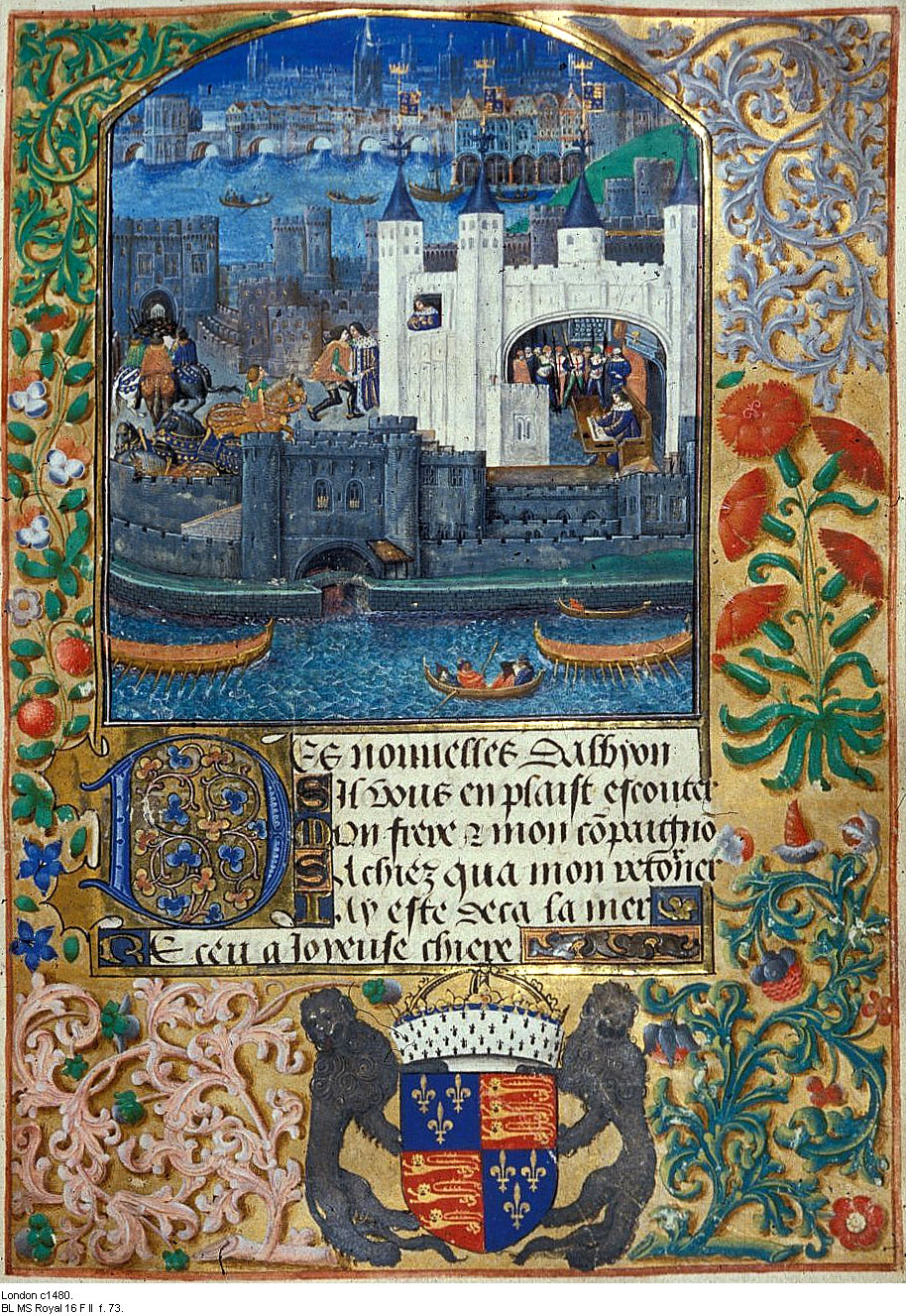
London c1480, MS Royal 16
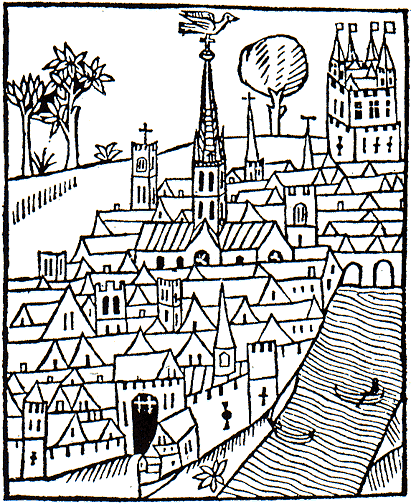
London, 1510, the earliest view in print
Map of England from Saxton's Descriptio Angliae, 1579
London in late 16th century
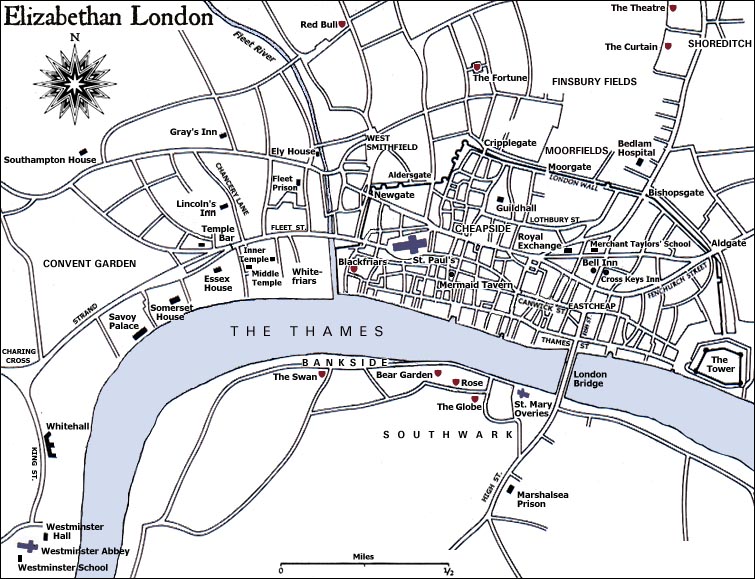
Location Map of Elizabethan London
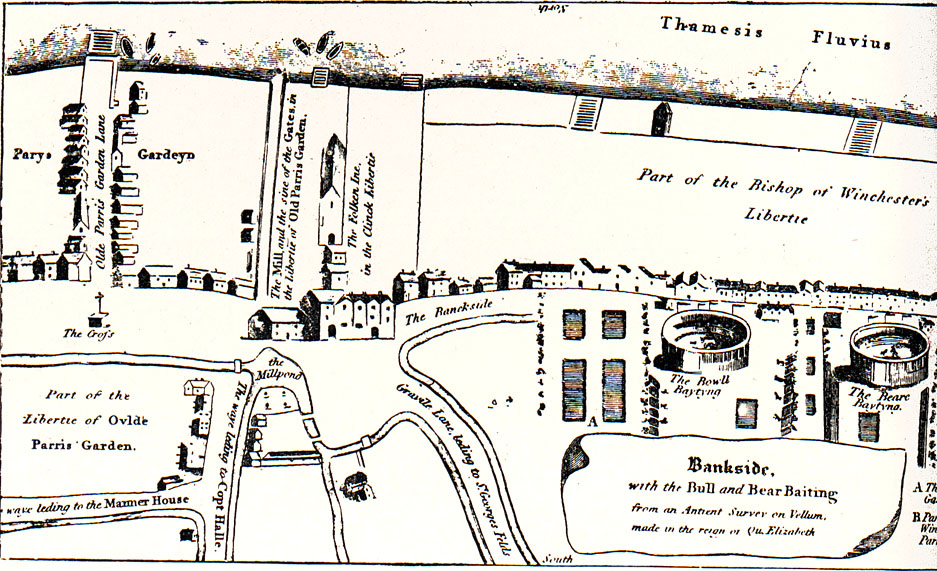
Plan of the Bankside, Southwark, in Shakespeare's time
Detail of Norden's Map of the Bankside, 1593
Bull and Bear Baiting Rings from the Agas Map (1569-1590, pub. 1631)
Sketch of the Swan Theatre, c. 1596
Westminster in the Seventeenth Century, by Hollar
Visscher's View of London, 1616
Larger Visscher's View in Sections
c. 1690. View of London Churches, after the Great Fire
The Yard of the Tabard Inn from Thornbury, Old and New London
|
|

 England under the Tudors