|
|
|
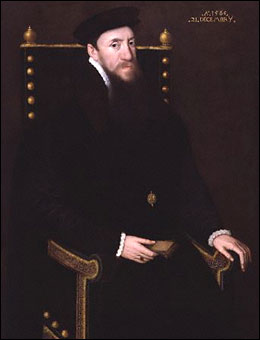

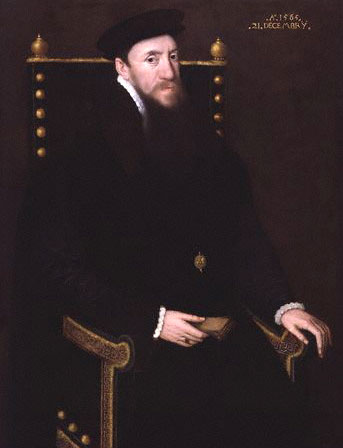
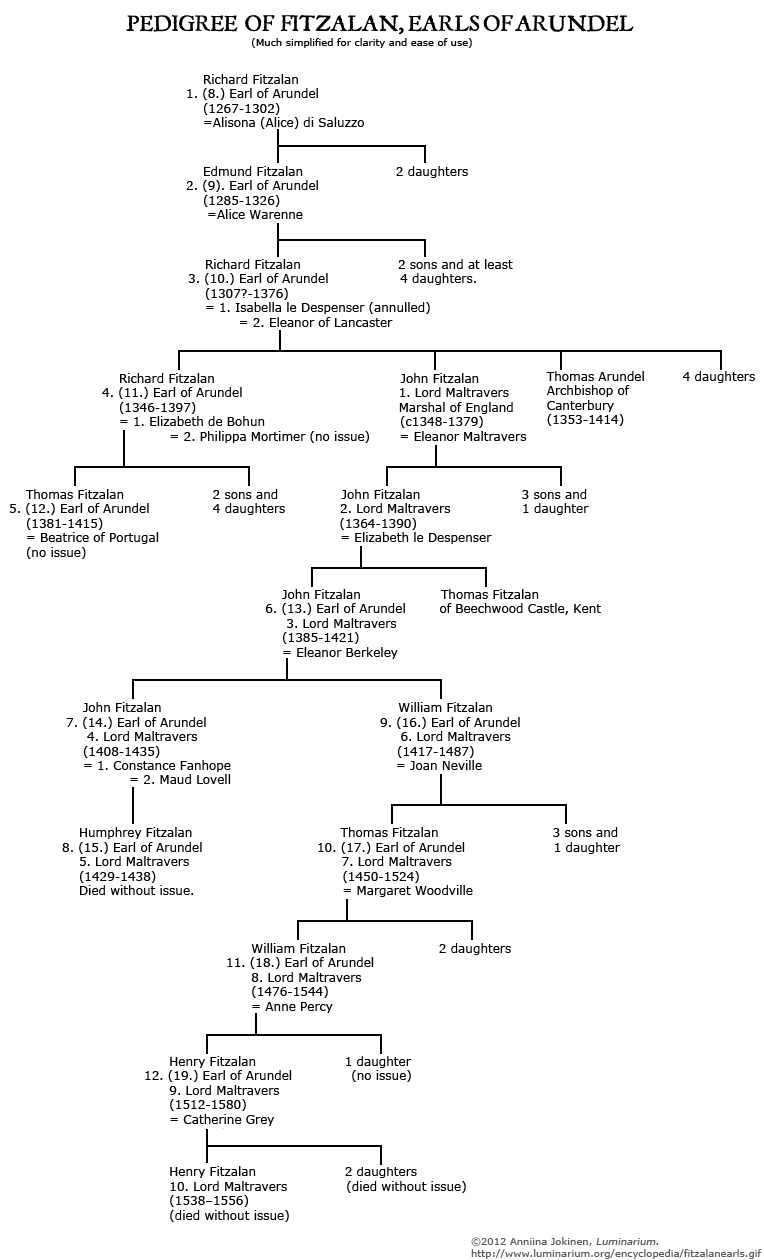
HENRY FITZALAN, twelfth Earl of Arundel (1511?-1580), born about 1511, was the only son of William Fitzalan, eleventh earl of Arundel,
K.G., by his second wife, Lady Anne Percy, daughter of Henry Percy, fourth earl of Northumberland. He was named
after Henry VIII, who personally stood godfather at his baptism. Upon entering his
fifteenth year his father proposed to place him in the household of Cardinal Wolsey, but he preferred the service
of the king, who received him with affection. He was in the train of Henry at the Calais interview of September 1532.
In February 1533 he was summoned to parliament by the title of Lord Maltravers. In July 1534 he was one of the peers summoned to attend the
trial of William, lord Dacre of Gillesland. In May 1536 he was present at the trial of Anne Boleyn and
Lord Rochford. In 1540 he succeeded Arthur Plantagenet, Viscount Lisle, in the office
of deputy of Calais. During a successful administration of three years he devoted himself to the improvement of military discipline and to
the strengthening of the town. At his own expense the fortifications were extended or repaired, and large bodies of serviceable recruits were
raised. The death of his father in January 1543-4 recalled him home. On 24 April of that year he was elected K.G., and during the two following
months appears to have lived at Arundel Place.
On war being declared with France Arundel and the Duke of Suffolk embarked in July 1544 with a numerous body of troops
for the French coast; Henry himself followed in a few days, and on 26 July the whole force of the English, amounting to thirty thousand men,
encamped before the walls of Boulogne. Arundel on being created 'marshal of the field' began elaborate preparations for investing the town. The
besieged made a most determined resistance. In the night, however, of 11 Sept. a mine was successfully sprung. He immediately ordered a sharp
cannonade, and at the head of a chosen body of troops marched to the intrenchments, and when the artillery had effected a breach by firing over
his head, successfully stormed the town [cf. Siege of Boulogne, 1544].
On his return to England Arundel was rewarded with the office of lord chamberlain, which he continued to fill during the remainder of Henry's
reign. 'The boke of Henrie, Earle of Arundel, Lorde Chamberleyn to Kyng Henrie th' Eighte,' containing thirty-two folio leaves and consisting
of instructions to the king's servants in the duties of their several places, is preserved in Harl. MS. 4107, and printed from another copy in
Jeffery's edition of the 'Antiquarian Repertory,' 4to, 1807, ii. 184-209. In his will the king bequeathed him £200. At Henry's funeral
Arundel was present as one of the twelve 'assistant mourners, and at the offering brought up, together with the Earl of Oxford,
'the king's broidered coat of armes.'1
On the accession of Edward VI, in 1547, Arundel was retained in the post of lord chamberlain and chosen to act as
high constable at the coronation. He had also been named, in the will of Henry VIII, as a member of the council of twelve, intended to assist
the executors in cases of difficulty; but his influence was destroyed when Somerset became protector. Somerset
soon disgusted the other members of the cabinet, and Arundel was among the first to urge his dismissal in favour of the Earl of Warwick.
At length, in 1549, Somerset was sent to the Tower, while Arundel, Warwick, and four other lords were appointed to take charge of the king.
Warwick quickly grew jealous of Arundel's influence. When the bill for the infliction of penalties on Somerset was brought before parliament in
1550 Arundel was still in office; but a series of ridiculous charges had been collected against him from the last twelve years of his life, and
when the late protector obtained his release the earl had been dismissed from his employments.
It was asserted that he had abused his privileges as lord chamberlain to enrich himself and his friends, that he had removed the locks and bolts
from the royal stores at Westminster, had distributed 'the king's stuff' among his acquaintance, and had been guilty of various other acts of
embezzlement. The proof of these charges was never exhibited, and Edward himself in his 'Diary' terms the offences only 'crimes of suspicion
against him;' but the 'suspicion' was sufficient for the purposes of Warwick. Arundel was removed from the council, was ordered to confine himself
to his house, and was mulcted in
the sum of £12,000, to be paid in equal annual instalments of £1,000 each. His confinement, however, was of short duration, and the
injustice of the accusations having been ascertained, £8,000 of the fine was remitted.
Arundel had been sent into Sussex to allay the insurrection of 1549. By his influence tranquillity was perfectly restored throughout Sussex. When
renewed symptoms of uneasiness appeared shortly after his release, the council made a second request for his assistance in repressing the disturbance.
Arundel returned a severely dignified refusal. His late punishment, he said, for offences which he had never committed had injured him both in his
fortune and his health, and he did not understand why his services, which had formerly been so ill requited, were again demanded. The council, after
attempting to frighten him into submission, were glad to despatch the Duke of Somerset in his stead.
His opposition to Warwick and the ruling party at court subjected him to much persecution. Finding the necessity of offering a united resistance
to the aggressions of Warwick, he formed a friendship with his old enemy the Duke of Somerset. On 16 Oct. 1551 Somerset was a second time committed
to the Tower on charges of felony and treason. In the original depositions no mention was made of Arundel as an accomplice, but in a few days the
evidence of one of the accused, named Crane, began to implicate him; by degrees Crane's recollections became more vivid, and on 8 Nov. Arundel was
arrested and conveyed to the Tower. It was said that he had listened to overtures from Somerset, and that he was privy to the intended massacre of
Northumberland, Northampton, and Pembroke, at the
house of Lord Paget. These accusations rest entirely on the doubtful testimony of Crane. During more than twelve months
that Arundel was confined to the Tower, Northumberland, although he plotted unceasingly against the life of his prisoner, never ventured to bring
him to his trial; Arundel's subsequent confession was exacted as the condition of his pardon, and on a subsequent occasion he publicly asserted his
innocence in the presence, and with the assent, of Pembroke himself.
On 3 Dec. 1552 he was called before the privy council, required to sign a submission and confession, and fined in the sum of six thousand marks, to
be paid in equal portions of one thousand marks annually; he was bound in a recognisance of ten thousand marks to be punctual in his payment of the
fine, and was at length dismissed with an admonition . The declining health of the king suggested to Northumberland the expediency of conciliating
the nobility. Arundel was first restored to his place at the council board, and four days before Edward's death was discharged entirely of his fine.
In June 1553 he strongly protested against Edward's 'device' for the succession, by which the king's sisters were declared illegitimate. He ultimately
signed the letters patent, but not the bond appended, with a deliberate intention of deserting Northumberland whenever a chance should present itself.
On the death of the king, 6 July 1553, Arundel entered with apparent ardour into the designs of the duke. But on the very same evening, while the
council were still discussing the measures necessary to be adopted before they proclaimed the Lady Jane, he contrived
to forward a letter to Mary, in which he informed her of her brother's death; assured her that Northumberland's motive in
conceding it was 'to entrap her before she knew of it;' and concluded by urging her to retire to a position of safety. Mary followed his advice; while
Arundel continued during more than ten days to concur in Northumberland's schemes with a view to his betrayal. He attended the meetings of the council,
he signed the letter to Mary denouncing her as illegitimate, and asserted the title of her rival; he accompanied Northumberland and others when they
informed Jane of her accession to the crown, and attended her on the progress from Sion House to the Tower preparatory to her coronation. Arundel and
the other secret partisans of Mary persuaded Northumberland to take the command in person of the force raised to attack Mary, and assured him of their
sympathy when he started. His speeches strongly betrayed his distrust of Arundel.
Arundel lost no time in endeavouring to sound the dispositions of the councillors. They were still under the eyes of the Tower garrison. Their first
meeting to form their plans was within the Tower walls, and Arundel said 'he liked not the air.' On 19 July 1553 they managed to pass the gates under
pretence, says Bishop Godwin, of conference with the French ambassador, Lavall, and made their way to Pembroke's house
at Baynard's Castle, above London Bridge, when they sent for the mayor, the aldermen, and other city magnates. Arundel opened the proceedings in a
vehement speech. He denounced the ambition and violence of Northumberland, asserted the right of the two daughters of Henry VIII to the throne, and
concluded by calling on the assembly to unite with him in vindicating the claim of the Lady Mary. Pembroke pledged himself
to die in the cause, amid general applause. The same evening Mary was proclaimed queen at the cross at Cheapside, and at St. Paul's. Pembroke took
possession of the Tower, and Arundel, with Lord Paget, galloped off with the great seal and a letter from the council, which he delivered to Mary at
Framlingham Castle in Suffolk. He then hastened to Cambridge to secure Northumberland. Their meeting is described by Stow and by Holinshed. In Harl.
MS. 787, f. 61, is a copy of the piteous letter which Northumberland addressed to Arundel the night before his execution.
In reward of his exertions Mary bestowed on Arundel the office of lord steward of the household; to this were added a seat at the council board, a
license for two hundred retainers beyond his ordinary attendants, and a variety of local privileges connected with his possessions in Sussex. He was
also appointed to act as lord high constable at the coronation, and was deputed to confer on any number of persons not exceeding sixty the dignity of
knighthood. Though favoured by the queen he deemed it politic to make some show of resenting her derogatory treatment of
Elizabeth. In September 1553 he was a commissioner for Bishop Bonner's
restitution. On 1 Jan. 1553-4 he was nominated a commissioner to treat of the queen's marriage, and on 17 Feb. 1554 he was lord high steward on the
trial of the Duke of Suffolk.
He bore, too, a part in checking the progress of Wyatt's shortlived rebellion. On Philip's landing at Southampton, 20 July
1554, Arundel received him and immediately presented him with the George and Garter. Along with William, marquis of Winchester
and others, he received from Philip and Mary, 6 Feb. 1555, a grant of a charter of incorporation by the name of Merchant Adventurers of England for
the discovery of unknown lands. In May 1555 he was selected with Cardinal Pole, Gardiner,
and Lord Paget to urge the mediatorial offices of the queen at the congress of Marque, and to effect, if possible, a renewal of amity between the
imperial and French crowns. He accompanied Philip to Brussels in the following September. In the same year (1555) he was elected high steward of
the university of Oxford.
When the troubles with France commenced, the queen appointed Arundel, 26 July 1557, lieutenant-general and captain of the forces for defence of the
kingdom. The following year he was deputed with Thirlby, bishop of Ely, and Dr. Nicholas Wotton to the conferences held by England, France, and Spain,
in the abbey of Cercamp, and was actually engaged in arranging the preliminaries of a general peace, when the death of Mary, in November 1558, caused
him to abruptly return home in December.
By Elizabeth, Arundel was retained in all the employments which he had held in the preceding
reign, although he was trusted by no one, chiefly because she could not afford to alienate so powerful a subject. A commission, dated 21 Nov. 1558,
empowers Arundel, William, lord Howard of Effingham, Thirlby, and Wotton to treat with Scotland; it was made out on 27 Sept. in the last year of Mary,
and the alterations are in the handwriting of Sir William Cecil. Disgusted by the 'sinister workinge of some meane persons
of her counsaile,' Arundel had surrendered the staff of lord steward shortly before the death of Mary.2 Elizabeth on her accession replaced
it in his hands; she called him to a seat in the council, and added to his other honours the appointments of high constable for the day before, and high
steward for the day of her coronation, on which occasion he received a commission to create thirty knights.
In January 1559 he was elected chancellor of the university of Oxford, but resigned the office, probably from religious motives, in little more than
four months. In August 1559 Elizabeth visited him at Nonsuch in Cheam, Surrey, where for five days she was sumptuously entertained with banquets, masques,
and music. At her departure she accepted 'a cupboard of plate,'3 as she had before received the perquisites obtained by the earl at her
coronation. The queen paid several subsequent visits to Nonsuch. In August 1560 he was one of the commissioners appointed to arrange a commercial treaty
with the Hanse Towns. During the same year Arundel, in the queen's presence, sharply rebuked Edward, lord Clinton, who advocated the prosecution of the
war with Scotland for the arrest of English subjects found attending mass at the Spanish or French chapels, and Elizabeth herself could scarcely prevent
them from coming to blows. 'Those,' Arundel exclaimed, 'who had advised the war with Scotland were traitors to their country.'4 Being a widower
Arundel was named among those who might aspire to the queen's hand, a fact which led to a violent quarrel with Leicester in 1561.
Upon the queen's dangerous illness in October 1562 a meeting was held at the house of Arundel in November to reconsider the succession.
The Duke of Norfolk, Arundel's son-in-law, was present. The object was to further the claims of Lady Catherine Grey, to whose
son Norfolk's infant daughter was to be betrothed. The discussion ended at two in the morning without result. When the queen heard of it she sent for
Arundel to reproach him, and Arundel, it is said, replied that if she intended to govern England with her caprices and fancies the nobility would be
forced to interfere. In 1564 he resigned the staff of lord steward 'with sundry speeches of offence,'5 and Elizabeth, to resent the affront,
restrained him to his house.
Though released within a month from his confinement, Arundel felt deeply the humiliation of his suit. Early in 1566 a smart attack of gout afforded him
a pretext for visiting the baths at Padua. He returned in March 1567. On his arrival at Canterbury he was met by a body of more than six hundred gentlemen
from Kent, Sussex, and Surrey; at Blackheath the cavalcade was joined by the recorder, the aldermen, and many of the chief merchants of London, and as it
drew near to the metropolis the lord chancellor, the earls of Pembroke, Huntingdon,
Sussex, Warwick, and Leicester, with others, to the number of two
thousand horsemen, came out to meet him. He passed in procession through the city, and having paid his respects to the queen at Westminster went by water
to his house in the Strand.
It has often been asserted, but quite erroneously, that on this occasion Arundel appeared in the first coach, and presented to Elizabeth the first pair of
silk stockings ever seen in England. The subject has been fully discussed by J. G. Nichols in the 'Gentleman's Magazine' for 1833 (vol. ciii. pt. ii. p. 212,
n. 12). That he sent the queen some valuable presents appears from her letter to him, dated at Westminster, 16 March 1507 (Cal. State Papers, Dom. 1547-80,
p. 289).
Arundel was now partially restored to favour, so that when the conferences relative to the accusations brought by the Earl of Murray against the
Queen of Scots were removed in November 1568 from York to Westminster, he was joined in the commission. His hopes of
gaining Elizabeth in marriage had long been buried. As the leader of the old nobility and the catholic party he now resolved that the Queen of Scots should
marry Norfolk; Cecil and Bacon were to be overthrown, Elizabeth deposed,
and the catholic religion restored. He became intimate with Leslie, bishop of Ross, and with Don Gueran, the Spanish ambassador. In 1569 he undertook to carry
Leslie's letter to Elizabeth, wherein it was falsely asserted that the king of Spain had directed the Duke of Alva and Don Gueran 'to treat and conclude with
the Queen of Scots for her marriage in three several ways,' and thus alarm the queen by the prospect of a possible league between France and Spain and the
papacy. He followed up the blow by laying in writing before her his own objections to extreme measures against Mary Stuart.
When at length the discovery of the proposed marriage determined Elizabeth to commit the Duke of Norfolk to the Tower, Arundel was also placed under arrest,
and restrained to his house in the Strand in September 1569 . The northern insurrection which broke out a few weeks later added to the length and rigour of
his confinement. From Arundel House he was removed to Eton College, and thence to Nonsuch , where a close imprisonment brought on a return of the gout, and
by withdrawing him from his concerns contributed to involve him in many pecuniary difficulties, which, however, his son-in-law, Lord Lumley, did much to
alleviate. Though his name appeared conspicuously in the depositions of the prisoners examined after the northern rebellion, he had been too prudent to commit
himself to open treason. He was able to represent his share of the conspiracy as part of an honest policy conceived in Elizabeth's interests, and Elizabeth
dared not openly break with the still powerful party among the nobles to which Arundel belonged.
Leicester, desiring to injure Cecil, had little difficulty in inducing the queen to recall Arundel to the council board during the
following year. With Arundel was recalled also Lord Lumley, and both of them renewed their treasonable communications with Don Gueran and La Mothe Fenelon. He
violently opposed himself to Elizabeth's matrimonial treaty with the Duke of Alençon. He strongly remonstrated against the Earl
of Lennox being sent with Sir William Drury's army to Scotland as the representative of James.
At length the discovery of the Ridolfi conspiracy, to which he was privy, in September 1571, afforded indubitable evidence that he had been for years conspiring
for a religious revolution and Elizabeth's overthrow. He was again placed under a guard at his own house, and did not regain his liberty until December 1572.
Arundel passed the remainder of his days in seclusion. He died 24 Feb. 1579-80 at Arundel House in the Strand, and on 22 March was buried, in accordance with
his desire, in the collegiate chapel at Arundel, where his monument, with a long biographical inscription from the pen of Lord Lumley, may still be seen. The
programme of his funeral is printed in the 'Sussex Archaeological Collections,' xii. 201-262. In his will, dated 30 Dec. 1579, and proved 27 Feb. 1579-80, he
appointed Lumley his sole executor and residuary legatee.
In person Arundel appears to have been of the middle size, well proportioned in limb, 'stronge of bone, furnished with cleane and firme fleshe, voide of fogines
and fatnes.' His countenance was regular and expressive, his voice powerful and pleasing; but the rapidity of his utterance often made his meaning 'somewhat harde
to the unskilfull.'6 His dislike of 'new-fangled and curious tearmes' was not more remarkable than his aversion to the use of foreign languages, although
he could speak French. According to his anonymous biographer he was 'not unlearned,' and with the counsel of Humphrey Lhuyd, who lived with him, he formed a library,
described by the same authority as 'righte worthye of remembrance.' His collection merged in that of Lord Lumley. With Lumley and Lhuyd he became a member of the
Elizabethan Society of Antiquaries enumerated in the introduction to vol. i. of the 'Archaeologia,' p. xix.
Arundel was twice married. His first wife, whom he had married before November 1533, was Katherine, second daughter of Thomas Grey, marquis of Dorset, K.G., by
whom he had one son, Henry, lord Maltravers, born in 1538, who died at Brussels, 30 June 1556, and two daughters, Jane and Mary. Jane was married before March
1552 to John, lord Lumley, but had no issue, and nursed her father after the death of his second wife, and died in 1576-7. Mary, born about 1541, became the wife
(between 1552 and 1554) of Thomas Howard, duke of Norfolk, and the mother of Philip Howard, who inherited the earldom of Arundel. She
died 25 Aug. 1557, and was buried at St. Clement Danes. Both these ladies were eminent for their classical attainments. Their learned exercises are preserved in
the British Museum among the Royal MSS., having been handed down with Lord Lumley's library. Arundel married secondly Mary, daughter of Sir John Arundell of Lanherne,
Cornwall, and widow of Robert Ratcliffe, first earl of Sussex of that family, and K.G. She had no children by Arundel, and dying 21 Oct. 1557 at Arundel House,
was buried 1 Sept. in the neighbouring church of St. Clement Danes, but was afterwards reinterred at Arundel. Arundel thus died the last earl of his family.
1. Strype, Memorials, 8vo ed. vol. ii. App. pp. 4, 15.
2.MS. The Life of Henrye Fitzallen, last Earle of Arundell of that name.
King's MSS. xvii. A. ix. ff. 49-61, British Museum.
3. Nichols, Progresses of Queen Elizabeth, i. 74.
4. Froude, History of England, ch. xxxviii. link
5. Strype, Annals, i. 413.
6. MS. Life. ff. 63, 68.
Excerpted from:
Goodwin, Gordon. "Henry Fitzalan, 12th Earl of Arundel."
Dictionary of National Biography. Vol. VII. Leslie Stephen and Sidney Lee, Eds.
New York: The Macmillan Company, 1908. 88-93.
Other Local Resources:
Web Links:
 | to King Henry VIII
|
|
| to Renaissance English Literature
|
|
| to Luminarium Encyclopedia |
Site ©1996-2023 Anniina Jokinen. All rights reserved.
This page was created on April 20, 2009. Last updated April 24, 2023..
|
Index of Encyclopedia Entries:
Medieval Cosmology
Prices of Items in Medieval England
Edward II
Isabella of France, Queen of England
Piers Gaveston
Thomas of Brotherton, E. of Norfolk
Edmund of Woodstock, E. of Kent
Thomas, Earl of Lancaster
Henry of Lancaster, Earl of Lancaster
Henry of Grosmont, Duke of Lancaster
Roger Mortimer, Earl of March
Hugh le Despenser the Younger
Bartholomew, Lord Burghersh, elder
Hundred Years' War (1337-1453)
Edward III
Philippa of Hainault, Queen of England
Edward, Black Prince of Wales
John of Eltham, Earl of Cornwall
The Battle of Crécy, 1346
The Siege of Calais, 1346-7
The Battle of Poitiers, 1356
Lionel of Antwerp, Duke of Clarence
John of Gaunt, Duke of Lancaster
Edmund of Langley, Duke of York
Thomas of Woodstock, Gloucester
Richard of York, E. of Cambridge
Richard Fitzalan, 3. Earl of Arundel
Roger Mortimer, 2nd Earl of March
The Good Parliament, 1376
Richard II
The Peasants' Revolt, 1381
Lords Appellant, 1388
Richard Fitzalan, 4. Earl of Arundel
Archbishop Thomas Arundel
Thomas de Beauchamp, E. Warwick
Robert de Vere, Earl of Oxford
Ralph Neville, E. of Westmorland
Thomas Mowbray, Duke of Norfolk
Edmund Mortimer, 3. Earl of March
Roger Mortimer, 4. Earl of March
John Holland, Duke of Exeter
Michael de la Pole, E. Suffolk
Hugh de Stafford, 2. E. Stafford
Henry IV
Edward, Duke of York
Edmund Mortimer, 5. Earl of March
Henry Percy, Earl of Northumberland
Sir Henry Percy, "Harry Hotspur"
Thomas Percy, Earl of Worcester
Owen Glendower
The Battle of Shrewsbury, 1403
Archbishop Richard Scrope
Thomas Mowbray, 3. E. Nottingham
John Mowbray, 2. Duke of Norfolk
Thomas Fitzalan, 5. Earl of Arundel
Henry V
Thomas, Duke of Clarence
John, Duke of Bedford
Humphrey, Duke of Gloucester
John Talbot, Earl of Shrewsbury
Richard, Earl of Cambridge
Henry, Baron Scrope of Masham
William de la Pole, Duke of Suffolk
Thomas Montacute, E. Salisbury
Richard Beauchamp, E. of Warwick
Henry Beauchamp, Duke of Warwick
Thomas Beaufort, Duke of Exeter
Cardinal Henry Beaufort
John Beaufort, Earl of Somerset
Sir John Fastolf
John Holland, 2. Duke of Exeter
Archbishop John Stafford
Archbishop John Kemp
Catherine of Valois
Owen Tudor
John Fitzalan, 7. Earl of Arundel
John, Lord Tiptoft
Charles VII, King of France
Joan of Arc
Louis XI, King of France
Charles the Bold, Duke of Burgundy
The Battle of Agincourt, 1415
The Battle of Castillon, 1453
The Wars of the Roses 1455-1485
Causes of the Wars of the Roses
The House of Lancaster
The House of York
The House of Beaufort
The House of Neville
The First Battle of St. Albans, 1455
The Battle of Blore Heath, 1459
The Rout of Ludford, 1459
The Battle of Northampton, 1460
The Battle of Wakefield, 1460
The Battle of Mortimer's Cross, 1461
The 2nd Battle of St. Albans, 1461
The Battle of Towton, 1461
The Battle of Hedgeley Moor, 1464
The Battle of Hexham, 1464
The Battle of Edgecote, 1469
The Battle of Losecoat Field, 1470
The Battle of Barnet, 1471
The Battle of Tewkesbury, 1471
The Treaty of Pecquigny, 1475
The Battle of Bosworth Field, 1485
The Battle of Stoke Field, 1487
Henry VI
Margaret of Anjou
Richard Plantagenet, Duke of York
Edward IV
Elizabeth Woodville
Richard Woodville, 1. Earl Rivers
Anthony Woodville, 2. Earl Rivers
Jane Shore
Edward V
Richard III
George, Duke of Clarence
Ralph Neville, 2. Earl of Westmorland
Richard Neville, Earl of Salisbury
Richard Neville, Earl of Warwick
Edward Neville, Baron Bergavenny
William Neville, Lord Fauconberg
Robert Neville, Bishop of Salisbury
John Neville, Marquis of Montagu
George Neville, Archbishop of York
John Beaufort, 1. Duke Somerset
Edmund Beaufort, 2. Duke Somerset
Henry Beaufort, 3. Duke of Somerset
Edmund Beaufort, 4. Duke Somerset
Margaret Beaufort
Edmund Tudor, Earl of Richmond
Jasper Tudor, Earl of Pembroke
Humphrey Stafford, D. Buckingham
Henry Stafford, Duke of Buckingham
Humphrey Stafford, E. of Devon
Thomas, Lord Stanley, Earl of Derby
Sir William Stanley
Archbishop Thomas Bourchier
Henry Bourchier, Earl of Essex
John Mowbray, 3. Duke of Norfolk
John Mowbray, 4. Duke of Norfolk
John Howard, Duke of Norfolk
Henry Percy, 2. E. Northumberland
Henry Percy, 3. E. Northumberland
Henry Percy, 4. E. Northumberland
William, Lord Hastings
Henry Holland, Duke of Exeter
William Fitzalan, Earl of Arundel
William Herbert, 1. Earl of Pembroke
John de Vere, 12th Earl of Oxford
John de Vere, 13th Earl of Oxford
Thomas de Clifford, 8. Baron Clifford
John de Clifford, 9. Baron Clifford
John Tiptoft, Earl of Worcester
Thomas Grey, 1. Marquis Dorset
Sir Andrew Trollop
Archbishop John Morton
Edward Plantagenet, E. of Warwick
John Talbot, 2. E. Shrewsbury
John Talbot, 3. E. Shrewsbury
John de la Pole, 2. Duke of Suffolk
John de la Pole, E. of Lincoln
Edmund de la Pole, E. of Suffolk
Richard de la Pole
John Sutton, Baron Dudley
James Butler, 5. Earl of Ormonde
Sir James Tyrell
Edmund Grey, first Earl of Kent
George Grey, 2nd Earl of Kent
John, 5th Baron Scrope of Bolton
James Touchet, 7th Baron Audley
Walter Blount, Lord Mountjoy
Robert Hungerford, Lord Moleyns
Thomas, Lord Scales
John, Lord Lovel and Holand
Francis Lovell, Viscount Lovell
Sir Richard Ratcliffe
William Catesby
Ralph, 4th Lord Cromwell
Jack Cade's Rebellion, 1450
Tudor Period
King Henry VII
Queen Elizabeth of York
Arthur, Prince of Wales
Lambert Simnel
Perkin Warbeck
The Battle of Blackheath, 1497
King Ferdinand II of Aragon
Queen Isabella of Castile
Maximilian I, Holy Roman Emperor
King Henry VIII
Queen Catherine of Aragon
Queen Anne Boleyn
Queen Jane Seymour
Queen Anne of Cleves
Queen Catherine Howard
Queen Katherine Parr
King Edward VI
Queen Mary I
Queen Elizabeth I
Henry Fitzroy, Duke of Richmond
Margaret Tudor, Queen of Scotland
James IV, King of Scotland
The Battle of Flodden Field, 1513
James V, King of Scotland
Mary of Guise, Queen of Scotland
Mary Tudor, Queen of France
Louis XII, King of France
Francis I, King of France
The Battle of the Spurs, 1513
Field of the Cloth of Gold, 1520
Charles V, Holy Roman Emperor
Eustace Chapuys, Imperial Ambassador
The Siege of Boulogne, 1544
Cardinal Thomas Wolsey
Archbishop Thomas Cranmer
Thomas Cromwell, Earl of Essex
Thomas, Lord Audley
Thomas Wriothesley, E. Southampton
Sir Richard Rich
Edward Stafford, D. of Buckingham
Thomas Howard, 2nd Duke of Norfolk
Thomas Howard, 3rd Duke of Norfolk
John Dudley, Duke of Northumberland
Charles Brandon, Duke of Suffolk
Thomas Boleyn, Earl of Wiltshire
George Boleyn, Viscount Rochford
John Russell, Earl of Bedford
Thomas Grey, 2. Marquis of Dorset
Henry Grey, D. of Suffolk
Charles Somerset, Earl of Worcester
George Talbot, 4. E. Shrewsbury
Francis Talbot, 5. E. Shrewsbury
Henry Algernon Percy,
5th Earl of Northumberland
Henry Algernon Percy,
6th Earl of Northumberland
Ralph Neville, 4. E. Westmorland
Henry Neville, 5. E. Westmorland
William Paulet, Marquis of Winchester
Sir Francis Bryan
Sir Nicholas Carew
John de Vere, 15th Earl of Oxford
John de Vere, 16th Earl of Oxford
Thomas Seymour, Lord Admiral
Edward Seymour, Protector Somerset
Margaret Pole, Countess of Salisbury
Henry Pole, Lord Montague
Sir Geoffrey Pole
Thomas Manners, Earl of Rutland
Henry Manners, Earl of Rutland
Henry Bourchier, 2. Earl of Essex
Robert Radcliffe, 1. Earl of Sussex
Henry Radcliffe, 2. Earl of Sussex
George Hastings, Earl of Huntingdon
Henry Courtenay, Marquis of Exeter
George Neville, Baron Bergavenny
Sir Edward Neville
William, Lord Paget
William Sandys, Baron Sandys
William Fitzwilliam, E. Southampton
Sir Anthony Browne
Sir Thomas Wriothesley
Sir William Kingston
George Brooke, Lord Cobham
Sir Richard Southwell
Thomas Fiennes, 9th Lord Dacre
Sir Francis Weston
Henry Norris
Lady Jane Grey
Sir Thomas Arundel
Sir Richard Sackville
Sir William Petre
Sir John Cheke
Walter Haddon, L.L.D
Sir Peter Carew
Sir John Mason
Nicholas Wotton
John Taylor
Sir Thomas Wyatt, the Younger
Cardinal Lorenzo Campeggio
Cardinal Reginald Pole
Stephen Gardiner, Bishop of Winchester
Edmund Bonner, Bishop of London
Nicholas Ridley, Bishop of London
John Hooper, Bishop of Gloucester
John Aylmer, Bishop of London
Thomas Linacre
William Grocyn
Archbishop William Warham
Cuthbert Tunstall, Bishop of Durham
Richard Fox, Bishop of Winchester
Edward Fox, Bishop of Hereford
Pope Julius II
Pope Leo X
Pope Clement VII
Pope Paul III
Pope Pius V
Pico della Mirandola
Desiderius Erasmus
Martin Bucer
Richard Pace
Christopher Saint-German
Thomas Tallis
Elizabeth Barton, the Nun of Kent
Hans Holbein, the Younger
The Sweating Sickness
Dissolution of the Monasteries
Pilgrimage of Grace, 1536
Robert Aske
Anne Askew
Lord Thomas Darcy
Sir Robert Constable
Oath of Supremacy
The Act of Supremacy, 1534
The First Act of Succession, 1534
The Third Act of Succession, 1544
The Ten Articles, 1536
The Six Articles, 1539
The Second Statute of Repeal, 1555
The Act of Supremacy, 1559
Articles Touching Preachers, 1583
Queen Elizabeth I
William Cecil, Lord Burghley
Robert Cecil, 1st Earl of Salisbury
Sir Francis Walsingham
Sir Nicholas Bacon
Sir Thomas Bromley
Robert Dudley, Earl of Leicester
Ambrose Dudley, Earl of Warwick
Henry Carey, Lord Hunsdon
Sir Thomas Egerton, Viscount Brackley
Sir Francis Knollys
Katherine "Kat" Ashley
Lettice Knollys, Countess of Leicester
George Talbot, 6. E. of Shrewsbury
Elizabeth, Countess of Shrewsbury
Gilbert Talbot, 7. E. of Shrewsbury
Sir Henry Sidney
Sir Robert Sidney
Archbishop Matthew Parker
Walter Devereux, 1st Earl of Essex
Robert Devereux, 2nd Earl of Essex
Penelope Devereux, Lady Rich
Sir Christopher Hatton
Edward Courtenay, E. Devonshire
Edward Manners, 3rd Earl of Rutland
Thomas Radcliffe, 3. Earl of Sussex
Henry Radcliffe, 4. Earl of Sussex
Robert Radcliffe, 5. Earl of Sussex
William Parr, Marquis of Northampton
Henry Wriothesley, 2. Southampton
Henry Wriothesley, 3. Southampton
Charles Neville, 6. E. Westmorland
Thomas Percy, 7. E. Northumberland
Henry Percy, 8. E. Northumberland
Henry Percy, 9. E. Nothumberland
William Herbert, 1. Earl of Pembroke
Charles, Lord Howard of Effingham
Thomas Howard, 4th Duke of Norfolk
Henry Howard, 1. Earl of Northampton
Thomas Howard, 1. Earl of Suffolk
Henry Hastings, 3. E. of Huntingdon
Edward Manners, 3rd Earl of Rutland
Roger Manners, 5th Earl of Rutland
Francis Manners, 6th Earl of Rutland
Henry FitzAlan, 12. Earl of Arundel
Thomas, Earl Arundell of Wardour
Edward Somerset, E. of Worcester
William Davison
Sir Walter Mildmay
Sir Ralph Sadler
Sir Amyas Paulet
Gilbert Gifford
Anthony Browne, Viscount Montague
François, Duke of Alençon & Anjou
Mary, Queen of Scots
Henry Stuart, Lord Darnley
James Hepburn, Earl of Bothwell
Anthony Babington and the Babington Plot
John Knox
Philip II of Spain
The Spanish Armada, 1588
Sir Francis Drake
Sir John Hawkins
William Camden
Archbishop Whitgift
Martin Marprelate Controversy
John Penry (Martin Marprelate)
Richard Bancroft, Archbishop of Canterbury
John Dee, Alchemist
Philip Henslowe
Edward Alleyn
The Blackfriars Theatre
The Fortune Theatre
The Rose Theatre
The Swan Theatre
Children's Companies
The Admiral's Men
The Lord Chamberlain's Men
Citizen Comedy
The Isle of Dogs, 1597
Common Law
Court of Common Pleas
Court of King's Bench
Court of Star Chamber
Council of the North
Fleet Prison
Assize
Attainder
First Fruits & Tenths
Livery and Maintenance
Oyer and terminer
Praemunire
The Stuarts
King James I of England
Anne of Denmark
Henry, Prince of Wales
The Gunpowder Plot, 1605
George Villiers, 1st Duke of Buckingham
Robert Carr, Earl of Somerset
Arabella Stuart, Lady Lennox
William Alabaster
Bishop Hall
Bishop Thomas Morton
Archbishop William Laud
John Selden
Lucy Harington, Countess of Bedford
Henry Lawes
King Charles I
Queen Henrietta Maria
Long Parliament
Rump Parliament
Kentish Petition, 1642
Thomas Wentworth, Earl of Strafford
John Digby, Earl of Bristol
George Digby, 2nd Earl of Bristol
Thomas Fairfax, 3rd Lord Fairfax
Robert Devereux, 3rd E. of Essex
Robert Sidney, 2. E. of Leicester
Algernon Percy, E. of Northumberland
Henry Montagu, Earl of Manchester
Edward Montagu, 2. Earl of Manchester
The Restoration
King Charles II
King James II
Test Acts
Greenwich Palace
Hatfield House
Richmond Palace
Windsor Palace
Woodstock Manor
The Cinque Ports
Mermaid Tavern
Malmsey Wine
Great Fire of London, 1666
Merchant Taylors' School
Westminster School
The Sanctuary at Westminster
"Sanctuary"
Images:
Chart of the English Succession from William I through Henry VII
Medieval English Drama
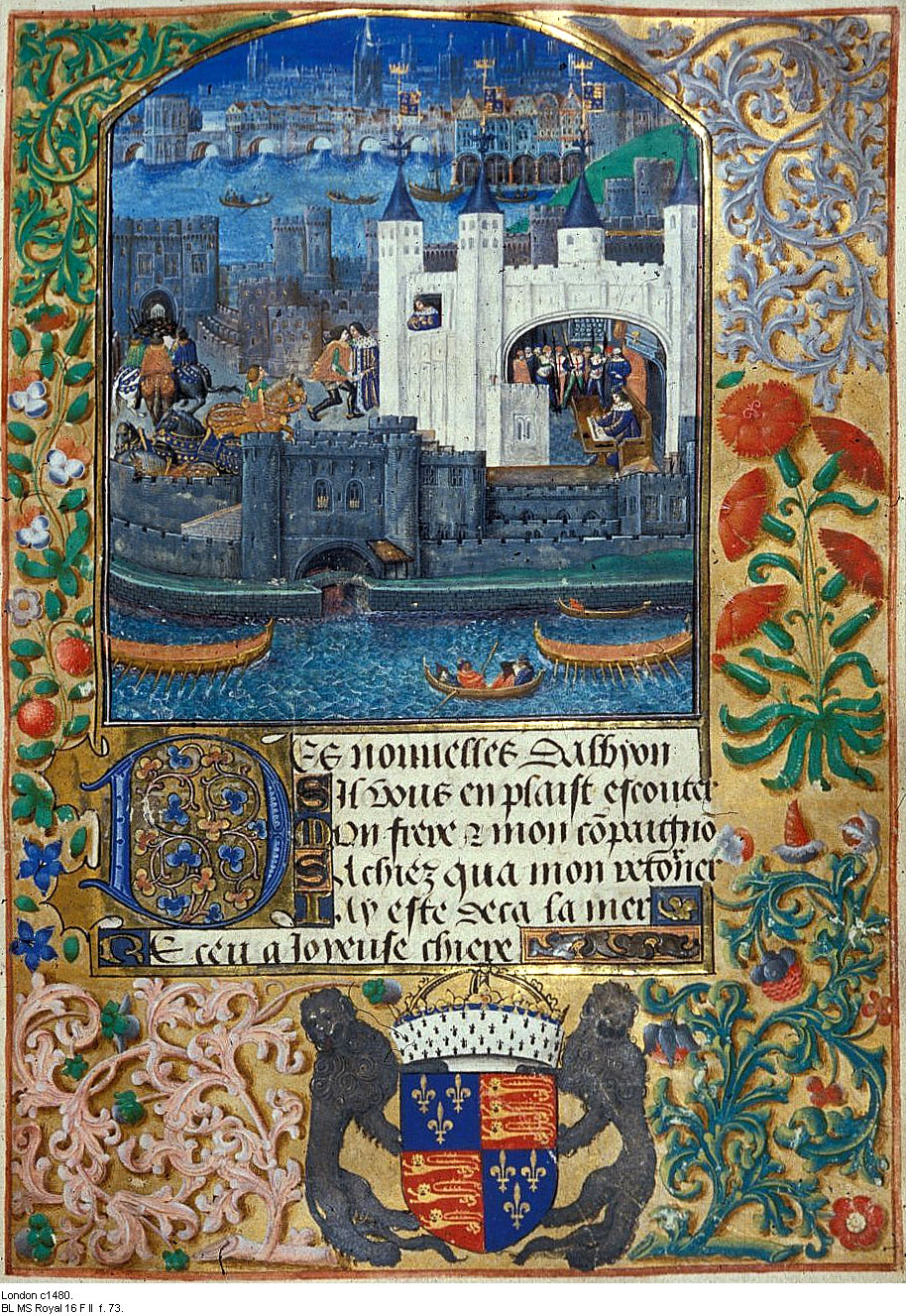
London c1480, MS Royal 16
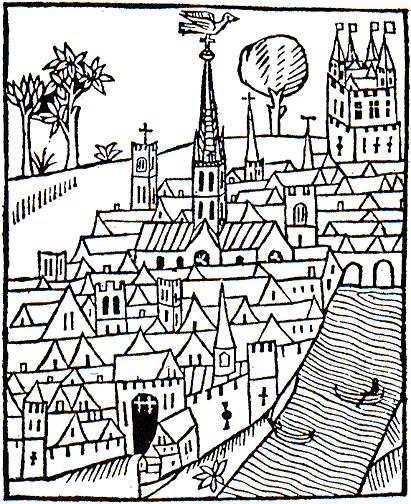
London, 1510, the earliest view in print
Map of England from Saxton's Descriptio Angliae, 1579
London in late 16th century
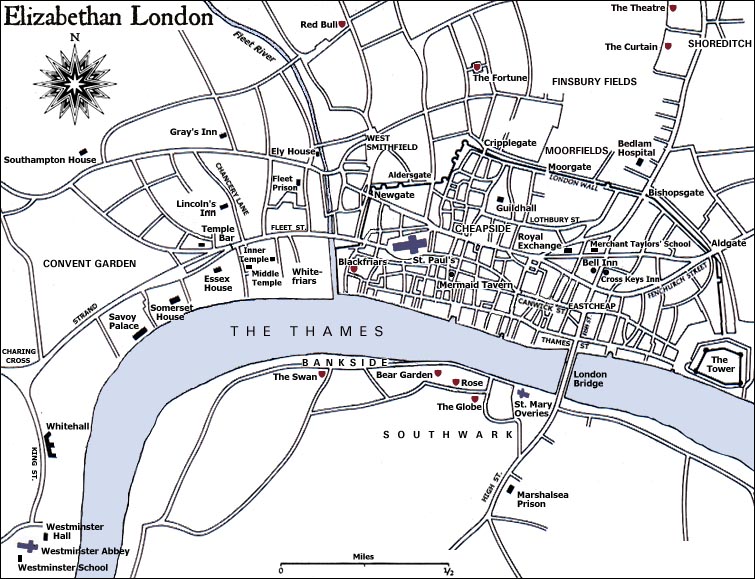
Location Map of Elizabethan London
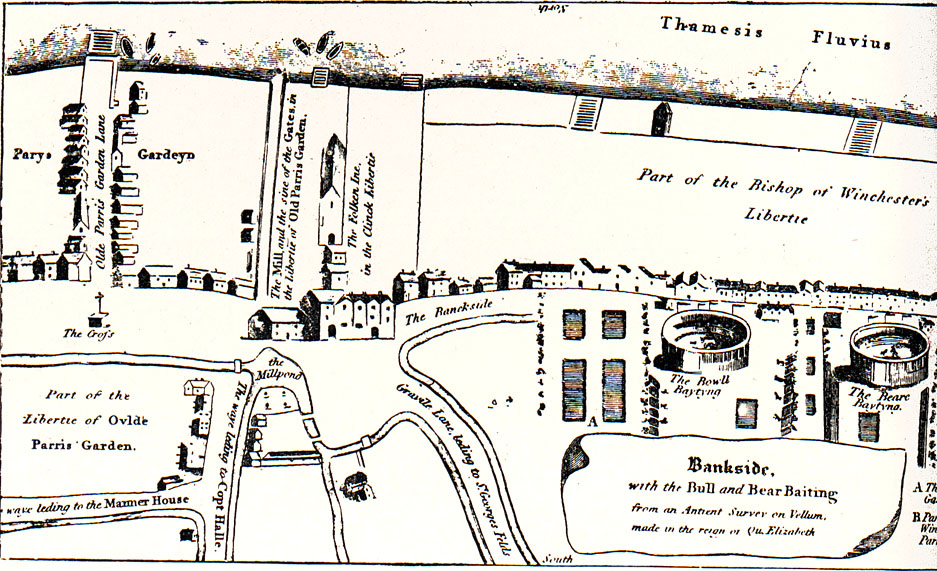
Plan of the Bankside, Southwark, in Shakespeare's time
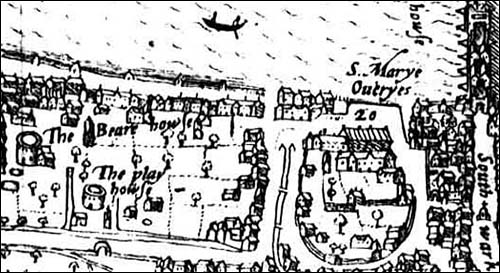
Detail of Norden's Map of the Bankside, 1593
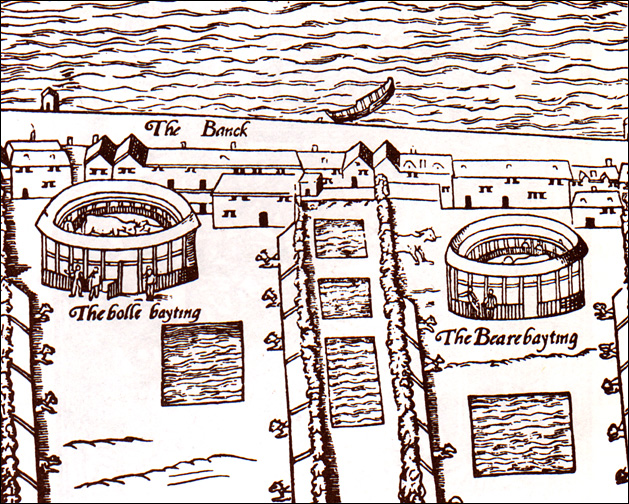
Bull and Bear Baiting Rings from the Agas Map (1569-1590, pub. 1631)
Sketch of the Swan Theatre, c. 1596
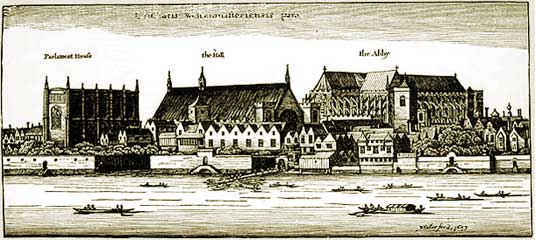
Westminster in the Seventeenth Century, by Hollar
Visscher's View of London, 1616
Larger Visscher's View in Sections
c. 1690. View of London Churches, after the Great Fire
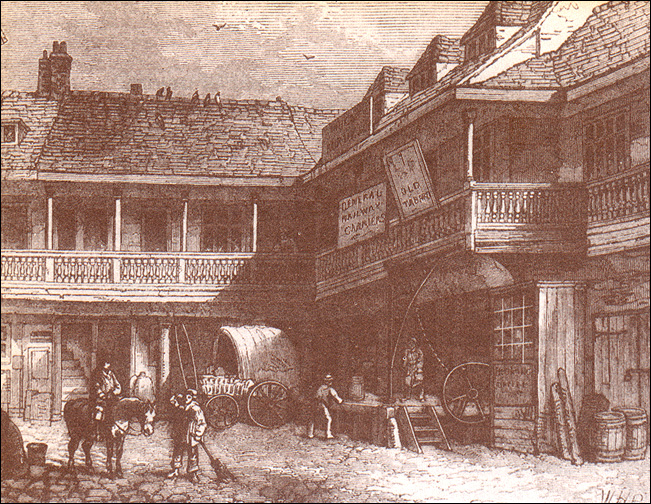
The Yard of the Tabard Inn from Thornbury, Old and New London
|
|

 England under the Tudors