|
|
|
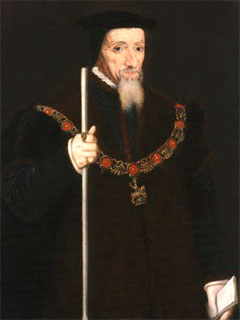
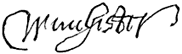

WILLIAM PAULET, PAWLET, or POULET, first Marquis of Winchester (1485?-1572), was eldest son of Sir John Paulet
of Basing, near Basingstoke in Hampshire, the head of a younger branch of an ancient Somerset family seated in the
fourteenth century at Pawlet or Paulet and Road, close to Bridgwater.1 William's great-grandfather acquired
the Hampshire estates by his marriage with Constance, granddaughter and coheiress of Thomas Poynings, baron St. John
of Basing (d. 1428). Hinton St. George, near Crewkerne, became from the middle of the fifteenth century the chief
residence of the elder branch, to which belong Sir Amias Paulet and the present Earl Poulett.2
Paulet's father held a command against the Cornish rebels in 1497 [see Battle of Blackheath],
and died after 1519.3 His monument remains in Basing church. He married his cousin Alice (or Elizabeth?),
daughter of Sir William Paulet, the first holder of Hinton St. George.4 William, their eldest son, was born,
according to Doyle (Official Baronage), in 1485; Brooke, followed by Dugdale, says 1483; while Camden asserts
that he was ninety-seven at his death, which would place his birth in 1474 or 1475.
Paulet was sheriff of Hampshire in 1512, 1519, 1523, and again in 1527.5 Knighted before the end of 1525,
he was appointed master of the king's wards in November of the next year with Thomas Englefield.6 He appears
in the privy council in the same year.7 In the Reformation parliament of 1529-36 he sat as knight of the
shire for Hampshire. Created 'surveyor of the king's widows and governor of all idiots and naturals in the king's hands'
in 1531, he became comptroller of the royal household in May 1532, and a few mouths later joint-master of the royal
woods with Thomas Cromwell.8 Now or later he held the offices of high steward
of St. Swithin's Priory, Winchester, steward of Shene Priory, Dorset, and keeper (1536) of Pamber Forest, near
Basingstoke.9
In the summer of 1533 Paulet went to France as a member of the embassy which the Duke of Norfolk
took over to join Francis I in a proposed interview with the pope, and kept Cromwell informed
of its progress. But Clement's fulmination against the divorce pronounced by
Cranmer caused their recall.10 On his return
he was charged with the unpleasant task of notifying the king's orders to his discarded wife [Catherine
of Aragon] and daughter [Princess, later Queen, Mary]. He was one of the judges of
Fisher and More
in the summer of 1535, and of Anne Boleyn's supposed accomplices in May 1536.
When the pilgrimage of grace broke out in the autumn, Paulet took joint charge of the
musters of the royal forces, and himself raised two hundred men. The rebels complaining of the exclusion of noblemen from
the king's council, Henry reminded them of the presence of Paulet and others.11 In carrying out his royal master's
commands he was not, it would appear, unnecessarily harsh. Anne Boleyn excepted him from her
complaints against the council; 'the controller,' she admitted,' was a very gentleman.'12
His services did not go unrewarded. The king visited his 'poor house' at Basing in October 1536.13 The site and
other possessions of Netley Abbey, near Southampton, were granted to him in August 1536.14 He acted as treasurer
of the household from October 1537 to March 1539, when the old St. John peerage was recreated in his favour, but without
the designation 'of Basing'.15
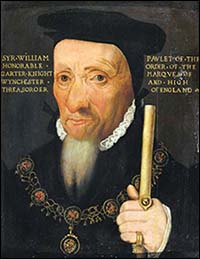 The new peer became the first master of
Henry VIII's Court of Wards and Liveries in 1540, Knight of the Garter
in 1543 (April), and, two years later, governor of Portsmouth. Appointed Lord Chamberlain of the Household in May 1543, he was
great master (i.e. lord steward) of the same from 1545 to 1550.16 A year before the king's death he became
lord president of the council, and was nominated in Henry's will one of the eighteen executors who were to act as a council of
regency during his son's minority.
The new peer became the first master of
Henry VIII's Court of Wards and Liveries in 1540, Knight of the Garter
in 1543 (April), and, two years later, governor of Portsmouth. Appointed Lord Chamberlain of the Household in May 1543, he was
great master (i.e. lord steward) of the same from 1545 to 1550.16 A year before the king's death he became
lord president of the council, and was nominated in Henry's will one of the eighteen executors who were to act as a council of
regency during his son's minority.
Under Somerset, St. John was for a few months in 1547 keeper of the great seal. He joined in
overthrowing the protector [i.e. Somerset], and, five days after parliament had deposed Somerset, was created (19 Jan. 1550)
earl of Wiltshire, in which county he had estates.17 The white staff laid down by Somerset was given to the new earl,
who contrived to remain lord treasurer until his death, twenty-two years later. Warwick succeeded
to his old offices of great master of the household and lord president of the council.18 Though Wiltshire was not, like
Northampton and Herbert, prominently identified with Warwick, he
received a further advance in the peerage on the final fall of Somerset. On 11 Oct. 1551, the same day that Warwick became duke of
Northumberland, he was created marquis of Winchester.19 Six weeks later he acted as lord steward at the trial of Somerset.
Careful as Winchester was to trim his sails to the prevailing wind, the protestants did not trust him. Knox,
unless he exaggerates, boldly denounced him in his last sermon before Edward VI as the 'crafty fox
Shebna unto good King Ezekias sometime comptroller and then treasurer.'20 Northumberland and Winchester, Knox tells us,
ruled all the court, the former by stout courage and proudness of stomach, the latter by counsel and wit. Though the reformers
considered him a papist, Winchester did not scruple to take out a license for himself, his wife, and twelve friends to eat flesh in
Lent and on fast days.21 Knox did him an injustice when he accused him of having been a prime party to Northumberland's
attempt to change the order of the succession. He was, on the contrary, strongly opposed to it: and even after he had bent, like
others, before the imperious will of the duke, and signed the letters patent of 21 June 1553, he did not cease to urge in the council
the superior claim of the original act of succession.22
After the death of the young king and the proclamation of Queen Jane, Winchester delivered the crown
jewels to the latter on 12 July. According to the Venetian Badoaro, he made her very indignant by informing her of Northumberland's
intention to have her husband crowned as well.23 But Winchester and several other lords were only waiting until they could
safely turn against the duke. The day after he left London to bring in Mary (15 July) they made a vain
attempt to get away from the Tower, where they were watched by the garrison Northumberland had placed there; Winchester made an excuse
to go to his house, but was sent for and brought back at midnight.
On the 19th, however, after the arrival of news of Northumberland's ill-success, the lords contrived to get away to Baynard's Castle,
and, after a brief deliberation, proclaimed Queen Mary. She confirmed him in all his offices, to which in
March 1556 that of lord privy seal was added, and thoroughly appreciated his care and vigilance in the management of her exchequer. He
gave a general support to Gardiner in the House of Lords, and did not refuse to convey
Elizabeth to the Tower. It was Sussex,
however, and not he, who generously took the risk of giving her time to make a last appeal to her sister.24 So firmly was
Winchester convinced of the impolicy of her Spanish marriage, that even after it was approved he was heard to swear that he would set
upon Philip when he landed.25 But he was rapidly brought to acquiesce in its accomplishment, and
entertained Philip and Mary at Basing on the day after their wedding.
On Mary's death Winchester rode through London with the proclamation of her successor [Queen Elizabeth I],
and, in spite of his advanced age, obtained confirmation in the onerous office of treasurer, and acted as speaker of the House of Lords
in the parliaments of 1559 and 1566, showing no signs of diminished vigour. He voted in the small minority against any alteration of the
church services, but did not carry his opposition further; and Heath, Archbishop of York, and Thirlby, Bishop of Ely, were deprived at
his house in Austin Friars.26 For some years he was on excellent terms with Cecil, to whom he wrote,
after an English reverse before Leith in May 1560, that 'worldly things would sometimes fall out contrary, but if quietly taken could be
quietly amended.'27
Three months later, when the queen visited him at Basing, he sent the secretary warning against certain 'back counsels' about the queen.28
Elizabeth was so pleased with the good cheer he made her that she playfully lamented his great age, 'for, by my troth,' said she, 'if my
lord treasurer were but a young man, I could find it in my heart to have him for a husband before any man in England.'29 Two
years later, when she was believed to be dying, Winchester persuaded the council to agree to submit the rival claims to the succession to
the crown lawyers and judges, and to stand by their decision.30
He was opposed to all extremes. In 1561, when there was danger of a Spanish alliance to cover a union between the queen and
Dudley, he supported the counter-proposal of alliance with the French Calvinists, but seven years later he
deprecated any such championship of protestantism abroad as might lead to a breach with Spain, and recommended that the Duke of Alva
should be allowed to procure clothes and food for his soldiers in England, 'that he might be ready for her grace when he might do her
any service.'31 He disliked the turn Cecil was endeavouring to give to English policy, and he was
in sympathy with, if he was not a party to, the intrigues of 1569 against the secretary.32
Winchester was still in harness when he died, a very old man, at Basing House on 10 March 1572. His tomb remains on the south side of
the chancel of Basing church. Winchester was twice married, and lived to see 103 of his own descendants.33 His first wife
was Elizabeth (d. 25 Dec. 1568), daughter of Sir William Capel, lord mayor of London in 1503, by whom he had four sons — (1) John,
second marquis of Winchester; (2) Thomas; (3) Chediok, governor of Southampton under Mary and Elizabeth; (4) Giles — and four
daughters: Elizabeth, Margaret, Margerie, and Eleanor, the last of whom married Sir Richard Pecksall, master of the buckhounds, and
died on 26 Sept. 1558.34 By his second wife, Winifrid, daughter of Sir John Bruges, alderman of London, and widow of Sir
Richard Sackville, chancellor of the exchequer, he left no issue. She died in 1586.
Sir Robert Naunton, in his reminiscences of Elizabethan statesmen (he was nine years old at Winchester's death), reports that in his
old age he was quite frank with his intimates on the secret of the success with which he had weathered the revolutions of four reigns.
'Questioned how he had stood up for thirty years together amidst the changes and ruins of so many chancellors and great personages,
"Why," quoth the marquis, "ortus sum e salice non ex quercu."35 And truly it seems the old man had taught them all, especially
William, earl of Pembroke.'36
Winchester rebuilt Basing House, which he obtained license to fortify in 1531, on so princely a scale that, according to Camden, his
posterity were forced to pull down a part of it. An engraving of the mansion after the famous siege is given in Baigent (p. 428). The
marquis was one of those who sent out the expedition of Chancellor and Willoughby to northern seas in 1553, and became a member of the
Muscovy Company incorporated under Mary.37 A portrait by a painter unknown is engraved in Doyle's 'Official Baronage,' and
another, which represents him with the treasurer's white staff; in Walpole's edition of Naunton (p. 103), from a painting also, it would
seem, unassigned, in King's College, Cambridge. Two portraits are mentioned in the catalogue of the Tudor exhibition (Nos. 323, 348),
in both of which he grasps the white staff. If the latter, which is in the Duke of Northumberland's collection, is correctly described,
its ascription to Holbein must be erroneous, as he did not become treasurer until 1550, and the artist died in 1543.
1. Collinson, History of Somerset, ii. 166, iii. 74.
2. [i.e., "present" at the writing of this article in 1909; the last Earl Poulett died in 1973].
3. Cayley, Architectural Memoir of Old Basing Church, p. 10; cf. Baigent, History of Basingstoke, p. 19; Dugdale, Baronage, ii. 376.
4. cf. Notes and Queries, 5th ser. viii 135.
5. Calendar of Letters and Papers of the Reign of Henry VIII, ed. Brewer and Gairdner.
6. ib. iv. 2000, 2673.
7. ib. iv. 3096.
8. ib. v. 80, 1069, 1549.
9. ib. x. 392.
10. ib. vi. 391, 661, 830; The Chronicle of Calais, p. 44.
11. Letters and Papers, xi. 957, xii. pt. i. 1013.
12. ib. x. 797.
13. ib. ix. 639.
14. ib. xi. 385.
15. Courthope, Historic Peerage.
16. Machyn, Diary, p. xiv.
17. Froude, History of England, iv. 498.
18. Machyn, pp. xiv-xv.
19. Journal of Edward VI, p. 47; Calendar of State Papers, ed. Lemon, p. 35; Dugdale, followed by Courthope and Doyle, gives 12 Oct.
20. Strype, Memorials and Annals, Clarendon Press Ed. iv. 71.
21. Rymer's Foedera, xv. 329.
22. Froude, v. 162,168.
23. ib. v. 190.
24. ib. vi. 379.
25. Froude, v. 812.
26. ib. vi. 194; Machyn, p. 203.
27. Froude, vi. 370.
28. ib. vi. 413.
29. Strype, Annals, i. 367.
30. Froude, vi. 589.
31. ib. vi. 461, viii. 445.
32. Camden, Annales, p.151.
33. ibid.
34. Machyn, p. 307; Dugdale, ii. 377.
35. [trans. "I came of the willow, not of the oak."]
36. Fragmenta Regalia, p. 95.
37. Calendar of State Papers, ed. Lemon, p. 66; Strype, Memorials, v. 620.
Source:
Tait, James. "William Paulet, first Marquis of Winchester."
The Dictionary of National Biography. Vol XV. Sidney Lee, Ed.
New York: The Macmillan Co., 1909. 537-539.
 | to Luminarium Encyclopedia |
Site ©1996-2023 Anniina Jokinen. All rights reserved.
This page was created on August 24, 2009. Last updated April 11, 2023.
|
Index of Encyclopedia Entries:
Medieval Cosmology
Prices of Items in Medieval England
Edward II
Isabella of France, Queen of England
Piers Gaveston
Thomas of Brotherton, E. of Norfolk
Edmund of Woodstock, E. of Kent
Thomas, Earl of Lancaster
Henry of Lancaster, Earl of Lancaster
Henry of Grosmont, Duke of Lancaster
Roger Mortimer, Earl of March
Hugh le Despenser the Younger
Bartholomew, Lord Burghersh, elder
Hundred Years' War (1337-1453)
Edward III
Philippa of Hainault, Queen of England
Edward, Black Prince of Wales
John of Eltham, Earl of Cornwall
The Battle of Crécy, 1346
The Siege of Calais, 1346-7
The Battle of Poitiers, 1356
Lionel of Antwerp, Duke of Clarence
John of Gaunt, Duke of Lancaster
Edmund of Langley, Duke of York
Thomas of Woodstock, Gloucester
Richard of York, E. of Cambridge
Richard Fitzalan, 3. Earl of Arundel
Roger Mortimer, 2nd Earl of March
The Good Parliament, 1376
Richard II
The Peasants' Revolt, 1381
Lords Appellant, 1388
Richard Fitzalan, 4. Earl of Arundel
Archbishop Thomas Arundel
Thomas de Beauchamp, E. Warwick
Robert de Vere, Earl of Oxford
Ralph Neville, E. of Westmorland
Thomas Mowbray, Duke of Norfolk
Edmund Mortimer, 3. Earl of March
Roger Mortimer, 4. Earl of March
John Holland, Duke of Exeter
Michael de la Pole, E. Suffolk
Hugh de Stafford, 2. E. Stafford
Henry IV
Edward, Duke of York
Edmund Mortimer, 5. Earl of March
Henry Percy, Earl of Northumberland
Sir Henry Percy, "Harry Hotspur"
Thomas Percy, Earl of Worcester
Owen Glendower
The Battle of Shrewsbury, 1403
Archbishop Richard Scrope
Thomas Mowbray, 3. E. Nottingham
John Mowbray, 2. Duke of Norfolk
Thomas Fitzalan, 5. Earl of Arundel
Henry V
Thomas, Duke of Clarence
John, Duke of Bedford
Humphrey, Duke of Gloucester
John Talbot, Earl of Shrewsbury
Richard, Earl of Cambridge
Henry, Baron Scrope of Masham
William de la Pole, Duke of Suffolk
Thomas Montacute, E. Salisbury
Richard Beauchamp, E. of Warwick
Henry Beauchamp, Duke of Warwick
Thomas Beaufort, Duke of Exeter
Cardinal Henry Beaufort
John Beaufort, Earl of Somerset
Sir John Fastolf
John Holland, 2. Duke of Exeter
Archbishop John Stafford
Archbishop John Kemp
Catherine of Valois
Owen Tudor
John Fitzalan, 7. Earl of Arundel
John, Lord Tiptoft
Charles VII, King of France
Joan of Arc
Louis XI, King of France
Charles the Bold, Duke of Burgundy
The Battle of Agincourt, 1415
The Battle of Castillon, 1453
The Wars of the Roses 1455-1485
Causes of the Wars of the Roses
The House of Lancaster
The House of York
The House of Beaufort
The House of Neville
The First Battle of St. Albans, 1455
The Battle of Blore Heath, 1459
The Rout of Ludford, 1459
The Battle of Northampton, 1460
The Battle of Wakefield, 1460
The Battle of Mortimer's Cross, 1461
The 2nd Battle of St. Albans, 1461
The Battle of Towton, 1461
The Battle of Hedgeley Moor, 1464
The Battle of Hexham, 1464
The Battle of Edgecote, 1469
The Battle of Losecoat Field, 1470
The Battle of Barnet, 1471
The Battle of Tewkesbury, 1471
The Treaty of Pecquigny, 1475
The Battle of Bosworth Field, 1485
The Battle of Stoke Field, 1487
Henry VI
Margaret of Anjou
Richard Plantagenet, Duke of York
Edward IV
Elizabeth Woodville
Richard Woodville, 1. Earl Rivers
Anthony Woodville, 2. Earl Rivers
Jane Shore
Edward V
Richard III
George, Duke of Clarence
Ralph Neville, 2. Earl of Westmorland
Richard Neville, Earl of Salisbury
Richard Neville, Earl of Warwick
Edward Neville, Baron Bergavenny
William Neville, Lord Fauconberg
Robert Neville, Bishop of Salisbury
John Neville, Marquis of Montagu
George Neville, Archbishop of York
John Beaufort, 1. Duke Somerset
Edmund Beaufort, 2. Duke Somerset
Henry Beaufort, 3. Duke of Somerset
Edmund Beaufort, 4. Duke Somerset
Margaret Beaufort
Edmund Tudor, Earl of Richmond
Jasper Tudor, Earl of Pembroke
Humphrey Stafford, D. Buckingham
Henry Stafford, Duke of Buckingham
Humphrey Stafford, E. of Devon
Thomas, Lord Stanley, Earl of Derby
Sir William Stanley
Archbishop Thomas Bourchier
Henry Bourchier, Earl of Essex
John Mowbray, 3. Duke of Norfolk
John Mowbray, 4. Duke of Norfolk
John Howard, Duke of Norfolk
Henry Percy, 2. E. Northumberland
Henry Percy, 3. E. Northumberland
Henry Percy, 4. E. Northumberland
William, Lord Hastings
Henry Holland, Duke of Exeter
William Fitzalan, Earl of Arundel
William Herbert, 1. Earl of Pembroke
John de Vere, 12th Earl of Oxford
John de Vere, 13th Earl of Oxford
Thomas de Clifford, 8. Baron Clifford
John de Clifford, 9. Baron Clifford
John Tiptoft, Earl of Worcester
Thomas Grey, 1. Marquis Dorset
Sir Andrew Trollop
Archbishop John Morton
Edward Plantagenet, E. of Warwick
John Talbot, 2. E. Shrewsbury
John Talbot, 3. E. Shrewsbury
John de la Pole, 2. Duke of Suffolk
John de la Pole, E. of Lincoln
Edmund de la Pole, E. of Suffolk
Richard de la Pole
John Sutton, Baron Dudley
James Butler, 5. Earl of Ormonde
Sir James Tyrell
Edmund Grey, first Earl of Kent
George Grey, 2nd Earl of Kent
John, 5th Baron Scrope of Bolton
James Touchet, 7th Baron Audley
Walter Blount, Lord Mountjoy
Robert Hungerford, Lord Moleyns
Thomas, Lord Scales
John, Lord Lovel and Holand
Francis Lovell, Viscount Lovell
Sir Richard Ratcliffe
William Catesby
Ralph, 4th Lord Cromwell
Jack Cade's Rebellion, 1450
Tudor Period
King Henry VII
Queen Elizabeth of York
Arthur, Prince of Wales
Lambert Simnel
Perkin Warbeck
The Battle of Blackheath, 1497
King Ferdinand II of Aragon
Queen Isabella of Castile
Maximilian I, Holy Roman Emperor
King Henry VIII
Queen Catherine of Aragon
Queen Anne Boleyn
Queen Jane Seymour
Queen Anne of Cleves
Queen Catherine Howard
Queen Katherine Parr
King Edward VI
Queen Mary I
Queen Elizabeth I
Henry Fitzroy, Duke of Richmond
Margaret Tudor, Queen of Scotland
James IV, King of Scotland
The Battle of Flodden Field, 1513
James V, King of Scotland
Mary of Guise, Queen of Scotland
Mary Tudor, Queen of France
Louis XII, King of France
Francis I, King of France
The Battle of the Spurs, 1513
Field of the Cloth of Gold, 1520
Charles V, Holy Roman Emperor
Eustace Chapuys, Imperial Ambassador
The Siege of Boulogne, 1544
Cardinal Thomas Wolsey
Archbishop Thomas Cranmer
Thomas Cromwell, Earl of Essex
Thomas, Lord Audley
Thomas Wriothesley, E. Southampton
Sir Richard Rich
Edward Stafford, D. of Buckingham
Thomas Howard, 2nd Duke of Norfolk
Thomas Howard, 3rd Duke of Norfolk
John Dudley, Duke of Northumberland
Charles Brandon, Duke of Suffolk
Thomas Boleyn, Earl of Wiltshire
George Boleyn, Viscount Rochford
John Russell, Earl of Bedford
Thomas Grey, 2. Marquis of Dorset
Henry Grey, D. of Suffolk
Charles Somerset, Earl of Worcester
George Talbot, 4. E. Shrewsbury
Francis Talbot, 5. E. Shrewsbury
Henry Algernon Percy,
5th Earl of Northumberland
Henry Algernon Percy,
6th Earl of Northumberland
Ralph Neville, 4. E. Westmorland
Henry Neville, 5. E. Westmorland
William Paulet, Marquis of Winchester
Sir Francis Bryan
Sir Nicholas Carew
John de Vere, 15th Earl of Oxford
John de Vere, 16th Earl of Oxford
Thomas Seymour, Lord Admiral
Edward Seymour, Protector Somerset
Margaret Pole, Countess of Salisbury
Henry Pole, Lord Montague
Sir Geoffrey Pole
Thomas Manners, Earl of Rutland
Henry Manners, Earl of Rutland
Henry Bourchier, 2. Earl of Essex
Robert Radcliffe, 1. Earl of Sussex
Henry Radcliffe, 2. Earl of Sussex
George Hastings, Earl of Huntingdon
Henry Courtenay, Marquis of Exeter
George Neville, Baron Bergavenny
Sir Edward Neville
William, Lord Paget
William Sandys, Baron Sandys
William Fitzwilliam, E. Southampton
Sir Anthony Browne
Sir Thomas Wriothesley
Sir William Kingston
George Brooke, Lord Cobham
Sir Richard Southwell
Thomas Fiennes, 9th Lord Dacre
Sir Francis Weston
Henry Norris
Lady Jane Grey
Sir Thomas Arundel
Sir Richard Sackville
Sir William Petre
Sir John Cheke
Walter Haddon, L.L.D
Sir Peter Carew
Sir John Mason
Nicholas Wotton
John Taylor
Sir Thomas Wyatt, the Younger
Cardinal Lorenzo Campeggio
Cardinal Reginald Pole
Stephen Gardiner, Bishop of Winchester
Edmund Bonner, Bishop of London
Nicholas Ridley, Bishop of London
John Hooper, Bishop of Gloucester
John Aylmer, Bishop of London
Thomas Linacre
William Grocyn
Archbishop William Warham
Cuthbert Tunstall, Bishop of Durham
Richard Fox, Bishop of Winchester
Edward Fox, Bishop of Hereford
Pope Julius II
Pope Leo X
Pope Clement VII
Pope Paul III
Pope Pius V
Pico della Mirandola
Desiderius Erasmus
Martin Bucer
Richard Pace
Christopher Saint-German
Thomas Tallis
Elizabeth Barton, the Nun of Kent
Hans Holbein, the Younger
The Sweating Sickness
Dissolution of the Monasteries
Pilgrimage of Grace, 1536
Robert Aske
Anne Askew
Lord Thomas Darcy
Sir Robert Constable
Oath of Supremacy
The Act of Supremacy, 1534
The First Act of Succession, 1534
The Third Act of Succession, 1544
The Ten Articles, 1536
The Six Articles, 1539
The Second Statute of Repeal, 1555
The Act of Supremacy, 1559
Articles Touching Preachers, 1583
Queen Elizabeth I
William Cecil, Lord Burghley
Robert Cecil, 1st Earl of Salisbury
Sir Francis Walsingham
Sir Nicholas Bacon
Sir Thomas Bromley
Robert Dudley, Earl of Leicester
Ambrose Dudley, Earl of Warwick
Henry Carey, Lord Hunsdon
Sir Thomas Egerton, Viscount Brackley
Sir Francis Knollys
Katherine "Kat" Ashley
Lettice Knollys, Countess of Leicester
George Talbot, 6. E. of Shrewsbury
Elizabeth, Countess of Shrewsbury
Gilbert Talbot, 7. E. of Shrewsbury
Sir Henry Sidney
Sir Robert Sidney
Archbishop Matthew Parker
Walter Devereux, 1st Earl of Essex
Robert Devereux, 2nd Earl of Essex
Penelope Devereux, Lady Rich
Sir Christopher Hatton
Edward Courtenay, E. Devonshire
Edward Manners, 3rd Earl of Rutland
Thomas Radcliffe, 3. Earl of Sussex
Henry Radcliffe, 4. Earl of Sussex
Robert Radcliffe, 5. Earl of Sussex
William Parr, Marquis of Northampton
Henry Wriothesley, 2. Southampton
Henry Wriothesley, 3. Southampton
Charles Neville, 6. E. Westmorland
Thomas Percy, 7. E. Northumberland
Henry Percy, 8. E. Northumberland
Henry Percy, 9. E. Nothumberland
William Herbert, 1. Earl of Pembroke
Charles, Lord Howard of Effingham
Thomas Howard, 4th Duke of Norfolk
Henry Howard, 1. Earl of Northampton
Thomas Howard, 1. Earl of Suffolk
Henry Hastings, 3. E. of Huntingdon
Edward Manners, 3rd Earl of Rutland
Roger Manners, 5th Earl of Rutland
Francis Manners, 6th Earl of Rutland
Henry FitzAlan, 12. Earl of Arundel
Thomas, Earl Arundell of Wardour
Edward Somerset, E. of Worcester
William Davison
Sir Walter Mildmay
Sir Ralph Sadler
Sir Amyas Paulet
Gilbert Gifford
Anthony Browne, Viscount Montague
François, Duke of Alençon & Anjou
Mary, Queen of Scots
Henry Stuart, Lord Darnley
James Hepburn, Earl of Bothwell
Anthony Babington and the Babington Plot
John Knox
Philip II of Spain
The Spanish Armada, 1588
Sir Francis Drake
Sir John Hawkins
William Camden
Archbishop Whitgift
Martin Marprelate Controversy
John Penry (Martin Marprelate)
Richard Bancroft, Archbishop of Canterbury
John Dee, Alchemist
Philip Henslowe
Edward Alleyn
The Blackfriars Theatre
The Fortune Theatre
The Rose Theatre
The Swan Theatre
Children's Companies
The Admiral's Men
The Lord Chamberlain's Men
Citizen Comedy
The Isle of Dogs, 1597
Common Law
Court of Common Pleas
Court of King's Bench
Court of Star Chamber
Council of the North
Fleet Prison
Assize
Attainder
First Fruits & Tenths
Livery and Maintenance
Oyer and terminer
Praemunire
The Stuarts
King James I of England
Anne of Denmark
Henry, Prince of Wales
The Gunpowder Plot, 1605
George Villiers, 1st Duke of Buckingham
Robert Carr, Earl of Somerset
Arabella Stuart, Lady Lennox
William Alabaster
Bishop Hall
Bishop Thomas Morton
Archbishop William Laud
John Selden
Lucy Harington, Countess of Bedford
Henry Lawes
King Charles I
Queen Henrietta Maria
Long Parliament
Rump Parliament
Kentish Petition, 1642
Thomas Wentworth, Earl of Strafford
John Digby, Earl of Bristol
George Digby, 2nd Earl of Bristol
Thomas Fairfax, 3rd Lord Fairfax
Robert Devereux, 3rd E. of Essex
Robert Sidney, 2. E. of Leicester
Algernon Percy, E. of Northumberland
Henry Montagu, Earl of Manchester
Edward Montagu, 2. Earl of Manchester
The Restoration
King Charles II
King James II
Test Acts
Greenwich Palace
Hatfield House
Richmond Palace
Windsor Palace
Woodstock Manor
The Cinque Ports
Mermaid Tavern
Malmsey Wine
Great Fire of London, 1666
Merchant Taylors' School
Westminster School
The Sanctuary at Westminster
"Sanctuary"
Images:
Chart of the English Succession from William I through Henry VII
Medieval English Drama
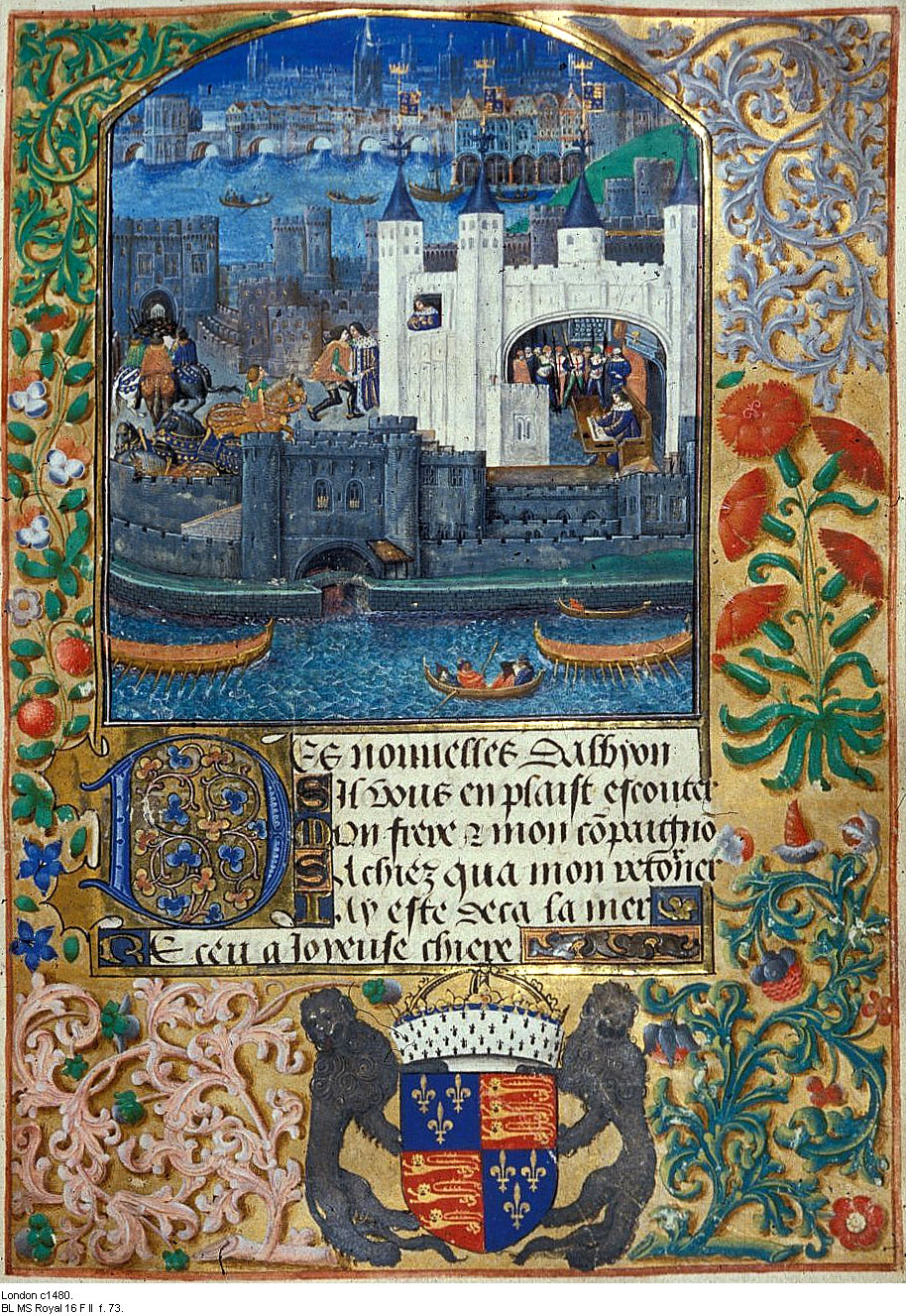
London c1480, MS Royal 16
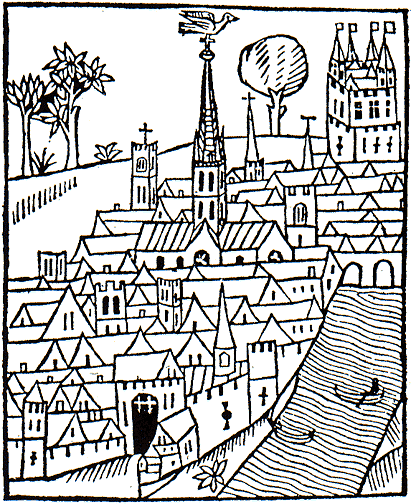
London, 1510, the earliest view in print
Map of England from Saxton's Descriptio Angliae, 1579
London in late 16th century
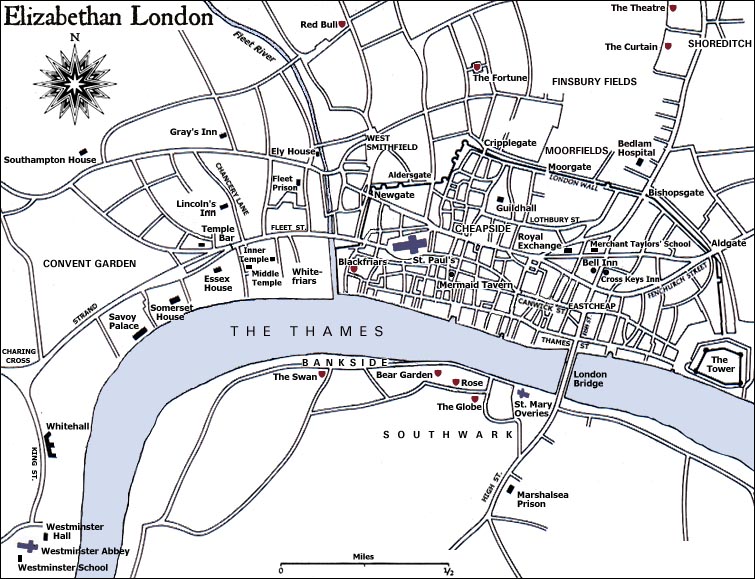
Location Map of Elizabethan London
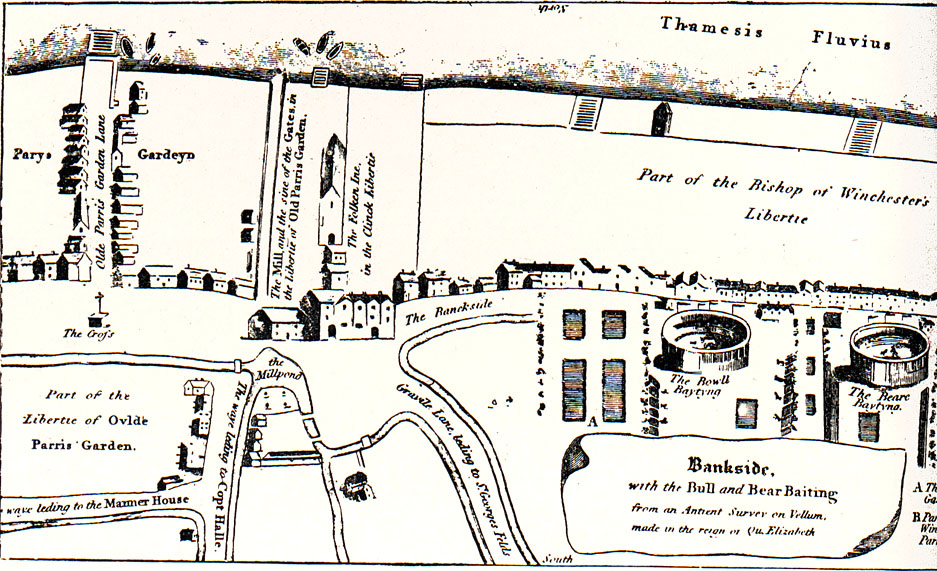
Plan of the Bankside, Southwark, in Shakespeare's time
Detail of Norden's Map of the Bankside, 1593
Bull and Bear Baiting Rings from the Agas Map (1569-1590, pub. 1631)
Sketch of the Swan Theatre, c. 1596
Westminster in the Seventeenth Century, by Hollar
Visscher's View of London, 1616
Larger Visscher's View in Sections
c. 1690. View of London Churches, after the Great Fire
The Yard of the Tabard Inn from Thornbury, Old and New London
|
|