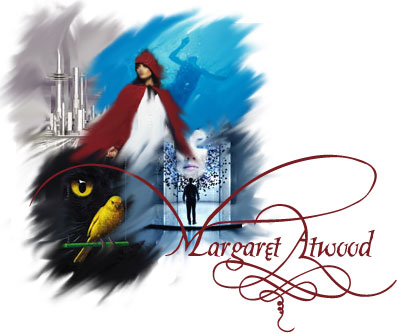
"The true story is vicious
and multiple and untrue
after all. Why do you
need it? Don't ever
ask for the true story."
—True Stories (1981)
Margaret Atwood Biography
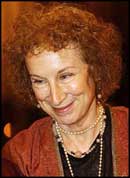
Margaret Atwood was born in Ottawa, Ontario, Canada on Nov. 18, 1939. Her father, Carl Atwood, was a forest entomologist, whose work, studying insects, kept the family in the forests of Ontario for much of her childhood. In her seventh year, her family moved to Toronto. She attended the University of Toronto, majoring in English, with minors in Philosophy and French. She received her BA with honors in 1961, after which she went on to get her master's degree from Radcliffe College in Massachussets, in 1962. She did two two-year periods of study at Harvard for her Ph.D., but writing was paramount, and she never finished.
Margaret Atwood self-published her first collection of poems, Double Persephone, in 1961. The Circle Game was published by Cranbrook Academy of Art in 1964 and won the governor general's award for poetry. Since then, over 15 collections of her poetry have been published, many running several editions, and individual poems have appeared in magazines and journals too numerous to mention.
In 1967, Atwood married Jim Polk, a fellow writer, but the couple drifted apart after a few years and separated. Atwood's first novel, The Edible Woman, was published in 1969. The story about a woman who cannot eat and feels as if she herself is being eaten, was well ahead of its time. Around the time of her second novel, Surfacing (1972), Atwood married Graeme Gibson and moved to the small community of Alliston, Ontario with Gibson and his two young sons. In 1976, the couple welcomed their daughter, Jess Atwood Gibson. The couple remain happily married to this day.
Her next books, Lady Oracle (1977), Life Before Man (1979), and the profoundly disquieting Bodily Harm (1981) gained her further critical acclaim. In 1982, her first collection of short stories, Dancing Girls and Other Stories was published. Her best-known work the world over, The Handmaid's Tale (1986), got Atwood short-listed for the Booker Prize. A novel about a futuristic dystopia, where women are dehumanized into mindless wombs, it also garnered millions of new readers worldwide, and a fervently loyal readership. The wonderful book was later turned by Hollywood into a lump of a movie.
The Handmaid's Tale was followed by Cat's Eye (1989), about bullying among schoolgirls; it, too was shortlisted for the Booker Prize. Next came The Robber Bride (1993), about the mysterious meanness of women toward women, and Alias Grace (1996), the story of a woman convicted of murder, who claims to have amnesia; and again Atwood was shortlisted for the Booker Prize. The elusive prize was won by The Blind Assassin, in 2000. Her most recent works of fiction are Oryx and Crake (2003),
The Penelopiad (2005), The Tent (2006), and Moral Disorder (2006).
Atwood is also a beloved children's book author. Her first children's book was Up In The Tree (1978), which she herself illustrated in charming, naive two-color pictures. It was followed by Anna's Pet (1980) and For The Birds (1990), and the delightfully illustrated Princess Prunella and the Purple Peanut (1995). Her latest children's books are Rude Ramsay and the Roaring Radishes (2003) and Bashful Bob and Doleful Dorinda (2004).
With all these works to her credit, Atwood also excels in the field of non-fiction. These writings include literary criticism, studies, autobiographical essays, book reviews, political essays, eulogies, ecological writings, and other journalism and essays. Written with her energetic style, keen intellect and dry wit, these collections of her non-fiction further affirm Margaret Atwood as one of the most noteworthy writers of our time. —A. Jokinen