|
|
|
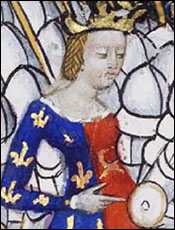
PHILIPPA OF HAINAULT (1314?-1369), queen of Edward III, daughter of William, called the Good,
Count of Holland and Hainault (d. 1337), and his countess Jeanne (d. 1342), daughter of Charles of Valois (d. 1325), son of
Philip III of France, was born in or about 1314. When Isabella (1292-1358), queen of
Edward II, was in Hainault with her son Edward in 1326, she arranged a
marriage between him and Philippa. While at the count's court at Valenciennes Edward was more with Philippa than with her
sisters, and when he took leave of her she burst into tears before the court, and innocently declared before the assembled
company that she was weeping because she had to part with him.1
The next year, when Edward had become king, he sent ambassadors to Count William requesting him to send him his daughter.
The count agreed, provided that the pope allowed the marriage; for a dispensation was necessary, as the young king and
Philippa were cousins, both being great-grandchildren of Philip III of France. At Edward's request the dispensation was
granted by John XXII,2 and Philippa was provided by her father with all such apparel as became her future
dignity3 In October the king sent Roger de Northburgh, bishop of Lichfield, to Valenciennes to marry Philippa
to him by proxy and declare her dower,4 and on 20 Nov. Bartholomew, lord Burghersh
(d. 1355), and William de Clinton were commissioned to escort her to England.5
She embarked at Wissant with a gallant suite, and landed at Dover on 23 Dec. There she was met by her uncle, Sir John of
Hainault, the king being engaged in the north in negotiations with Scotland. After stopping at Canterbury to offer at the
shrine of St. Thomas the archbishop, she proceeded to London, where she was received with rejoicing, and was presented
with gifts of the value of three hundred marks. Leaving London on the 27th, she spent 1 Jan. 1328 at the abbey of Peterborough,
and went on to York, where she was married to the king on the 30th.6 Her Flemish attendants then for the most
part returned home, though a young esquire, Walter Manny, remained with her to wait upon
her.7 On 15 May the king pledged himself to assign her the dower in lands and rents promised on his behalf by
the bishop of Lichfield.8
At the time of her marriage Philippa was in her fourteenth year.9 Her marriage was of political importance.
Queen Isabella had already used Philippa's marriage portion in hiring troops that helped
her to depose her husband and set her son on the throne; Isabella landed in England with a large body of Hainaulters under
Philippa's uncle, Sir John of Hainault. In the war with Scotland in 1327 Sir John and his Hainaulters took a prominent part.
It was, however, when Edward was entering on his long war with France that his marriage was
specially important to him, for it gave him a claim on the alliance of his queen's father and brother, her brothers-in-law
the Emperor Lewis of Bavaria and William, marquis of Juliers, and other princes and lords, and her abiding affection for her
own people helped forward his plans. With Philippa's marriage with Edward must probably be connected his efforts to persuade
Flemish weavers to settle in England and pursue and teach their trade there.10 Many of these alien workmen appear
to have settled in Norwich, and it is probable that the queen took a personal interest in their welfare, for she visited the
city several times, in 1340, 1342, and 134411
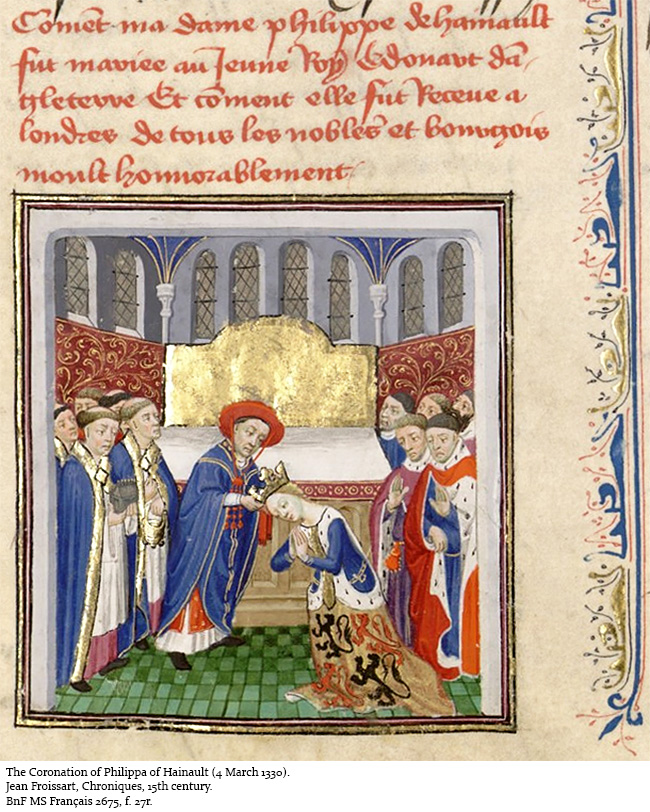
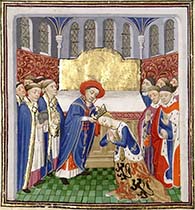 On Edward's return from France in June 1329 he hastened to rejoin his wife at Windsor. She was crowned at Westminster on
4 March 1330, and on 15 June, at Woodstock, bore her first child, Edward, called the Black Prince.
Her nurse was Katherine, daughter of Sir Adam Banaster of Shevington, Lancashire, and wife of Sir John Haryngton of Farleton
in that county.12 In September 1331 she had a narrow escape at a tournament in Cheapside, for the stand from which
she and her ladies were watching the proceedings broke down, and they were all thrown to the ground. Neither she nor her
attendants were injured, though many others were badly hurt. The carpenters would have suffered for their negligence had she
not interceded for them on her knees with the king and his friends. Her pitifulness on this occasion excited general love
for her.13
On Edward's return from France in June 1329 he hastened to rejoin his wife at Windsor. She was crowned at Westminster on
4 March 1330, and on 15 June, at Woodstock, bore her first child, Edward, called the Black Prince.
Her nurse was Katherine, daughter of Sir Adam Banaster of Shevington, Lancashire, and wife of Sir John Haryngton of Farleton
in that county.12 In September 1331 she had a narrow escape at a tournament in Cheapside, for the stand from which
she and her ladies were watching the proceedings broke down, and they were all thrown to the ground. Neither she nor her
attendants were injured, though many others were badly hurt. The carpenters would have suffered for their negligence had she
not interceded for them on her knees with the king and his friends. Her pitifulness on this occasion excited general love
for her.13
After spending Christmas 1333 with the king at Wallingford, she parted from him when the festival was over, and went to
Woodstock, where she bore a daughter, Isabella. While she was there, in February 1334, a letter
was addressed to her by the chancellor and masters of the university of Oxford, praying her to write to the pope on their
behalf against the attempt to set up a university at Stamford to which many of the Oxford students had seceded.14
She was at Bamborough apparently in the winter of 1335, when the king was at war with Scotland. The Scots, under the Earl
of Moray, made an attempt on the town, were met and defeated before they reached it, and the earl was brought to the queen
as a prisoner.15 She is said to have taken part in a chivalrous ceremony called the 'vow of the heron' in 1338,16
and, being about to cross over to Flanders with the king, received from him 564l. 3s. 4d. for horses,
dress, and jewels.17
She landed at Antwerp with Edward in July, accompanied him on his journey to Coblentz as far as Herenthals, and returned
to Antwerp, where, on 29 Nov., she bore her son Lionel (afterwards Duke of Clarence).
In 1339 the king's need of money forced him to pledge her crown, which was not redeemed until 1342 (ib.). She stayed
at Antwerp, Louvain, Brussels, and Ghent, where she was left at St. Peter's Abbey by the king in February 1340, when he
proceeded to Antwerp and thence to England. During his absence in March she bore her son John of Gaunt,
and was constantly visited by Jacob van Artevelde and the ladies of the city.
Having been rejoined by the king, she
accompanied him to England in November. In 1342 she received a visit from her brother William, count of Hainault, and a
tournament was held in his honour at Eltham, at which he was hurt in the arm. She was also present at a great tournament
held that year at Northampton, where many were seriously hurt.18 On 20 Nov. the king gave her the custody of
the earldom of Richmond granted to her son John of Gaunt, together with full powers as guardian of him and her other
younger children and of their lands.19
She was staying in the Tower of London when the king returned from
Brittany in March 1343, and, having been joined by him there, spent Easter with him at Havering atte Bower in Essex.
When Edward held his festival of the 'Round Table' at Windsor in January 1344, at which there was jousting for three days
and much magnificence, Philippa took part in the rejoicings, splendidly apparelled, and attended by a large number of
ladies.20 She made some vow of pilgrimages to places over sea, and in 1344 appointed a proxy to perform it
for her.21 On the death of her brother Count William in 1346, her inheritance in Zealand was claimed by the
king on her behalf.22
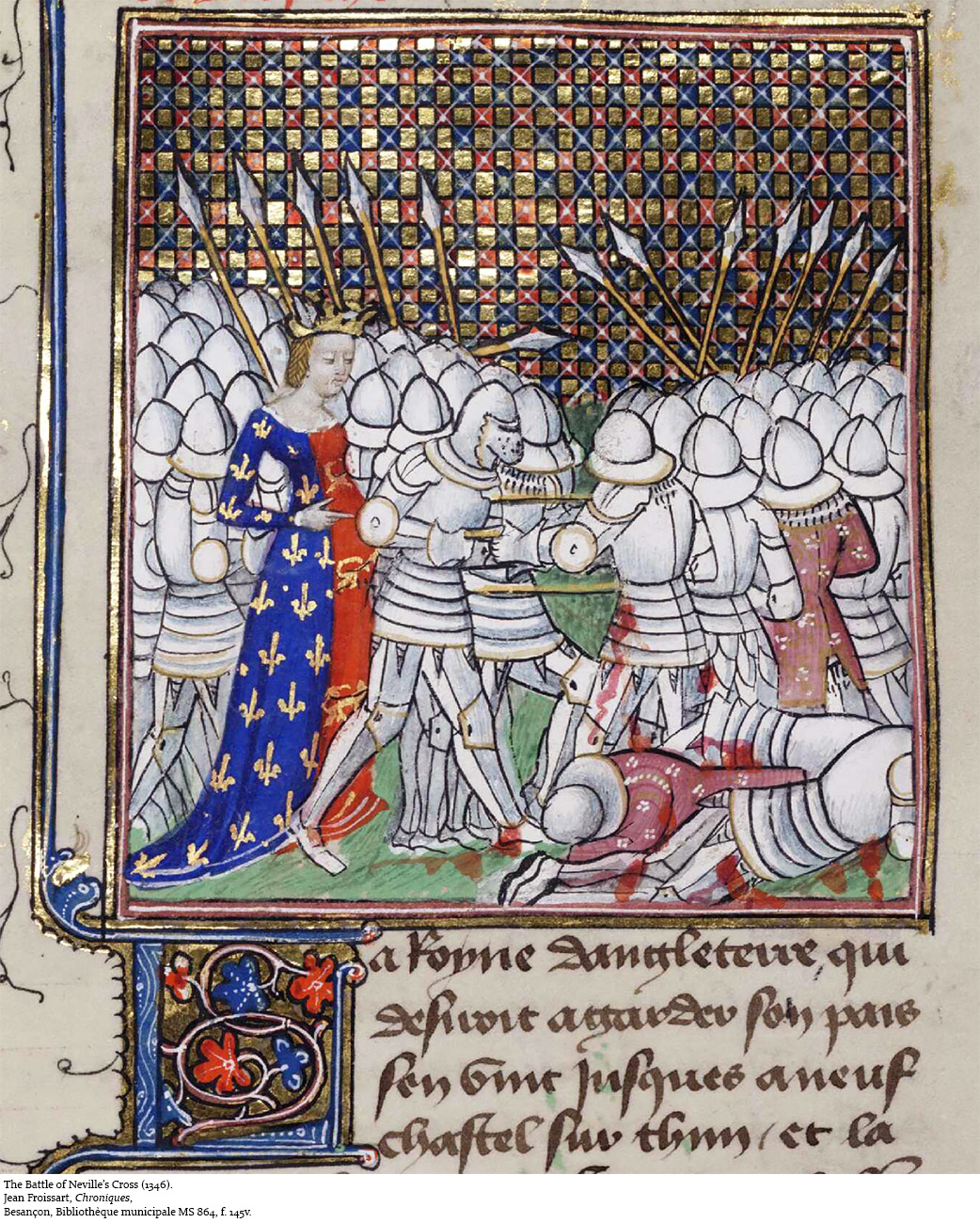
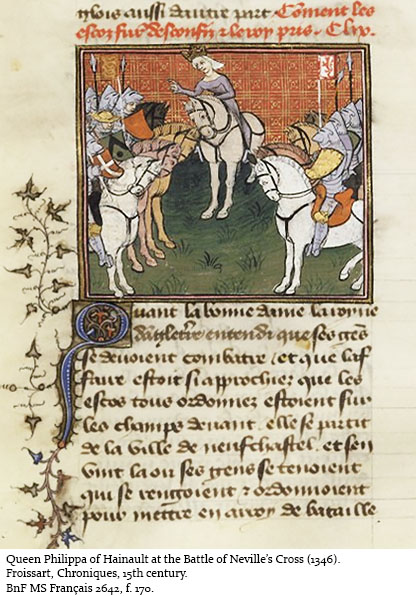
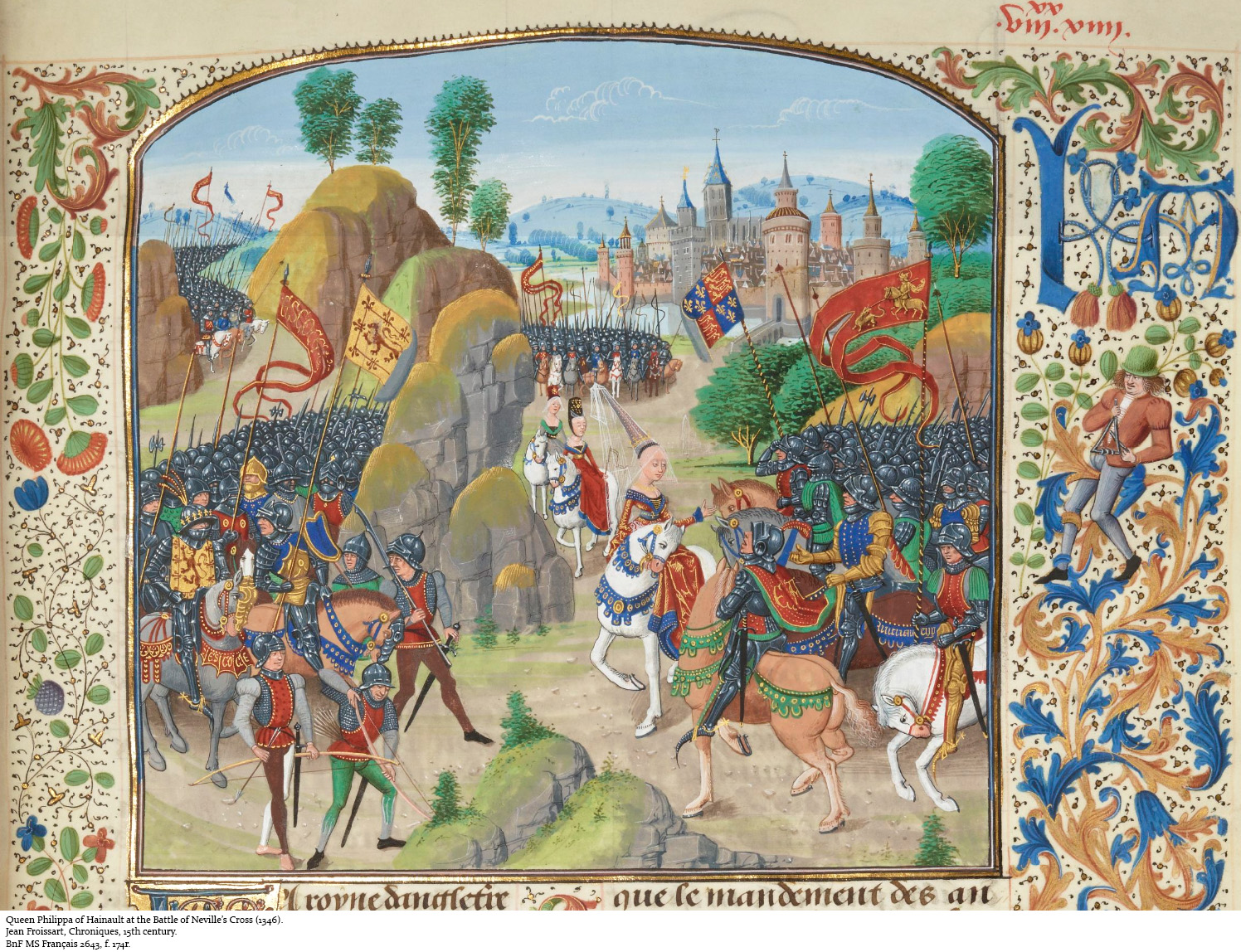
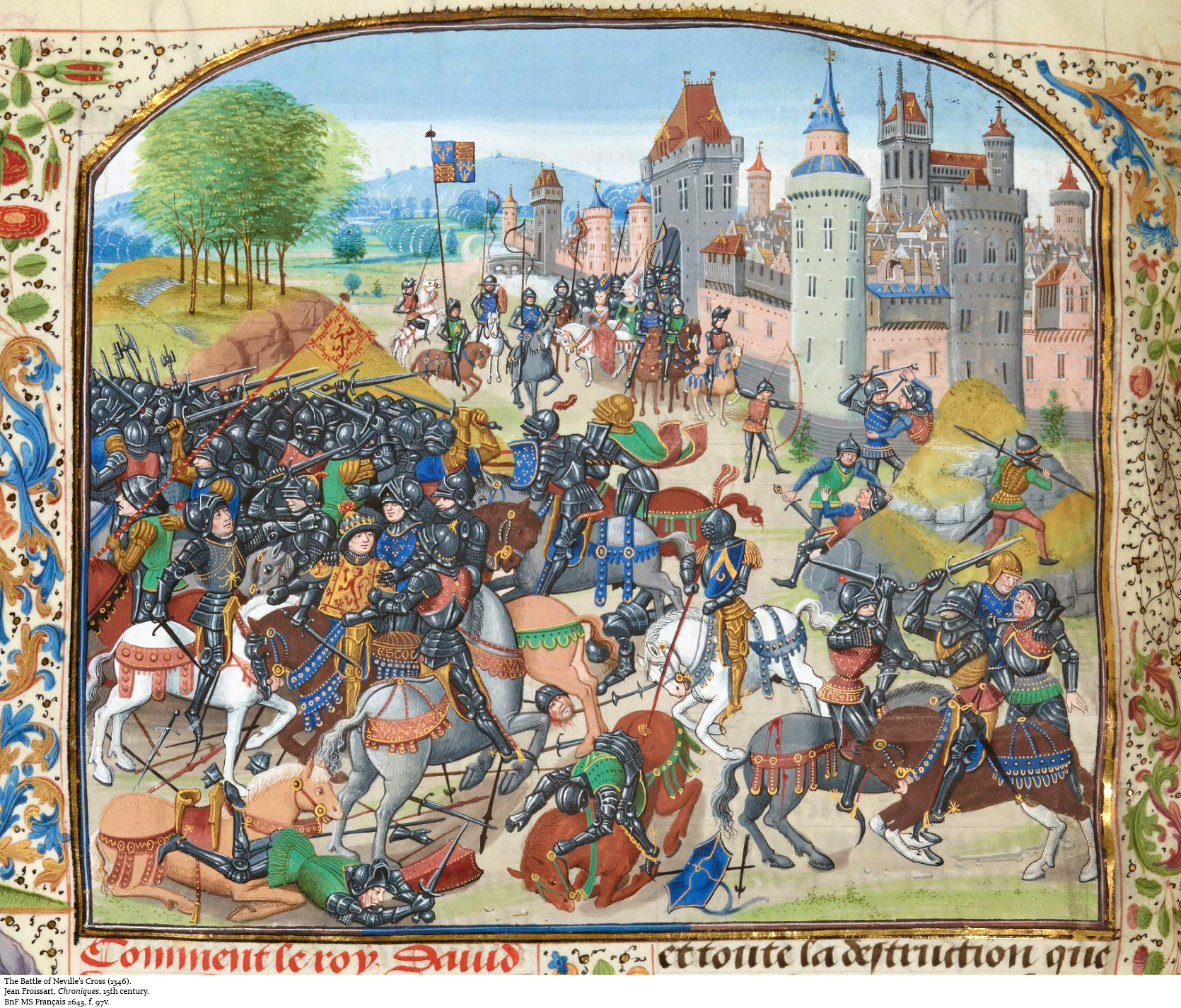
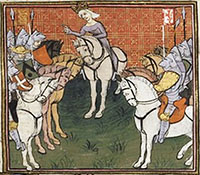 During Edward's absence on the campaign of Crécy, David, king of Scotland, was defeated
and taken prisoner at the battle of Neville's Cross, near Durham, on 17 Oct. 1346. Jehan
le Bel and Froissart relate that the English forces were summoned by Philippa, though her son Lionel was the nominal
guardian of the kingdom; that she met and harangued them at Newcastle before the battle; and Froissart says that after
the battle she rode from Newcastle to the field, and remained there that day with her army.23 The victory was
won by William de la Zouche, archbishop of York, and the lords and forces of the north.24
During Edward's absence on the campaign of Crécy, David, king of Scotland, was defeated
and taken prisoner at the battle of Neville's Cross, near Durham, on 17 Oct. 1346. Jehan
le Bel and Froissart relate that the English forces were summoned by Philippa, though her son Lionel was the nominal
guardian of the kingdom; that she met and harangued them at Newcastle before the battle; and Froissart says that after
the battle she rode from Newcastle to the field, and remained there that day with her army.23 The victory was
won by William de la Zouche, archbishop of York, and the lords and forces of the north.24
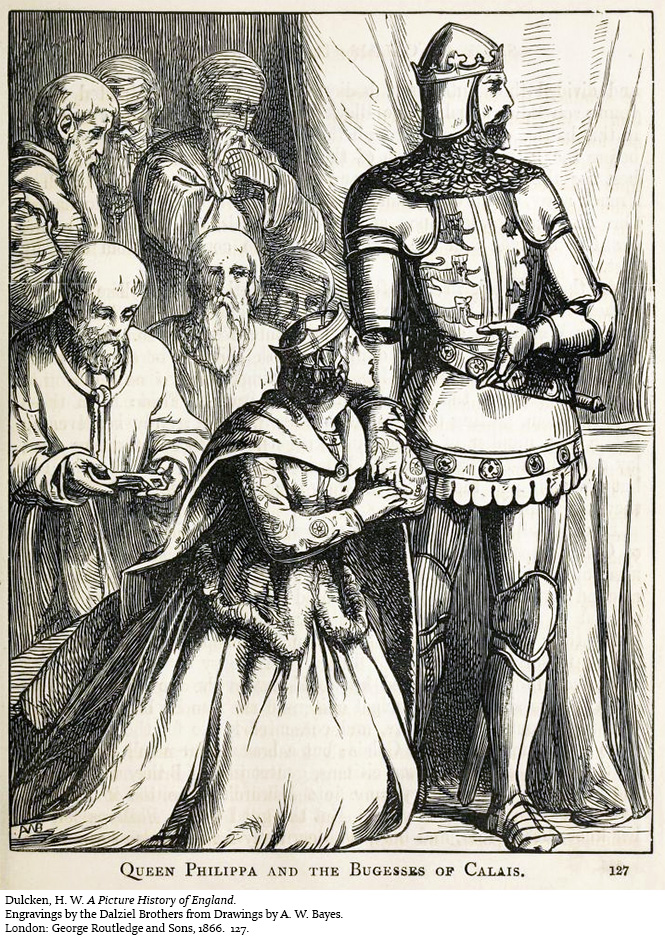
Before Christmas Philippa joined the king at the siege of Calais. When the town surrendered
on 5 Aug. 1347, and six of the principal burgesses appeared before Edward in their shirts and with halters round their necks,
putting themselves at his mercy, she joined with the lords there present in beseeching the king to pardon them, and, being
then great with child, knelt before him, weeping and praying him that since she had crossed the sea in much peril he would
grant her request 'for the love of our Lady's Son.' For her sake the king spared the lives of the burgesses, and granted
them to her, and she provided them with raiment, food, and a gift of money. Having returned to England with the king in
October, she soon after, at Windsor, bore a son, who died in infancy.
The offer of the imperial crown to her husband in 1348 caused her much anxiety and sorrow, but Edward declined it.25
She appears to have made a progress in the west in 1349, and while at Ford Abbey, Dorset, made an offering at the tomb of
Hugh Courtenay, earl of Devon. In August 1350 she went with the king to Winchelsea, Sussex, where the fleet was gathered
to intercept the Spaniards, and she remained in a religious house there, or in the immediate neighbourhood, while the king
and her two sons, the Prince of Wales and John of Gaunt, sailed forth on the 28th to engage the enemy, with whom they fell
in on the next day. She passed the day of the battle of 'Lespagnols sur mer' in great anxiety, doubting of the issue; for
her attendants, who could see the battle from the hills, told her of the number and size of the enemy's ships. In the
evening, after the victory was won, the king and her sons joined her, and the night was spent in revelry.26
Her presence at the festival of the Garter on St. George's day, 23 April, 1351, is expressly noted; and in March 1355 she
was at a grand tournament held by the king at Woodstock to celebrate her recovery after the birth of her son Thomas at
that place. A special grant was made by the king for her apparel at the St. George's festival of 1358, which was of
extraordinary splendour. During the summer of that year she and the king stayed at Marlborough and at Cosham, and while
she was hunting there she met with an accident in riding, and dislocated her shoulder-joint.27 She did not
accompany the king to France in 1359.
In 1361 Froissart came over to England and presented her with a book that he had written on the war with France, and
specially the battle of Poitiers, the germ of his future chronicles. Philippa, who loved
the people of her own land, received him and his gift with kindness, made him her clerk or secretary, and encouraged
him to pursue his historical work. He was lodged in the palace, entertained her with noble tales and discourses on
love, and received from her the means of travelling about the country to collect materials for his work, being once
sent by her to Scotland with letters setting forth that he was one of her secretaries, and there and everywhere he
found that for love of his sovereign mistress, that 'noble and valiant lady,' great lords and knights welcomed him
and gave him aid. For five years he remained in England in her service, and when he left in 1366 travelled as a
member of her household.28
Her presence at the magnificent tournaments held in Smithfield in May 1362 is expressly noted. After Christmas she went
with the king from Windsor to Berkhampstead in Hertfordshire, on a visit to the Prince of Wales,
who resided there, to take leave of him before he went to his government in Aquitaine. She bore her share in the
festivities of that year and the early months of 1364, when the kings of France, Scotland, and Cyprus were all in
London at the same time, entertained King John of France at Eltham, and gave many rich feasts to King Peter de
Lusignan of Cyprus, and made him presents when he left. The illness and death of King John caused her much grief.
Her nephew William, count of Holland, second son of the Emperor Lewis of Bavaria, had been insane since 1357,
and his dominions were governed for him by his brother Albert of Bavaria as regent. Albert desired to be recognised
as sovereign, but the claims that Edward acquired by his marriage with Philippa were unsettled, and hindered the
accomplishment of his wish. To remove this obstacle, he obtained from the estates of Holland, assembled at
Gertruydenberg on 25 April 1364, a decision that the English queen could not inherit any part of the dominions
of her brother Count William, his sovereignty being indivisible. Albert visited the English court in 1365, but was
unable to obtain the king's assent to his wishes respecting Philippa's rights.29 In 1369 she joined the
king in his vain endeavours to procure Albert as an ally against France, and it was probably in connection with this
attempt that she sent certain jewels over to Maud, countess of Holland, a daughter of
Henry of Lancaster, first duke of Lancaster.30

In the course of that year she was dangerously ill at Windsor Castle, and, knowing that she was dying, took leave
of the king, requesting that he would fulfil all her engagements to merchants and pay her debts; that he would pay
all that she had left or promised to churches in England or the continent, wherein she had made her prayers; and
would provide for all her servants, and that he would be buried by her side at Westminster, which things the King
promised. She was attended on her deathbed by William of Wykeham, bishop of Winchester. She died on 16 Aug., and
was buried with great pomp on the south side of the chapel of the kings, where her tomb, built by her husband,
stands, with her recumbent effigy, evidently a likeness, surrounded by the effigies of thirty persons of princely
rank who were connected with her by birth.31
A bust by an unknown sculptor, taken from this effigy, is in the National Portrait Gallery, London. There are also
heads, believed to be hers, in some of the Bristol churches, specially in the crypt of St. Nicholas; for, like other
queens, she had the town and castle of Bristol as part of her dower.32 A painting of her is said to have
been found in the cloisters of St. Stephen's, Westminster, and there is a wooden effigy of her in the library of
Queen's College, Oxford.
In person Philippa was tall and handsome. She was prudent, kindly, humble, and devout; very liberal and pitiful,
graceful in manner, adorned, Froissart says, 'with every noble virtue, and beloved of God and all men.' While she
was strongly attached to the people of her fatherland, she greatly loved the English, and was extremely popular
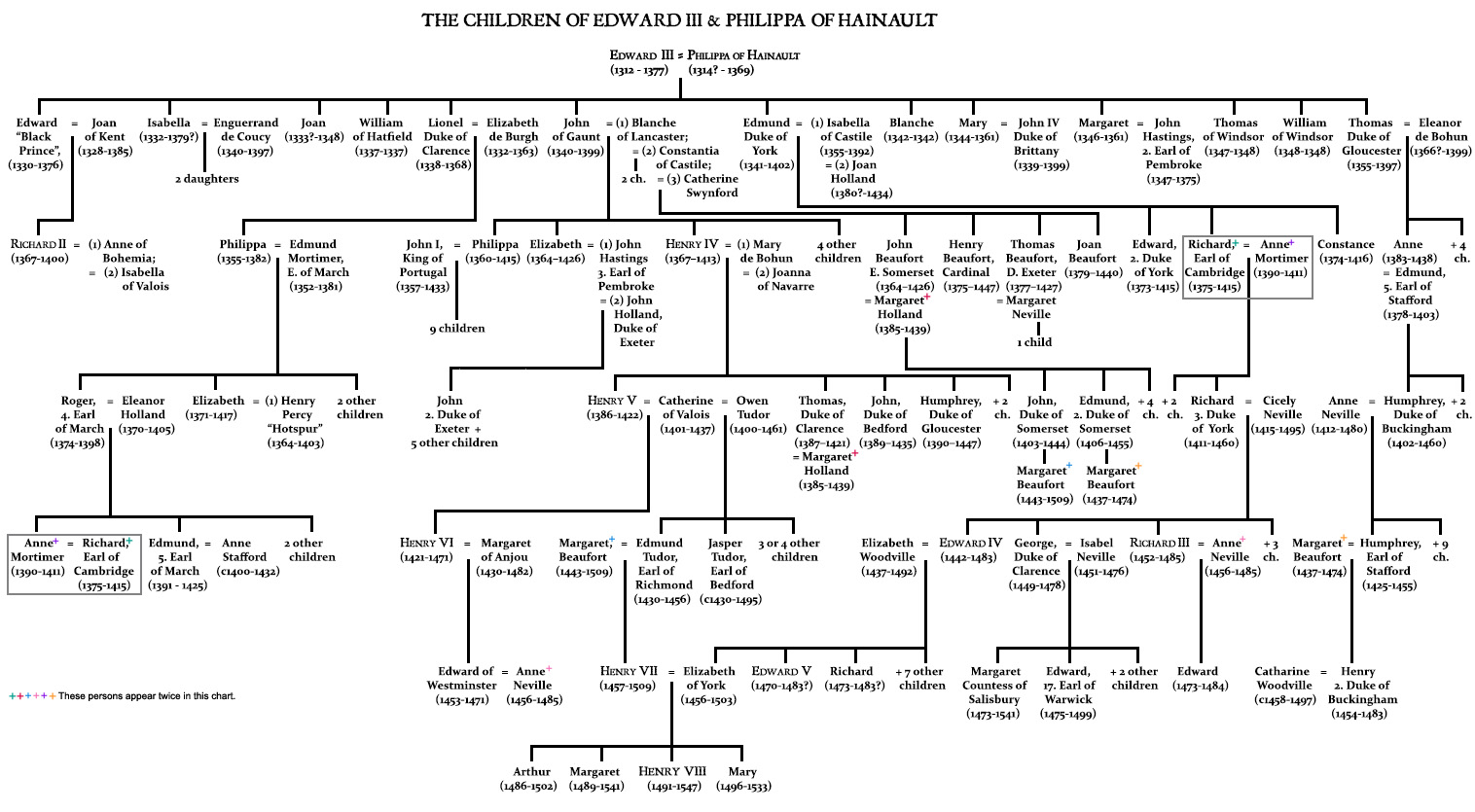
with them. Her death was a terrible misfortune to her husband. She bore him seven sons and five daughters.
Two mottoes that she used were 'Myn Biddenye' and 'Iche wrude muche,' and they were worked on two richly embroidered
corsets that were given to her by the king.33 She greatly enlarged the hospital of St. Katherine, near
the Tower, and was a benefactress to the canons of St. Stephen's, Westminster, and to Queen's College, Oxford,
founded and called after her by her chaplain, Robert of Eglesfield. Queenborough, in the Isle of Sheppey, Kent,
where part of her dower lay, was founded and called after her by Edward III, who, in honour of her, made the place
a free borough in 1366.34
1. Froissart, Chroniques, i. 235, ed. Luce.
2. Rymer's Foedera, iv. 306, 307.
3. Jehan Le Bel, Les vrayes chroniques, &c., i. 76.
4. Foedera, iv. 313-4.
5. ib. 323.
6. Annales Paulini, ap. Chronicles Edward II, i. 339.
7. Jehan Le Bel, u.s.
8. Foedera iv. 353.
9. Froissart, i. 285.
10. Cunningham, English Industry and Commerce, i. 9,
282.
11. Blomefield, History of Norfolk, i. 83-8.
12. Beltz, Memorials of the Order of the Garter, p. 244.
13. Geoffrey Le Baker, Chronicon, p. 48;
Annales Paulini, p. 365;
Murimuth, p. 63.
14. Fletcher, ed., Collectanea, i. 8,
Oxford Historical Society.
15. Knighton, in Twisden's Decem Scriptores, col. 2567.
16. Wright, ed. Political Poems, i. 23.
17. Foedera, v. 19.
18. Murimuth, p. 124;
Nicolas, History of the Orders of Knighthood, i. Introd. p. lxxx.
19. Foedera, v. 348-9.
20. Murimuth, p. 156; Froissart, iii. 41, 268.
21. Foedera, v. 418.
22. ib. pp. 509,
510,
515.
23. Jehan Le Bel, ii. 109-10;
Froissart, iv. 18-29.
24. Murimuth, p. 218;
Avesbury, De Gestis Edwardi Tertii, p. 376;
Foedera, v. 528.
25. Knighton, col. 2597.
26. Froissart, iv. 4, 97, 827.
27. Eulogium Historiarum, iii. 227.
28. Darmesteter, Froissart, pp. 13-28.
29. L'Art de verifier les Dates, xiv. 448;
Foedera, iii. 779,
789.
30. ib. p. 868.
31. Stanley, Memorials of Westminster, p. 122.
32. Taylor, Bristol, Past and Present, i. 59,
ii. 167.
33. Nicolas, Orders of Knighthood, ii. 486.
34. Hasted, History of Kent, 1886 ed., ii. 620, 666.
Excerpted from:
Hunt, Rev. William. "Philippa of Hainault."
Dictionary of National Biography. Vol. XV. Sidney Lee, Ed.
New York: The Macmillan Co., 1909. 1050-3.
Other Local Resources:
Books for further study:
Mortimer, Ian. The Perfect King: The Life of Edward III.
Pimlico, 2007.
Ormrod, W. Mark. Edward III.
Yale University Press, 2013.
St. John, Lisa Benz. Three Medieval Queens: Queenship and the Crown
in Fourteenth-Century England.
Palgrave Macmillan, 2012.
Waugh, Scott L. England in the Reign of Edward III.
Cambridge University Press, 2007.
Queen Philippa on the Web:
 | to Hundred Years' War
|
|
| to Luminarium Encyclopedia |
Site ©1996-2023 Anniina Jokinen. All rights reserved.
This page was created on January 8, 2018. Last updated March 23, 2023.
|
Index of Encyclopedia Entries:
Medieval Cosmology
Prices of Items in Medieval England
Edward II
Isabella of France, Queen of England
Piers Gaveston
Thomas of Brotherton, E. of Norfolk
Edmund of Woodstock, E. of Kent
Thomas, Earl of Lancaster
Henry of Lancaster, Earl of Lancaster
Henry of Grosmont, Duke of Lancaster
Roger Mortimer, Earl of March
Hugh le Despenser the Younger
Bartholomew, Lord Burghersh, elder
Hundred Years' War (1337-1453)
Edward III
Philippa of Hainault, Queen of England
Edward, Black Prince of Wales
John of Eltham, Earl of Cornwall
The Battle of Crécy, 1346
The Siege of Calais, 1346-7
The Battle of Poitiers, 1356
Lionel of Antwerp, Duke of Clarence
John of Gaunt, Duke of Lancaster
Edmund of Langley, Duke of York
Thomas of Woodstock, Gloucester
Richard of York, E. of Cambridge
Richard Fitzalan, 3. Earl of Arundel
Roger Mortimer, 2nd Earl of March
The Good Parliament, 1376
Richard II
The Peasants' Revolt, 1381
Lords Appellant, 1388
Richard Fitzalan, 4. Earl of Arundel
Archbishop Thomas Arundel
Thomas de Beauchamp, E. Warwick
Robert de Vere, Earl of Oxford
Ralph Neville, E. of Westmorland
Thomas Mowbray, Duke of Norfolk
Edmund Mortimer, 3. Earl of March
Roger Mortimer, 4. Earl of March
John Holland, Duke of Exeter
Michael de la Pole, E. Suffolk
Hugh de Stafford, 2. E. Stafford
Henry IV
Edward, Duke of York
Edmund Mortimer, 5. Earl of March
Henry Percy, Earl of Northumberland
Sir Henry Percy, "Harry Hotspur"
Thomas Percy, Earl of Worcester
Owen Glendower
The Battle of Shrewsbury, 1403
Archbishop Richard Scrope
Thomas Mowbray, 3. E. Nottingham
John Mowbray, 2. Duke of Norfolk
Thomas Fitzalan, 5. Earl of Arundel
Henry V
Thomas, Duke of Clarence
John, Duke of Bedford
Humphrey, Duke of Gloucester
John Talbot, Earl of Shrewsbury
Richard, Earl of Cambridge
Henry, Baron Scrope of Masham
William de la Pole, Duke of Suffolk
Thomas Montacute, E. Salisbury
Richard Beauchamp, E. of Warwick
Henry Beauchamp, Duke of Warwick
Thomas Beaufort, Duke of Exeter
Cardinal Henry Beaufort
John Beaufort, Earl of Somerset
Sir John Fastolf
John Holland, 2. Duke of Exeter
Archbishop John Stafford
Archbishop John Kemp
Catherine of Valois
Owen Tudor
John Fitzalan, 7. Earl of Arundel
John, Lord Tiptoft
Charles VII, King of France
Joan of Arc
Louis XI, King of France
Charles the Bold, Duke of Burgundy
The Battle of Agincourt, 1415
The Battle of Castillon, 1453
The Wars of the Roses 1455-1485
Causes of the Wars of the Roses
The House of Lancaster
The House of York
The House of Beaufort
The House of Neville
The First Battle of St. Albans, 1455
The Battle of Blore Heath, 1459
The Rout of Ludford, 1459
The Battle of Northampton, 1460
The Battle of Wakefield, 1460
The Battle of Mortimer's Cross, 1461
The 2nd Battle of St. Albans, 1461
The Battle of Towton, 1461
The Battle of Hedgeley Moor, 1464
The Battle of Hexham, 1464
The Battle of Edgecote, 1469
The Battle of Losecoat Field, 1470
The Battle of Barnet, 1471
The Battle of Tewkesbury, 1471
The Treaty of Pecquigny, 1475
The Battle of Bosworth Field, 1485
The Battle of Stoke Field, 1487
Henry VI
Margaret of Anjou
Richard Plantagenet, Duke of York
Edward IV
Elizabeth Woodville
Richard Woodville, 1. Earl Rivers
Anthony Woodville, 2. Earl Rivers
Jane Shore
Edward V
Richard III
George, Duke of Clarence
Ralph Neville, 2. Earl of Westmorland
Richard Neville, Earl of Salisbury
Richard Neville, Earl of Warwick
Edward Neville, Baron Bergavenny
William Neville, Lord Fauconberg
Robert Neville, Bishop of Salisbury
John Neville, Marquis of Montagu
George Neville, Archbishop of York
John Beaufort, 1. Duke Somerset
Edmund Beaufort, 2. Duke Somerset
Henry Beaufort, 3. Duke of Somerset
Edmund Beaufort, 4. Duke Somerset
Margaret Beaufort
Edmund Tudor, Earl of Richmond
Jasper Tudor, Earl of Pembroke
Humphrey Stafford, D. Buckingham
Henry Stafford, Duke of Buckingham
Humphrey Stafford, E. of Devon
Thomas, Lord Stanley, Earl of Derby
Sir William Stanley
Archbishop Thomas Bourchier
Henry Bourchier, Earl of Essex
John Mowbray, 3. Duke of Norfolk
John Mowbray, 4. Duke of Norfolk
John Howard, Duke of Norfolk
Henry Percy, 2. E. Northumberland
Henry Percy, 3. E. Northumberland
Henry Percy, 4. E. Northumberland
William, Lord Hastings
Henry Holland, Duke of Exeter
William Fitzalan, Earl of Arundel
William Herbert, 1. Earl of Pembroke
John de Vere, 12th Earl of Oxford
John de Vere, 13th Earl of Oxford
Thomas de Clifford, 8. Baron Clifford
John de Clifford, 9. Baron Clifford
John Tiptoft, Earl of Worcester
Thomas Grey, 1. Marquis Dorset
Sir Andrew Trollop
Archbishop John Morton
Edward Plantagenet, E. of Warwick
John Talbot, 2. E. Shrewsbury
John Talbot, 3. E. Shrewsbury
John de la Pole, 2. Duke of Suffolk
John de la Pole, E. of Lincoln
Edmund de la Pole, E. of Suffolk
Richard de la Pole
John Sutton, Baron Dudley
James Butler, 5. Earl of Ormonde
Sir James Tyrell
Edmund Grey, first Earl of Kent
George Grey, 2nd Earl of Kent
John, 5th Baron Scrope of Bolton
James Touchet, 7th Baron Audley
Walter Blount, Lord Mountjoy
Robert Hungerford, Lord Moleyns
Thomas, Lord Scales
John, Lord Lovel and Holand
Francis Lovell, Viscount Lovell
Sir Richard Ratcliffe
William Catesby
Ralph, 4th Lord Cromwell
Jack Cade's Rebellion, 1450
Tudor Period
King Henry VII
Queen Elizabeth of York
Arthur, Prince of Wales
Lambert Simnel
Perkin Warbeck
The Battle of Blackheath, 1497
King Ferdinand II of Aragon
Queen Isabella of Castile
Maximilian I, Holy Roman Emperor
King Henry VIII
Queen Catherine of Aragon
Queen Anne Boleyn
Queen Jane Seymour
Queen Anne of Cleves
Queen Catherine Howard
Queen Katherine Parr
King Edward VI
Queen Mary I
Queen Elizabeth I
Henry Fitzroy, Duke of Richmond
Margaret Tudor, Queen of Scotland
James IV, King of Scotland
The Battle of Flodden Field, 1513
James V, King of Scotland
Mary of Guise, Queen of Scotland
Mary Tudor, Queen of France
Louis XII, King of France
Francis I, King of France
The Battle of the Spurs, 1513
Field of the Cloth of Gold, 1520
Charles V, Holy Roman Emperor
Eustace Chapuys, Imperial Ambassador
The Siege of Boulogne, 1544
Cardinal Thomas Wolsey
Archbishop Thomas Cranmer
Thomas Cromwell, Earl of Essex
Thomas, Lord Audley
Thomas Wriothesley, E. Southampton
Sir Richard Rich
Edward Stafford, D. of Buckingham
Thomas Howard, 2nd Duke of Norfolk
Thomas Howard, 3rd Duke of Norfolk
John Dudley, Duke of Northumberland
Charles Brandon, Duke of Suffolk
Thomas Boleyn, Earl of Wiltshire
George Boleyn, Viscount Rochford
John Russell, Earl of Bedford
Thomas Grey, 2. Marquis of Dorset
Henry Grey, D. of Suffolk
Charles Somerset, Earl of Worcester
George Talbot, 4. E. Shrewsbury
Francis Talbot, 5. E. Shrewsbury
Henry Algernon Percy,
5th Earl of Northumberland
Henry Algernon Percy,
6th Earl of Northumberland
Ralph Neville, 4. E. Westmorland
Henry Neville, 5. E. Westmorland
William Paulet, Marquis of Winchester
Sir Francis Bryan
Sir Nicholas Carew
John de Vere, 15th Earl of Oxford
John de Vere, 16th Earl of Oxford
Thomas Seymour, Lord Admiral
Edward Seymour, Protector Somerset
Margaret Pole, Countess of Salisbury
Henry Pole, Lord Montague
Sir Geoffrey Pole
Thomas Manners, Earl of Rutland
Henry Manners, Earl of Rutland
Henry Bourchier, 2. Earl of Essex
Robert Radcliffe, 1. Earl of Sussex
Henry Radcliffe, 2. Earl of Sussex
George Hastings, Earl of Huntingdon
Henry Courtenay, Marquis of Exeter
George Neville, Baron Bergavenny
Sir Edward Neville
William, Lord Paget
William Sandys, Baron Sandys
William Fitzwilliam, E. Southampton
Sir Anthony Browne
Sir Thomas Wriothesley
Sir William Kingston
George Brooke, Lord Cobham
Sir Richard Southwell
Thomas Fiennes, 9th Lord Dacre
Sir Francis Weston
Henry Norris
Lady Jane Grey
Sir Thomas Arundel
Sir Richard Sackville
Sir William Petre
Sir John Cheke
Walter Haddon, L.L.D
Sir Peter Carew
Sir John Mason
Nicholas Wotton
John Taylor
Sir Thomas Wyatt, the Younger
Cardinal Lorenzo Campeggio
Cardinal Reginald Pole
Stephen Gardiner, Bishop of Winchester
Edmund Bonner, Bishop of London
Nicholas Ridley, Bishop of London
John Hooper, Bishop of Gloucester
John Aylmer, Bishop of London
Thomas Linacre
William Grocyn
Archbishop William Warham
Cuthbert Tunstall, Bishop of Durham
Richard Fox, Bishop of Winchester
Edward Fox, Bishop of Hereford
Pope Julius II
Pope Leo X
Pope Clement VII
Pope Paul III
Pope Pius V
Pico della Mirandola
Desiderius Erasmus
Martin Bucer
Richard Pace
Christopher Saint-German
Thomas Tallis
Elizabeth Barton, the Nun of Kent
Hans Holbein, the Younger
The Sweating Sickness
Dissolution of the Monasteries
Pilgrimage of Grace, 1536
Robert Aske
Anne Askew
Lord Thomas Darcy
Sir Robert Constable
Oath of Supremacy
The Act of Supremacy, 1534
The First Act of Succession, 1534
The Third Act of Succession, 1544
The Ten Articles, 1536
The Six Articles, 1539
The Second Statute of Repeal, 1555
The Act of Supremacy, 1559
Articles Touching Preachers, 1583
Queen Elizabeth I
William Cecil, Lord Burghley
Robert Cecil, 1st Earl of Salisbury
Sir Francis Walsingham
Sir Nicholas Bacon
Sir Thomas Bromley
Robert Dudley, Earl of Leicester
Ambrose Dudley, Earl of Warwick
Henry Carey, Lord Hunsdon
Sir Thomas Egerton, Viscount Brackley
Sir Francis Knollys
Katherine "Kat" Ashley
Lettice Knollys, Countess of Leicester
George Talbot, 6. E. of Shrewsbury
Elizabeth, Countess of Shrewsbury
Gilbert Talbot, 7. E. of Shrewsbury
Sir Henry Sidney
Sir Robert Sidney
Archbishop Matthew Parker
Walter Devereux, 1st Earl of Essex
Robert Devereux, 2nd Earl of Essex
Penelope Devereux, Lady Rich
Sir Christopher Hatton
Edward Courtenay, E. Devonshire
Edward Manners, 3rd Earl of Rutland
Thomas Radcliffe, 3. Earl of Sussex
Henry Radcliffe, 4. Earl of Sussex
Robert Radcliffe, 5. Earl of Sussex
William Parr, Marquis of Northampton
Henry Wriothesley, 2. Southampton
Henry Wriothesley, 3. Southampton
Charles Neville, 6. E. Westmorland
Thomas Percy, 7. E. Northumberland
Henry Percy, 8. E. Northumberland
Henry Percy, 9. E. Nothumberland
William Herbert, 1. Earl of Pembroke
Charles, Lord Howard of Effingham
Thomas Howard, 4th Duke of Norfolk
Henry Howard, 1. Earl of Northampton
Thomas Howard, 1. Earl of Suffolk
Henry Hastings, 3. E. of Huntingdon
Edward Manners, 3rd Earl of Rutland
Roger Manners, 5th Earl of Rutland
Francis Manners, 6th Earl of Rutland
Henry FitzAlan, 12. Earl of Arundel
Thomas, Earl Arundell of Wardour
Edward Somerset, E. of Worcester
William Davison
Sir Walter Mildmay
Sir Ralph Sadler
Sir Amyas Paulet
Gilbert Gifford
Anthony Browne, Viscount Montague
François, Duke of Alençon & Anjou
Mary, Queen of Scots
Henry Stuart, Lord Darnley
James Hepburn, Earl of Bothwell
Anthony Babington and the Babington Plot
John Knox
Philip II of Spain
The Spanish Armada, 1588
Sir Francis Drake
Sir John Hawkins
William Camden
Archbishop Whitgift
Martin Marprelate Controversy
John Penry (Martin Marprelate)
Richard Bancroft, Archbishop of Canterbury
John Dee, Alchemist
Philip Henslowe
Edward Alleyn
The Blackfriars Theatre
The Fortune Theatre
The Rose Theatre
The Swan Theatre
Children's Companies
The Admiral's Men
The Lord Chamberlain's Men
Citizen Comedy
The Isle of Dogs, 1597
Common Law
Court of Common Pleas
Court of King's Bench
Court of Star Chamber
Council of the North
Fleet Prison
Assize
Attainder
First Fruits & Tenths
Livery and Maintenance
Oyer and terminer
Praemunire
The Stuarts
King James I of England
Anne of Denmark
Henry, Prince of Wales
The Gunpowder Plot, 1605
George Villiers, 1st Duke of Buckingham
Robert Carr, Earl of Somerset
Arabella Stuart, Lady Lennox
William Alabaster
Bishop Hall
Bishop Thomas Morton
Archbishop William Laud
John Selden
Lucy Harington, Countess of Bedford
Henry Lawes
King Charles I
Queen Henrietta Maria
Long Parliament
Rump Parliament
Kentish Petition, 1642
Thomas Wentworth, Earl of Strafford
John Digby, Earl of Bristol
George Digby, 2nd Earl of Bristol
Thomas Fairfax, 3rd Lord Fairfax
Robert Devereux, 3rd E. of Essex
Robert Sidney, 2. E. of Leicester
Algernon Percy, E. of Northumberland
Henry Montagu, Earl of Manchester
Edward Montagu, 2. Earl of Manchester
The Restoration
King Charles II
King James II
Test Acts
Greenwich Palace
Hatfield House
Richmond Palace
Windsor Palace
Woodstock Manor
The Cinque Ports
Mermaid Tavern
Malmsey Wine
Great Fire of London, 1666
Merchant Taylors' School
Westminster School
The Sanctuary at Westminster
"Sanctuary"
Images:
Chart of the English Succession from William I through Henry VII
Medieval English Drama
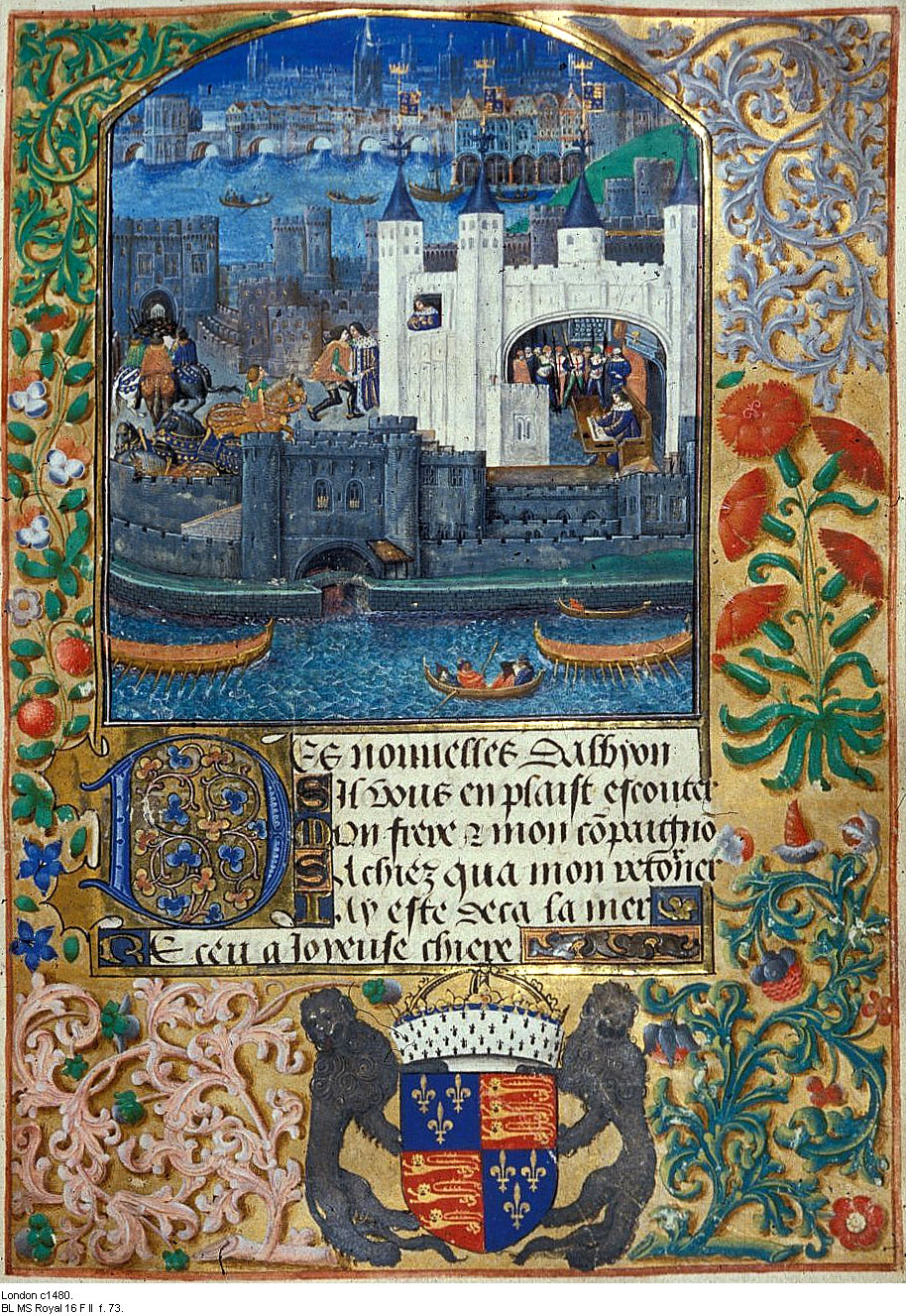
London c1480, MS Royal 16
London, 1510, the earliest view in print
Map of England from Saxton's Descriptio Angliae, 1579
London in late 16th century
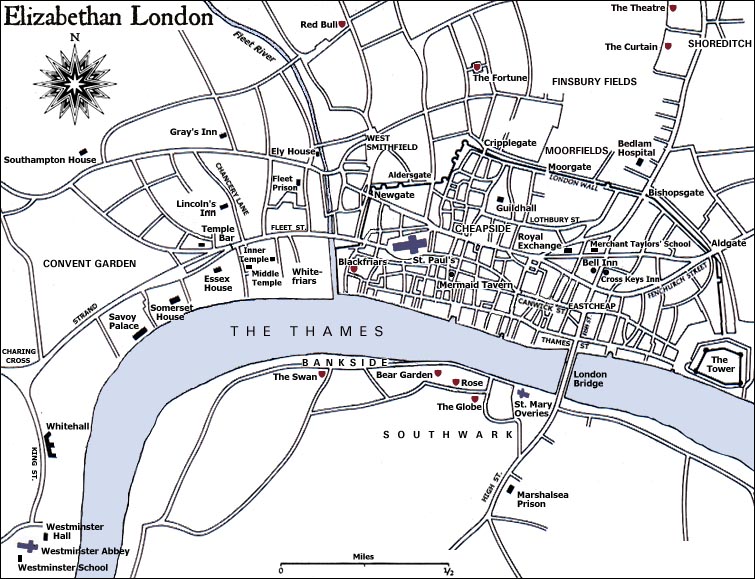
Location Map of Elizabethan London
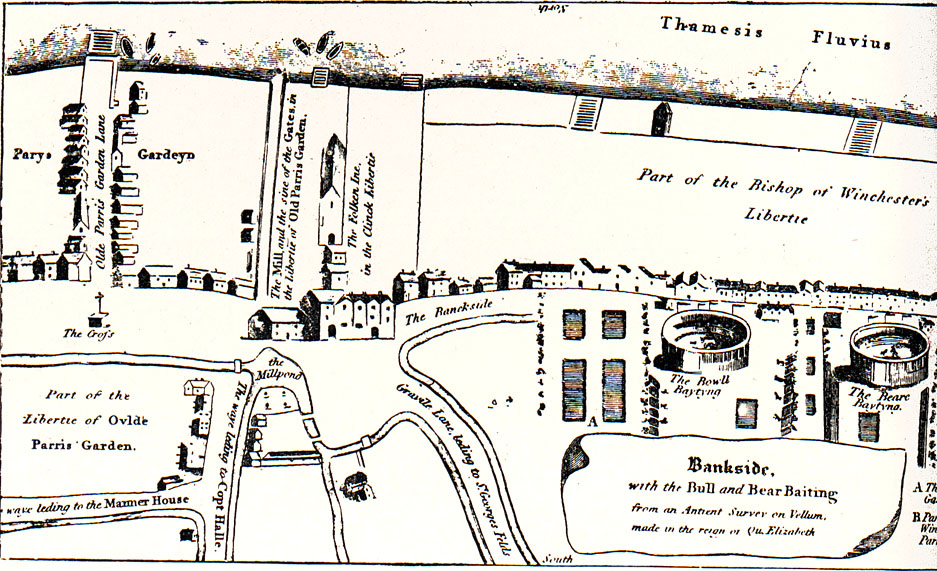
Plan of the Bankside, Southwark, in Shakespeare's time
Detail of Norden's Map of the Bankside, 1593
Bull and Bear Baiting Rings from the Agas Map (1569-1590, pub. 1631)
Sketch of the Swan Theatre, c. 1596
Westminster in the Seventeenth Century, by Hollar
Visscher's View of London, 1616
Larger Visscher's View in Sections
c. 1690. View of London Churches, after the Great Fire
The Yard of the Tabard Inn from Thornbury, Old and New London
|
|