|
|
|
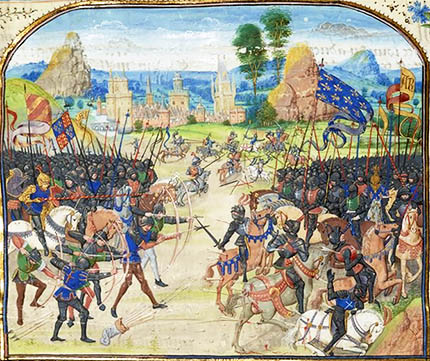

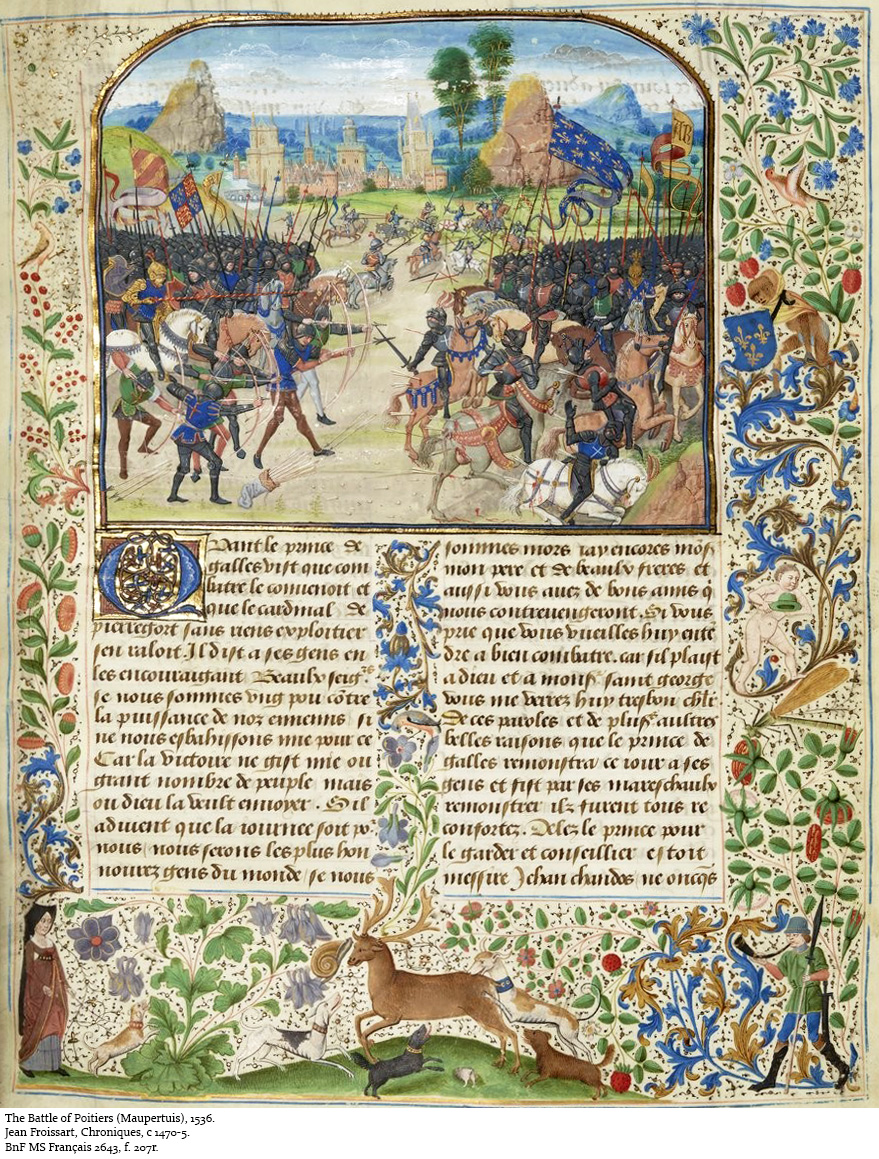
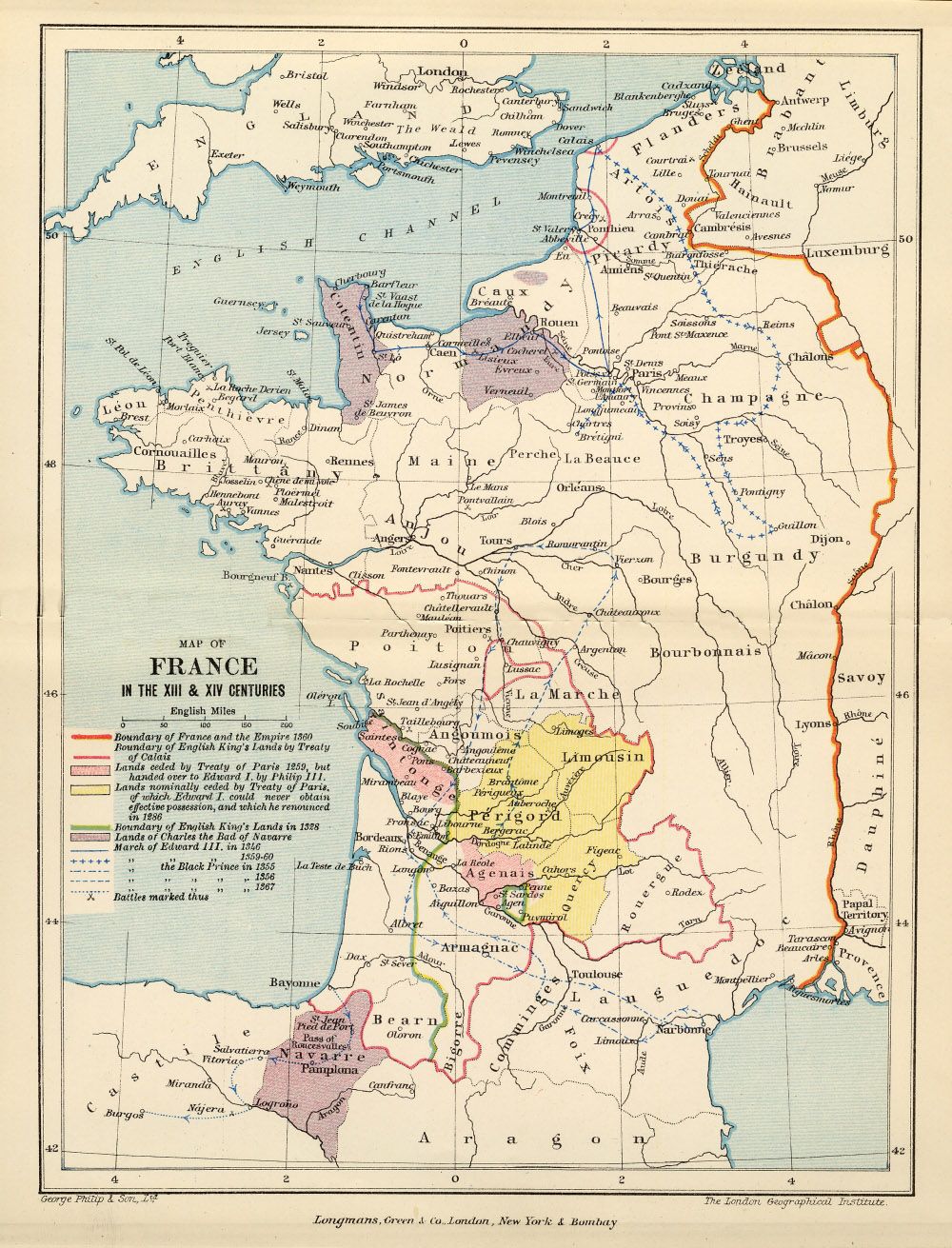
THE BATTLE OF POITIERS (September 19, 1356). In the early summer of 1356 the Black Prince took the field with a small army,
not more than from eight to ten thousand men,1 the most part not English, and rode into the Rouergue, Auvergne, and the Limousin, meeting
no resistance, sacking and taking all they found, and so upwards to the Loire.... The French King was lying before Breteuil, with a strong force,
when news of the Prince's northward ride came to him. He hastily granted the garrison of the town easy terms, and they withdrew to Cherbourg;
then he marched to Paris, and summoned all his nobles and fief-holders to a rendezvous on the borders of Blois and Touraine. He himself moved southwards
as far as Chartres.
The Black Prince threatened Bourges and Issoudun, failing to take either city; then he marched to Vierzon, a large town of no strength,
and took it; here he found, what he sorely needed, wine and food in plenty. While he lay here he heard that King John was at Chartres with all France at
his back, and that the passages of the Loire were occupied. So he broke up, and turned his face towards Bordeaux, at once abandoning any plan he may have
had of joining the Earl of Lancaster in Normandy. King John, hastening to overtake him, actually overshot the English army, and placed
himself across the Prince's line of retreat. Thus he had the English utterly in his power: a little patience and prudence, and he might have avenged
himself almost without loss on the invading army, by capturing both it and its brilliant captain. But, unfortunately for France, John 'the Good' was
possessed with chivalrous ideas, which prompted him to do exactly the wrong thing.
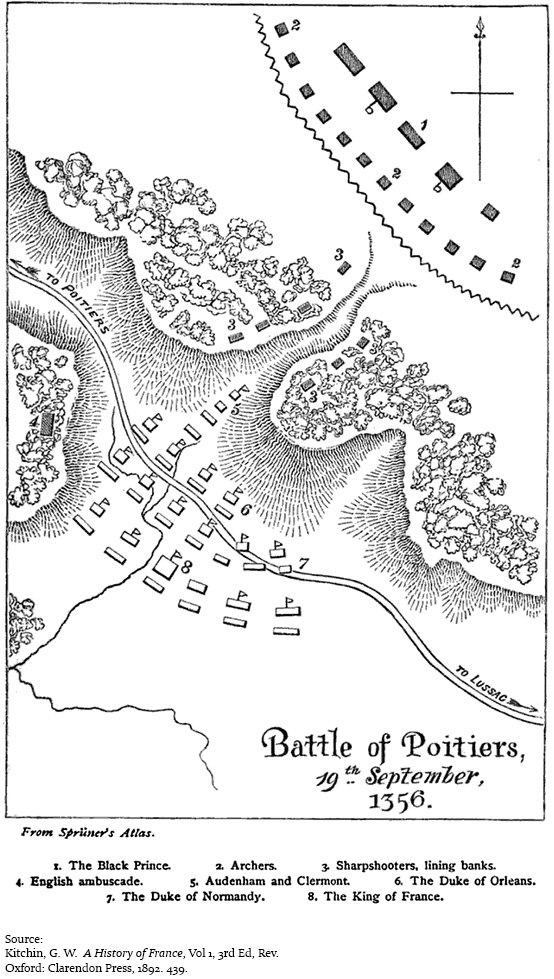
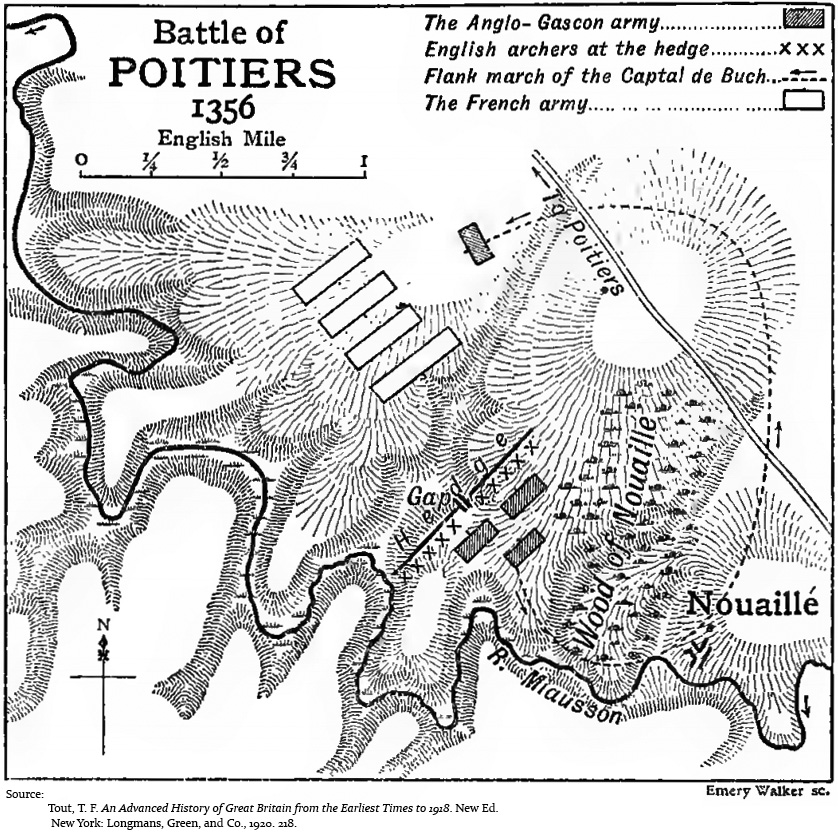
The Black Prince, seeing his retreat cut off, stood at bay in a strong position at Maupertuis, near Poitiers. It was a rough hill-side, covered with
vineyards; cut up by hedges, and also sprinkled with low scrub. Nothing could be better for defence: the chivalry of France, whose overwhelming weight
would have been irresistible on the plain, were of no avail on such a hillside; and there was plenty of cover to delight sharp-shooters who knew their
work. The only point of attack from the front was a narrow and hollow way, liable to a converging fire, which would grow more severe the farther the
enemy penetrated; for the cheeks of the ravine commanded the whole of the roadway.
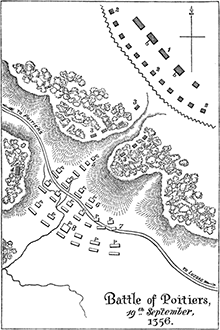
On the level ground atop lay the main English force: every available point was crowded with archers; the narrow way had high hedge-crowned banks.
Underneath lay the 50,000 Frenchmen, 'the flower of their chivalry,' all feudal, no city-levies this time. The King was there, with his four sons,
his brother, and a crowd of great princes and barons. Had they been content to wait, and watch vigilantly, the Black Prince would have been starved,
and must have laid down his arms. This, however, was not their idea, nor the idea of that age. So they got them ready to assault the Prince's
formidable position; to give themselves the utmost disadvantage arising from useless numbers; and to give him the means of taking the greatest
possible advantage of his ground, where every man of his little force was available.
Before the assault took place the Papal Legate interposed, and obtained a truce for twenty-four hours. The Black Prince, knowing well his peril,
was willing to treat on terms honourable to France: unconditional surrender was the only thing King John would listen to. This would have been
as bad as a lost battle; what could they do but refuse? better die in arms than suffer imprisonment, starvation, and perhaps a shameful death.
So they set themselves to use the remainder of the day's truce in strengthening their position; an ambuscade was quietly posted on the left flank
of the one possible line of attack.
Next morning, the 19th of September, 1356, the French army was moved forwards: in the van came two marshals, Audenham and Clermont, with three
hundred men-at-arms, on swift warhorses; behind them were the Germans of Saarbrück and Nassau; then the Duke of Orleans in command of the
first line of battle; Charles, Duke of Normandy, the King's eldest son, was with the second; and lastly the King, surrounded by nineteen knights
all wearing his dress, that he might be the safer in the fight:2 before him fluttered the Oriflamme.
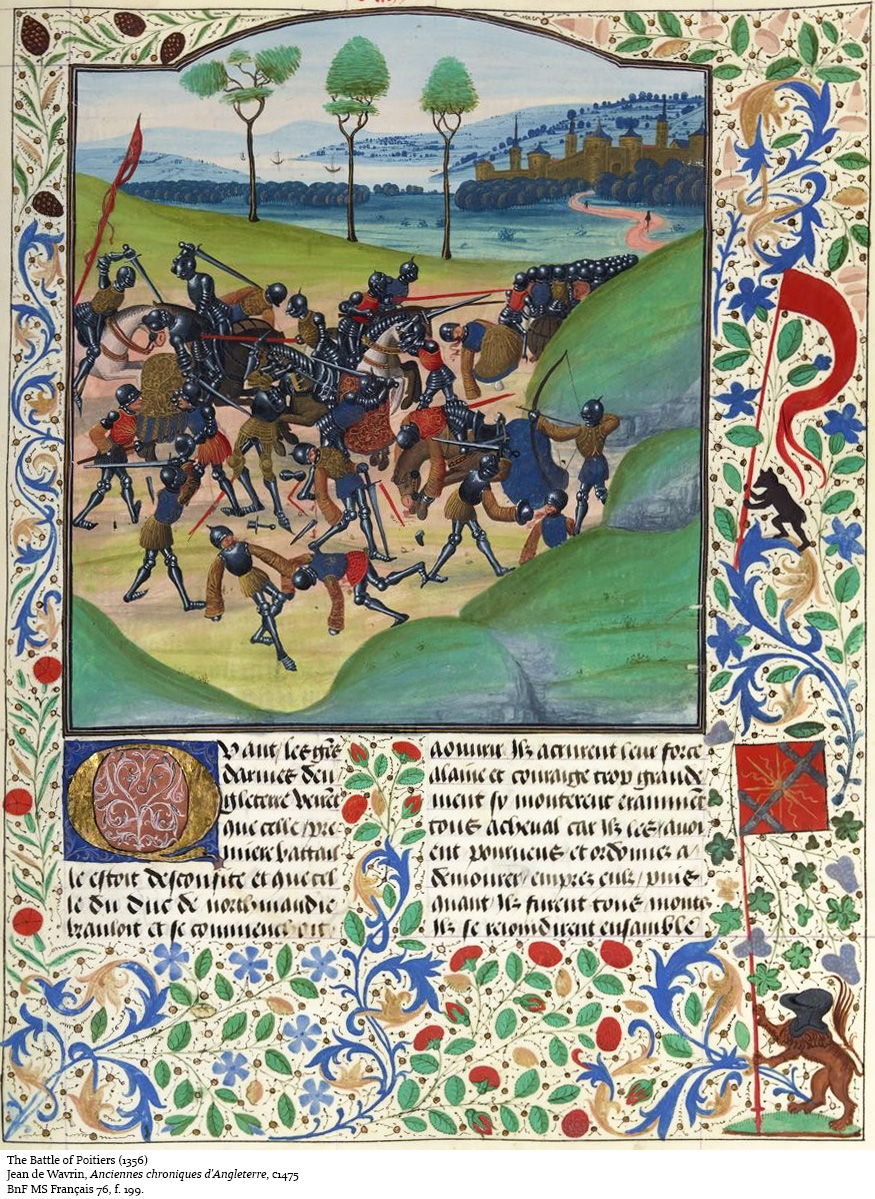
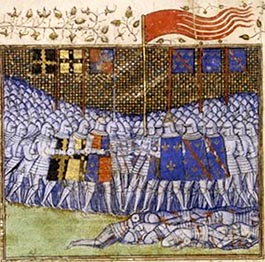 With heedless courage the vanguard dashed at the centre of the English position; for such were the King's orders. They rode full speed along the
narrow roadway up the hill-side, between the thick hedges; but the hill was steep, and the archers flanking it shot fast and well. A few only
struggled to the top; these were easily overthrown. The rest were rolled back in wild confusion on the Duke of Normandy's line, and broke their order;
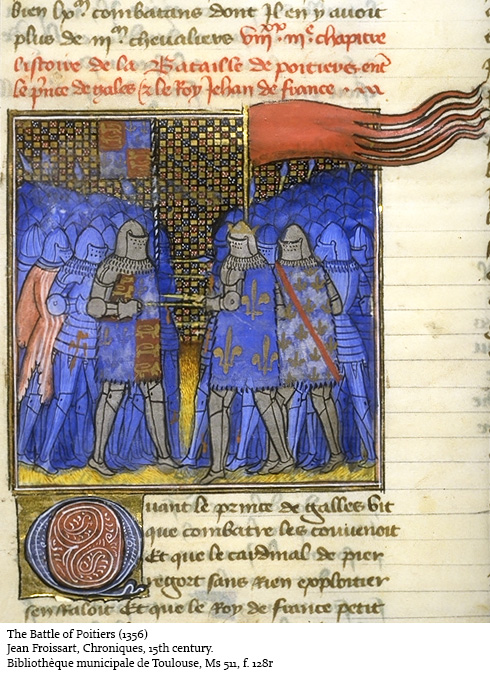
at this moment the English ambuscade fell on their left flank. Then, when the "Black Prince saw that the Duke's battle 'was shaking and beginning
to open,' he bade his men mount quickly, and rode down into the midst, with loud cries of 'St. George' and 'Guienne.' Pushing on cheerily, he fell
upon the Constable of France, the Duke of Athens; the English archers, keeping pace afoot with the horsemen, supported them, shooting so swiftly
and well that the French and Germans were speedily put to flight.
With heedless courage the vanguard dashed at the centre of the English position; for such were the King's orders. They rode full speed along the
narrow roadway up the hill-side, between the thick hedges; but the hill was steep, and the archers flanking it shot fast and well. A few only
struggled to the top; these were easily overthrown. The rest were rolled back in wild confusion on the Duke of Normandy's line, and broke their order;
at this moment the English ambuscade fell on their left flank. Then, when the "Black Prince saw that the Duke's battle 'was shaking and beginning
to open,' he bade his men mount quickly, and rode down into the midst, with loud cries of 'St. George' and 'Guienne.' Pushing on cheerily, he fell
upon the Constable of France, the Duke of Athens; the English archers, keeping pace afoot with the horsemen, supported them, shooting so swiftly
and well that the French and Germans were speedily put to flight.
Then Charles, the Dauphin, with his two brothers, put spurs to their horses, and fled headlong from the field; there followed them full eight hundred
lances, the pride of the French army, who might well have upheld the fortune of the day. It was a pitiful beginning for the the young Prince,
who would so soon be called to fill his father's place. The first and second lines of battle were thus utterly scattered, almost in a moment:
some riding hither and thither off the field, in panic; others driven back under the walls of Poitiers, where the English garrison took great
store of negotiable prisoners; for at that time prisoners meant ransom.
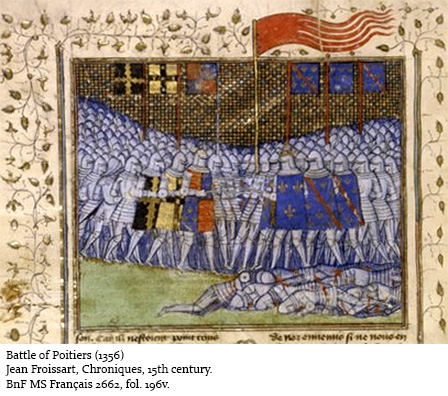
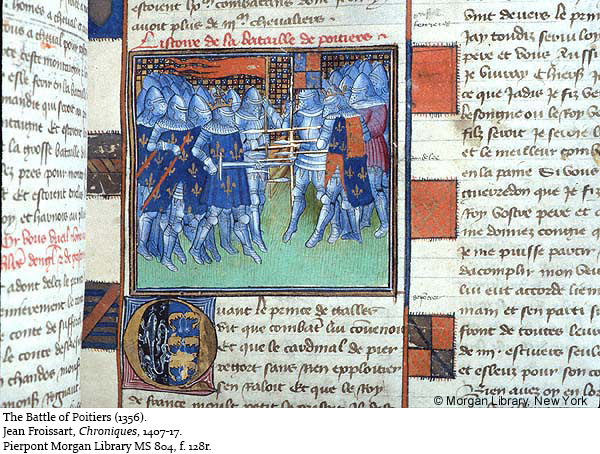
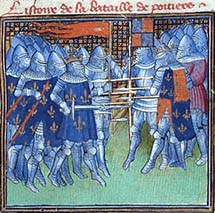 The King, perhaps remembering the mishap of Crécy, now ordered all his line to dismount and fight afoot. And then for the first time
a stand was made, and something worthy of the name of a battle began. The French were still largely superior in force: at the beginning they
had been seven to one;3 and the advantage of the ground was no longer with the English. But the Prince of Wales pressed ever forwards,
with Sir John Chandos at his side, who bore himself so loyally that he never thought that day of prisoners, but kept on saying to the Prince
'Sire, ride onwards; God is with you, the day is yours!' 'And the Prince, who aimed at all perfectness of honour, rode onwards, with his banner
before him, succouring his people whenever he saw them scattering or unsteady, and proving himself a right good knight.4
The King, perhaps remembering the mishap of Crécy, now ordered all his line to dismount and fight afoot. And then for the first time
a stand was made, and something worthy of the name of a battle began. The French were still largely superior in force: at the beginning they
had been seven to one;3 and the advantage of the ground was no longer with the English. But the Prince of Wales pressed ever forwards,
with Sir John Chandos at his side, who bore himself so loyally that he never thought that day of prisoners, but kept on saying to the Prince
'Sire, ride onwards; God is with you, the day is yours!' 'And the Prince, who aimed at all perfectness of honour, rode onwards, with his banner
before him, succouring his people whenever he saw them scattering or unsteady, and proving himself a right good knight.4
Thus the English force fell, like an iron bar, on the soft mass of the French army, which had but little coherence, after the manner of a great
feudal levy; and this swift onset, with the Prince riding manfully in the van, like the point of the bar, scattered them hither and thither,
and decided the fortunes of the day. The Dukes of Bourbon and Athens perished, with many another of noble name; among them the Bishop of Chalons
in Champagne: the French gave back, till they were stayed by the walls of Poitiers. King John was now in the very thick of it: and with his own
hands did many feats of arms, defending himself manfully with a battle-axe.5 By his side was Philip, his youngest son, afterwards
Duke of Burgundy, founder of the second line of that house, who here earned for himself the name of 'le Hardi,' the Bold: for though but a child,
he stood gallantly by his father, warding off the blows that rained thickly on him.
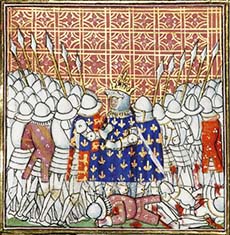 The rout was too complete to be stayed by their gallantry. The gates of Poitiers were firmly shut; there was a great slaughter under the walls.
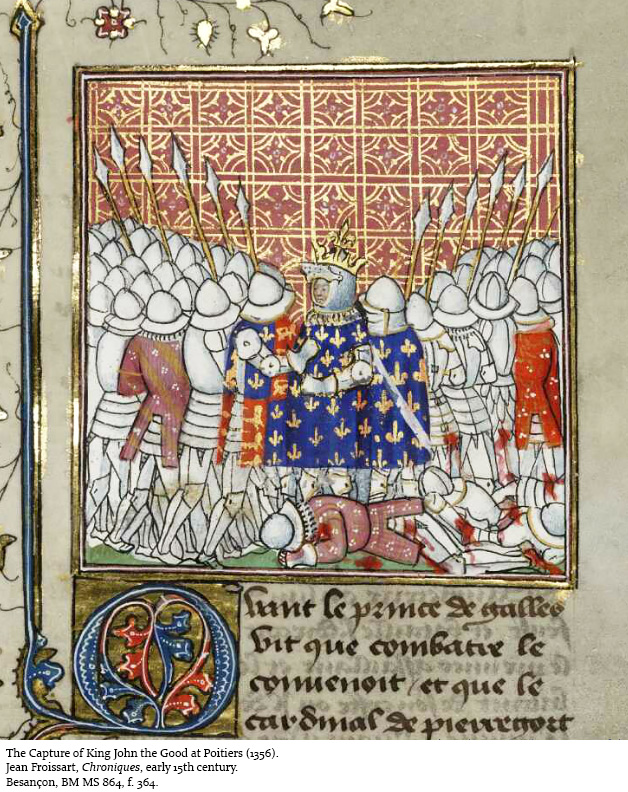
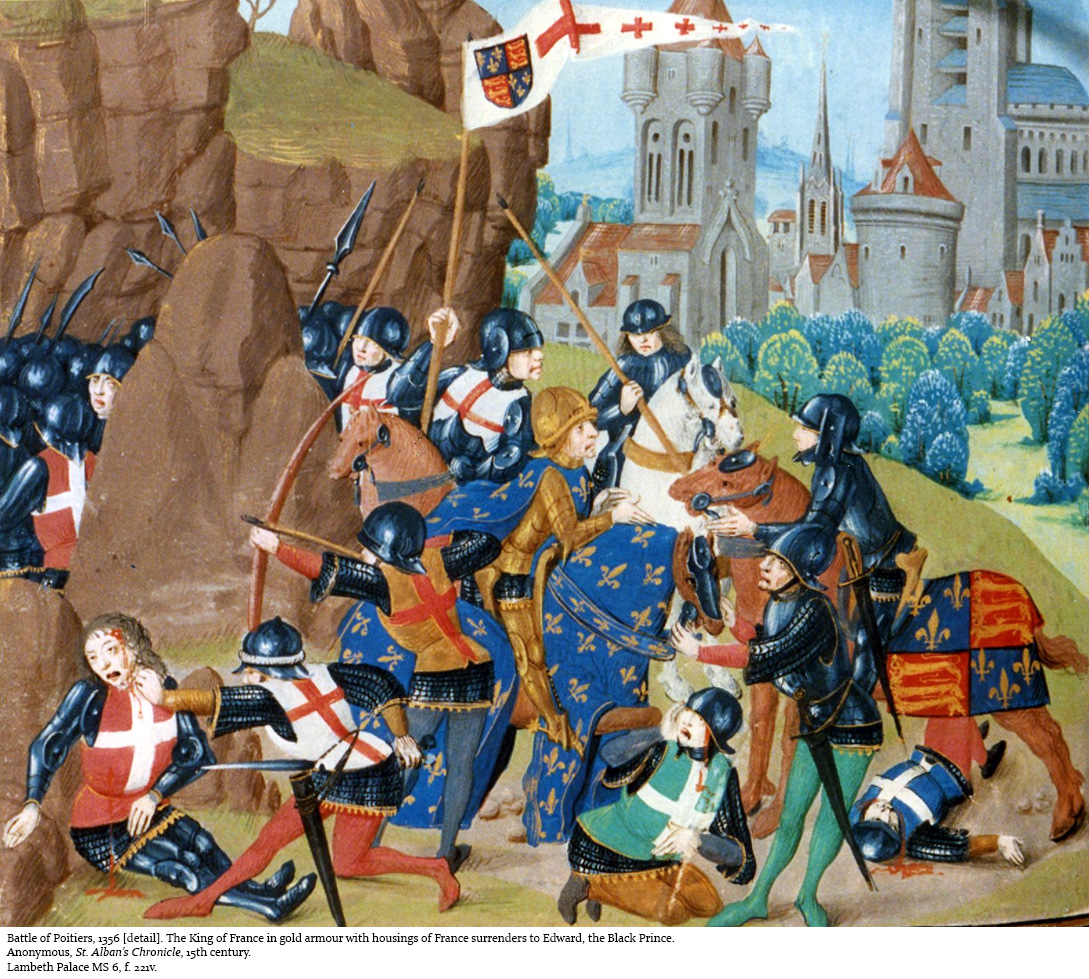
Round the King himself the fight was stubborn; many of his bodyguard were taken or slain. Geoffrey de Chargny, who bore the Oriflamme, went down:
and the King was hemmed in, all men being eager to take so great a prize. Through the crowd came shouldering a man of huge stature, Denis of Mortbeque,
a knight of St. Omer; when he got up to the King he prayed him in good French to surrender. The King then asked for 'his cousin, the Prince of Wales':
and Denis promised that if he would yield he would see him safely to the Prince: the King agreed. Thus he was taken, and with him Philip his little son.
The rout was too complete to be stayed by their gallantry. The gates of Poitiers were firmly shut; there was a great slaughter under the walls.
Round the King himself the fight was stubborn; many of his bodyguard were taken or slain. Geoffrey de Chargny, who bore the Oriflamme, went down:
and the King was hemmed in, all men being eager to take so great a prize. Through the crowd came shouldering a man of huge stature, Denis of Mortbeque,
a knight of St. Omer; when he got up to the King he prayed him in good French to surrender. The King then asked for 'his cousin, the Prince of Wales':
and Denis promised that if he would yield he would see him safely to the Prince: the King agreed. Thus he was taken, and with him Philip his little son.
Then arose around him a great debate between English and Gascons, all claiming to have taken him: they tore him away from Denis, and for a moment
he was in great peril. At last two barons, seeing the turmoil, rode up; and hearing that it was the French King, they spurred their horses,
forcing their way into the angry croud, and rescued him from their clutches. Then he was treated with high respect, and led to the Prince of Wales,
who bowed low to the ground before one who in the hierarchy of princes was his superior: he paid him all honour; sent for wine and spices, and served
them to him with his own hands. And thus King John, who one day before had held the English, as he thought, securely in his grasp, now found himself,
broken and wounded, a prisoner in their hands.
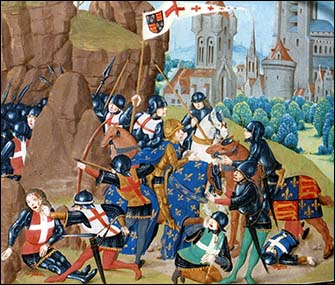
Thus went the great day of Maupertuis, or, as it is more commonly called by us, of Poitiers.
Great was the carnage among the French: they left eleven thousand on the field, of whom nearly two thousand five hundred6
were men of noble birth; while nearly a hundred barons, and full two thousand men-at-arms, to say nothing of lesser folk, were prisoners.
They were so many that the victors scarcely knew what to do with them: they fixed their ransom as quickly as they could, and then let them
go free on their word. The Prince with the huge booty gathered in his expedition, and with the richest prize of all, King John and his
little son, at once fell back to Bordeaux. The French army melted away like snow in spring, such feudal nobles as had escaped wandering
home crestfallen, the lawless and now lordless men-at-arms spreading over the land like a pestilence. A two-years' truce was struck between
England and France; and Edward at once carried his captives over to London.
1 Froissart (Buchon), xxiime addition 3, p. 155: 'Avec deux mille hommes d'armes et six mille archers, parmi les brigands' (i.e. besides the light-armed
mercenaries).
2 Froissart (Buchon), 3, c. 351, p. 186, 'armé lui vingtième de ses parements.'
3 Froissart (Buchon), 3, c. 360, p. 210, 'Les François étoient bien de gens d'armes sept contre un.'
4 Froissart (Buchon), 3, c. 361, p. 216.
5 Ibid. c. 364, p. 223.
6 In exact numbers, 2426. See the careful list given in Buchon's note to Froissart, 3, c. 364, p. 224.
Excerpted from:
Kitchin, G. W. A History of France, Vol 1, 3rd Ed, Rev.
Oxford: Clarendon Press, 1892. 437-444.
Other Local Resources:
Books for further study:
Allmand, Christopher. The Hundred Years War: England and France at War.
Cambridge University Press, 2005.
Barker, Juliet. Conquest: The English Kingdom of France, 1417-1450.
Harvard University Press, 2012.
Green, David. The Battle of Poitiers 1356.
Osprey Publishing, 2004.
Hoskins, Peter. In the Steps of the Black Prince: The Road to Poitiers, 1355-1356.
Boydell & Brewer, 2014.
Nicolle, David. Poitiers 1356: The Capture of a King.
The History Press, 2009.
Seward, Desmond. The Hundred Years War: The English in France 1337-1453.
Penguin, 1999.
The Battle of Poitiers on the Web:
 | to Luminarium Encyclopedia |
Site ©1996-2023 Anniina Jokinen. All rights reserved.
This page was created on September 22, 2017. Last updated May 3, 2023.
|
Index of Encyclopedia Entries:
Medieval Cosmology
Prices of Items in Medieval England
Edward II
Isabella of France, Queen of England
Piers Gaveston
Thomas of Brotherton, E. of Norfolk
Edmund of Woodstock, E. of Kent
Thomas, Earl of Lancaster
Henry of Lancaster, Earl of Lancaster
Henry of Grosmont, Duke of Lancaster
Roger Mortimer, Earl of March
Hugh le Despenser the Younger
Bartholomew, Lord Burghersh, elder
Hundred Years' War (1337-1453)
Edward III
Philippa of Hainault, Queen of England
Edward, Black Prince of Wales
John of Eltham, Earl of Cornwall
The Battle of Crécy, 1346
The Siege of Calais, 1346-7
The Battle of Poitiers, 1356
Lionel of Antwerp, Duke of Clarence
John of Gaunt, Duke of Lancaster
Edmund of Langley, Duke of York
Thomas of Woodstock, Gloucester
Richard of York, E. of Cambridge
Richard Fitzalan, 3. Earl of Arundel
Roger Mortimer, 2nd Earl of March
The Good Parliament, 1376
Richard II
The Peasants' Revolt, 1381
Lords Appellant, 1388
Richard Fitzalan, 4. Earl of Arundel
Archbishop Thomas Arundel
Thomas de Beauchamp, E. Warwick
Robert de Vere, Earl of Oxford
Ralph Neville, E. of Westmorland
Thomas Mowbray, Duke of Norfolk
Edmund Mortimer, 3. Earl of March
Roger Mortimer, 4. Earl of March
John Holland, Duke of Exeter
Michael de la Pole, E. Suffolk
Hugh de Stafford, 2. E. Stafford
Henry IV
Edward, Duke of York
Edmund Mortimer, 5. Earl of March
Henry Percy, Earl of Northumberland
Sir Henry Percy, "Harry Hotspur"
Thomas Percy, Earl of Worcester
Owen Glendower
The Battle of Shrewsbury, 1403
Archbishop Richard Scrope
Thomas Mowbray, 3. E. Nottingham
John Mowbray, 2. Duke of Norfolk
Thomas Fitzalan, 5. Earl of Arundel
Henry V
Thomas, Duke of Clarence
John, Duke of Bedford
Humphrey, Duke of Gloucester
John Talbot, Earl of Shrewsbury
Richard, Earl of Cambridge
Henry, Baron Scrope of Masham
William de la Pole, Duke of Suffolk
Thomas Montacute, E. Salisbury
Richard Beauchamp, E. of Warwick
Henry Beauchamp, Duke of Warwick
Thomas Beaufort, Duke of Exeter
Cardinal Henry Beaufort
John Beaufort, Earl of Somerset
Sir John Fastolf
John Holland, 2. Duke of Exeter
Archbishop John Stafford
Archbishop John Kemp
Catherine of Valois
Owen Tudor
John Fitzalan, 7. Earl of Arundel
John, Lord Tiptoft
Charles VII, King of France
Joan of Arc
Louis XI, King of France
Charles the Bold, Duke of Burgundy
The Battle of Agincourt, 1415
The Battle of Castillon, 1453
The Wars of the Roses 1455-1485
Causes of the Wars of the Roses
The House of Lancaster
The House of York
The House of Beaufort
The House of Neville
The First Battle of St. Albans, 1455
The Battle of Blore Heath, 1459
The Rout of Ludford, 1459
The Battle of Northampton, 1460
The Battle of Wakefield, 1460
The Battle of Mortimer's Cross, 1461
The 2nd Battle of St. Albans, 1461
The Battle of Towton, 1461
The Battle of Hedgeley Moor, 1464
The Battle of Hexham, 1464
The Battle of Edgecote, 1469
The Battle of Losecoat Field, 1470
The Battle of Barnet, 1471
The Battle of Tewkesbury, 1471
The Treaty of Pecquigny, 1475
The Battle of Bosworth Field, 1485
The Battle of Stoke Field, 1487
Henry VI
Margaret of Anjou
Richard Plantagenet, Duke of York
Edward IV
Elizabeth Woodville
Richard Woodville, 1. Earl Rivers
Anthony Woodville, 2. Earl Rivers
Jane Shore
Edward V
Richard III
George, Duke of Clarence
Ralph Neville, 2. Earl of Westmorland
Richard Neville, Earl of Salisbury
Richard Neville, Earl of Warwick
Edward Neville, Baron Bergavenny
William Neville, Lord Fauconberg
Robert Neville, Bishop of Salisbury
John Neville, Marquis of Montagu
George Neville, Archbishop of York
John Beaufort, 1. Duke Somerset
Edmund Beaufort, 2. Duke Somerset
Henry Beaufort, 3. Duke of Somerset
Edmund Beaufort, 4. Duke Somerset
Margaret Beaufort
Edmund Tudor, Earl of Richmond
Jasper Tudor, Earl of Pembroke
Humphrey Stafford, D. Buckingham
Henry Stafford, Duke of Buckingham
Humphrey Stafford, E. of Devon
Thomas, Lord Stanley, Earl of Derby
Sir William Stanley
Archbishop Thomas Bourchier
Henry Bourchier, Earl of Essex
John Mowbray, 3. Duke of Norfolk
John Mowbray, 4. Duke of Norfolk
John Howard, Duke of Norfolk
Henry Percy, 2. E. Northumberland
Henry Percy, 3. E. Northumberland
Henry Percy, 4. E. Northumberland
William, Lord Hastings
Henry Holland, Duke of Exeter
William Fitzalan, Earl of Arundel
William Herbert, 1. Earl of Pembroke
John de Vere, 12th Earl of Oxford
John de Vere, 13th Earl of Oxford
Thomas de Clifford, 8. Baron Clifford
John de Clifford, 9. Baron Clifford
John Tiptoft, Earl of Worcester
Thomas Grey, 1. Marquis Dorset
Sir Andrew Trollop
Archbishop John Morton
Edward Plantagenet, E. of Warwick
John Talbot, 2. E. Shrewsbury
John Talbot, 3. E. Shrewsbury
John de la Pole, 2. Duke of Suffolk
John de la Pole, E. of Lincoln
Edmund de la Pole, E. of Suffolk
Richard de la Pole
John Sutton, Baron Dudley
James Butler, 5. Earl of Ormonde
Sir James Tyrell
Edmund Grey, first Earl of Kent
George Grey, 2nd Earl of Kent
John, 5th Baron Scrope of Bolton
James Touchet, 7th Baron Audley
Walter Blount, Lord Mountjoy
Robert Hungerford, Lord Moleyns
Thomas, Lord Scales
John, Lord Lovel and Holand
Francis Lovell, Viscount Lovell
Sir Richard Ratcliffe
William Catesby
Ralph, 4th Lord Cromwell
Jack Cade's Rebellion, 1450
Tudor Period
King Henry VII
Queen Elizabeth of York
Arthur, Prince of Wales
Lambert Simnel
Perkin Warbeck
The Battle of Blackheath, 1497
King Ferdinand II of Aragon
Queen Isabella of Castile
Maximilian I, Holy Roman Emperor
King Henry VIII
Queen Catherine of Aragon
Queen Anne Boleyn
Queen Jane Seymour
Queen Anne of Cleves
Queen Catherine Howard
Queen Katherine Parr
King Edward VI
Queen Mary I
Queen Elizabeth I
Henry Fitzroy, Duke of Richmond
Margaret Tudor, Queen of Scotland
James IV, King of Scotland
The Battle of Flodden Field, 1513
James V, King of Scotland
Mary of Guise, Queen of Scotland
Mary Tudor, Queen of France
Louis XII, King of France
Francis I, King of France
The Battle of the Spurs, 1513
Field of the Cloth of Gold, 1520
Charles V, Holy Roman Emperor
Eustace Chapuys, Imperial Ambassador
The Siege of Boulogne, 1544
Cardinal Thomas Wolsey
Archbishop Thomas Cranmer
Thomas Cromwell, Earl of Essex
Thomas, Lord Audley
Thomas Wriothesley, E. Southampton
Sir Richard Rich
Edward Stafford, D. of Buckingham
Thomas Howard, 2nd Duke of Norfolk
Thomas Howard, 3rd Duke of Norfolk
John Dudley, Duke of Northumberland
Charles Brandon, Duke of Suffolk
Thomas Boleyn, Earl of Wiltshire
George Boleyn, Viscount Rochford
John Russell, Earl of Bedford
Thomas Grey, 2. Marquis of Dorset
Henry Grey, D. of Suffolk
Charles Somerset, Earl of Worcester
George Talbot, 4. E. Shrewsbury
Francis Talbot, 5. E. Shrewsbury
Henry Algernon Percy,
5th Earl of Northumberland
Henry Algernon Percy,
6th Earl of Northumberland
Ralph Neville, 4. E. Westmorland
Henry Neville, 5. E. Westmorland
William Paulet, Marquis of Winchester
Sir Francis Bryan
Sir Nicholas Carew
John de Vere, 15th Earl of Oxford
John de Vere, 16th Earl of Oxford
Thomas Seymour, Lord Admiral
Edward Seymour, Protector Somerset
Margaret Pole, Countess of Salisbury
Henry Pole, Lord Montague
Sir Geoffrey Pole
Thomas Manners, Earl of Rutland
Henry Manners, Earl of Rutland
Henry Bourchier, 2. Earl of Essex
Robert Radcliffe, 1. Earl of Sussex
Henry Radcliffe, 2. Earl of Sussex
George Hastings, Earl of Huntingdon
Henry Courtenay, Marquis of Exeter
George Neville, Baron Bergavenny
Sir Edward Neville
William, Lord Paget
William Sandys, Baron Sandys
William Fitzwilliam, E. Southampton
Sir Anthony Browne
Sir Thomas Wriothesley
Sir William Kingston
George Brooke, Lord Cobham
Sir Richard Southwell
Thomas Fiennes, 9th Lord Dacre
Sir Francis Weston
Henry Norris
Lady Jane Grey
Sir Thomas Arundel
Sir Richard Sackville
Sir William Petre
Sir John Cheke
Walter Haddon, L.L.D
Sir Peter Carew
Sir John Mason
Nicholas Wotton
John Taylor
Sir Thomas Wyatt, the Younger
Cardinal Lorenzo Campeggio
Cardinal Reginald Pole
Stephen Gardiner, Bishop of Winchester
Edmund Bonner, Bishop of London
Nicholas Ridley, Bishop of London
John Hooper, Bishop of Gloucester
John Aylmer, Bishop of London
Thomas Linacre
William Grocyn
Archbishop William Warham
Cuthbert Tunstall, Bishop of Durham
Richard Fox, Bishop of Winchester
Edward Fox, Bishop of Hereford
Pope Julius II
Pope Leo X
Pope Clement VII
Pope Paul III
Pope Pius V
Pico della Mirandola
Desiderius Erasmus
Martin Bucer
Richard Pace
Christopher Saint-German
Thomas Tallis
Elizabeth Barton, the Nun of Kent
Hans Holbein, the Younger
The Sweating Sickness
Dissolution of the Monasteries
Pilgrimage of Grace, 1536
Robert Aske
Anne Askew
Lord Thomas Darcy
Sir Robert Constable
Oath of Supremacy
The Act of Supremacy, 1534
The First Act of Succession, 1534
The Third Act of Succession, 1544
The Ten Articles, 1536
The Six Articles, 1539
The Second Statute of Repeal, 1555
The Act of Supremacy, 1559
Articles Touching Preachers, 1583
Queen Elizabeth I
William Cecil, Lord Burghley
Robert Cecil, 1st Earl of Salisbury
Sir Francis Walsingham
Sir Nicholas Bacon
Sir Thomas Bromley
Robert Dudley, Earl of Leicester
Ambrose Dudley, Earl of Warwick
Henry Carey, Lord Hunsdon
Sir Thomas Egerton, Viscount Brackley
Sir Francis Knollys
Katherine "Kat" Ashley
Lettice Knollys, Countess of Leicester
George Talbot, 6. E. of Shrewsbury
Elizabeth, Countess of Shrewsbury
Gilbert Talbot, 7. E. of Shrewsbury
Sir Henry Sidney
Sir Robert Sidney
Archbishop Matthew Parker
Walter Devereux, 1st Earl of Essex
Robert Devereux, 2nd Earl of Essex
Penelope Devereux, Lady Rich
Sir Christopher Hatton
Edward Courtenay, E. Devonshire
Edward Manners, 3rd Earl of Rutland
Thomas Radcliffe, 3. Earl of Sussex
Henry Radcliffe, 4. Earl of Sussex
Robert Radcliffe, 5. Earl of Sussex
William Parr, Marquis of Northampton
Henry Wriothesley, 2. Southampton
Henry Wriothesley, 3. Southampton
Charles Neville, 6. E. Westmorland
Thomas Percy, 7. E. Northumberland
Henry Percy, 8. E. Northumberland
Henry Percy, 9. E. Nothumberland
William Herbert, 1. Earl of Pembroke
Charles, Lord Howard of Effingham
Thomas Howard, 4th Duke of Norfolk
Henry Howard, 1. Earl of Northampton
Thomas Howard, 1. Earl of Suffolk
Henry Hastings, 3. E. of Huntingdon
Edward Manners, 3rd Earl of Rutland
Roger Manners, 5th Earl of Rutland
Francis Manners, 6th Earl of Rutland
Henry FitzAlan, 12. Earl of Arundel
Thomas, Earl Arundell of Wardour
Edward Somerset, E. of Worcester
William Davison
Sir Walter Mildmay
Sir Ralph Sadler
Sir Amyas Paulet
Gilbert Gifford
Anthony Browne, Viscount Montague
François, Duke of Alençon & Anjou
Mary, Queen of Scots
Henry Stuart, Lord Darnley
James Hepburn, Earl of Bothwell
Anthony Babington and the Babington Plot
John Knox
Philip II of Spain
The Spanish Armada, 1588
Sir Francis Drake
Sir John Hawkins
William Camden
Archbishop Whitgift
Martin Marprelate Controversy
John Penry (Martin Marprelate)
Richard Bancroft, Archbishop of Canterbury
John Dee, Alchemist
Philip Henslowe
Edward Alleyn
The Blackfriars Theatre
The Fortune Theatre
The Rose Theatre
The Swan Theatre
Children's Companies
The Admiral's Men
The Lord Chamberlain's Men
Citizen Comedy
The Isle of Dogs, 1597
Common Law
Court of Common Pleas
Court of King's Bench
Court of Star Chamber
Council of the North
Fleet Prison
Assize
Attainder
First Fruits & Tenths
Livery and Maintenance
Oyer and terminer
Praemunire
The Stuarts
King James I of England
Anne of Denmark
Henry, Prince of Wales
The Gunpowder Plot, 1605
George Villiers, 1st Duke of Buckingham
Robert Carr, Earl of Somerset
Arabella Stuart, Lady Lennox
William Alabaster
Bishop Hall
Bishop Thomas Morton
Archbishop William Laud
John Selden
Lucy Harington, Countess of Bedford
Henry Lawes
King Charles I
Queen Henrietta Maria
Long Parliament
Rump Parliament
Kentish Petition, 1642
Thomas Wentworth, Earl of Strafford
John Digby, Earl of Bristol
George Digby, 2nd Earl of Bristol
Thomas Fairfax, 3rd Lord Fairfax
Robert Devereux, 3rd E. of Essex
Robert Sidney, 2. E. of Leicester
Algernon Percy, E. of Northumberland
Henry Montagu, Earl of Manchester
Edward Montagu, 2. Earl of Manchester
The Restoration
King Charles II
King James II
Test Acts
Greenwich Palace
Hatfield House
Richmond Palace
Windsor Palace
Woodstock Manor
The Cinque Ports
Mermaid Tavern
Malmsey Wine
Great Fire of London, 1666
Merchant Taylors' School
Westminster School
The Sanctuary at Westminster
"Sanctuary"
Images:
Chart of the English Succession from William I through Henry VII
Medieval English Drama
London c1480, MS Royal 16
London, 1510, the earliest view in print
Map of England from Saxton's Descriptio Angliae, 1579
London in late 16th century
Location Map of Elizabethan London
Plan of the Bankside, Southwark, in Shakespeare's time
Detail of Norden's Map of the Bankside, 1593
Bull and Bear Baiting Rings from the Agas Map (1569-1590, pub. 1631)
Sketch of the Swan Theatre, c. 1596
Westminster in the Seventeenth Century, by Hollar
Visscher's View of London, 1616
Larger Visscher's View in Sections
c. 1690. View of London Churches, after the Great Fire
The Yard of the Tabard Inn from Thornbury, Old and New London
|
|