|
|
|
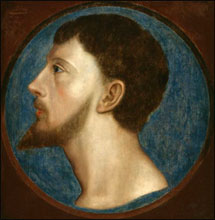

SIR THOMAS WYATT, the Younger (1521?-1554), conspirator, was the eldest and only surviving son of
Sir Thomas Wyatt the elder, by his wife Elizabeth, daughter of Thomas Brooke,
third lord Cobham. He was brought up as a catholic. He is described as 'twenty-one years and upwards' in the 'inquisitio post mortem'
of his father, which was dated 8 Jan. 1542-3. The Duke of Norfolk was one of his godfathers. In boyhood
he is said to have accompanied his father on an embassy to Spain, where the elder Sir Thomas Wyatt
was threatened by the Inquisition. To this episode has been traced an irremovable detestation of the Spanish government, but the anecdote
is probably apocryphal. All that is positively known of his relations with his father while the latter was in Spain is found in two
letters which the elder Wyatt addressed from Spain to the younger, then fifteen years old. The letters give much sound moral advice.
In 1537 young Wyatt married when barely sixteen. He succeeded on his father's death in 1542 to Allington Castle and Boxley Abbey in Kent,
with much other property. But the estate was embarrassed, and he parted with some outlying lands on 30 Nov. 1543 to the king, receiving for
them £3,669 8s. 2d. In 1542 he alienated, too, the estate of Tarrant in Dorset in favour of a natural son, Francis Wyatt, whose mother
was Elizabeth, daughter of Sir Edward Darrel of Littlecote. Wyatt was of somewhat wild and impulsive temperament. At an early age he had made
the acquaintance of his father's disciple, Henry Howard, earl of Surrey, and during
Lent 1543 he joined Surrey and other young men in breaking at night the windows of citizens' houses and of London churches. They were arrested
and brought before the privy council on 1 April, and they were charged not merely with acts of violence, but with having eaten meat during Lent.
Surrey explained that his efforts were directed to awakening the citizens of London to a sense of sin. Wyatt was inclined to deny the charges.
He remained in the Tower till 3 May.
In the autumn of 1543 Wyatt joined a regiment of volunteers which Surrey raised at his own expense to take part in the siege of Landrecies.
Wyatt distinguished himself in the military operations, and was highly commended by Thomas Churchyard, who was present. In 1544 Wyatt took part
in the siege of Boulogne and was given responsible command next year. When Surrey became governor he joined the
English council there (14 June 1545). Surrey, writing to Henry VIII, highly commended
Wyatt's hardiness, painfulness, circumspection, and natural disposition to the war. He seems to have remained abroad till the surrender of
Boulogne in 1550.
In November 1550 he was named a commissioner to delimit the English frontier in France, but owing to ill-health was unable to act. Subsequently
he claimed to have served Queen Mary against the Duke of Northumberland when the
duke attempted to secure the throne for his daughter-in-law, Lady Jane Grey. But he took no well-defined part in
public affairs at home until he learned of Queen Mary's resolve to marry Philip of Spain. He regarded the step as an
outrage on the nation's honour, but, according to his own account, never thought of publicly protesting against it until he received an invitation
from Edward Courtenay, earl of Devonshire, to join in a general insurrection throughout the country for the
purpose of preventing the accomplishment of the queen's plan. He cheerfully undertook to raise Kent. Help was vaguely promised him by the French
ambassador.
The official announcement of the marriage was published on 15 Jan. 1553-4. Seven days later Wyatt summoned his friends and neighbours to meet at
Allington Castle to discuss means of resistance. He offered, if they would attempt an armed rebellion, to lead the insurgent force. Like endeavours
made by Courtenay, the Duke of Suffolk, Sir James
Crofts, and Sir Peter Carew, to excite rebellion in other counties failed. The instigators elsewhere were all arrested
before they had time to mature their designs. Wyatt was thus forced into the position of chief actor in the attack on the government of the queen.
He straightway published a proclamation at Maidstone which was addressed 'unto the commons' of Kent. He stated that his course had been approved by
'dyvers of the best of the shire.' Neighbours and friends were urged to secure the advancement of 'liberty and commonwealth,' which were imperilled
by 'the queen's determinate pleasure to marry with a stranger.'
Wyatt showed himself worthy of his responsibilities and laid his plans with boldness. Noailles, the French ambassador, wrote that he was 'estimé
par deçà homme vaillant et de bonne conduicte;' and M. d'Oysel, the French ambassador in Scotland, who was at the time in London, informed
the French king, his master, that Wyatt was 'ung gentil chevallier et fort estimé parmy ceste nation.'1 Fifteen hundred men were soon
in arms under his command, while five thousand promised adherence later. He fixed his headquarters at the castle of Rochester. Some cannon and ammunition
were secretly sent him up the Medway by agents in London; batteries were erected to command the passage of the bridge at Rochester and the opposite bank
of the river.
When the news of Wyatt's action reached the queen and government in London, a proclamation was issued offering pardon to such of his followers as
should within twenty-four hours depart peaceably to their homes. Royal officers with their retainers were despatched to disperse small parties of
Wyatt's associates while on their way to Rochester; Sir Robert Southwell broke up one band under an insurgent named Knevet; Lord Abergavenny defeated
another reinforcement led by a friend of Wyatt named Isley; the citizens of Canterbury rejected Wyatt's entreaties to join him, and derided his threats.
Wyatt maintained the spirit of his followers by announcing that he daily expected succour from France, and circulated false reports of successful risings
in other parts of the country.
Some of his followers sent to the council offers to return to their duty, and at the end of January Wyatt's fortunes looked desperate. But the tide turned
for a season in his favour when the government ordered the Duke of Norfolk to march from London upon Wyatt's main body,
with a detachment of white-coated guards under the command of Sir Henry Jerningham. The manoeuvre gave Wyatt an unexpected advantage. The duke was followed
immediately by five hundred Londoners, hastily collected by one Captain Bret, and was afterwards joined by the sheriff of Kent, who had called out the
trained bands of the county. The force thus embodied by the government was inferior in number to Wyatt's, and it included many who were in sympathy with
the rebels. As soon as they came within touch of Wyatt's forces at Rochester, the majority of them joined him, and the duke with his principal officers
fled towards Gravesend.
Wyatt set out for London at the head of four thousand men. He found the road open. Through Dartford and Gravesend he marched to Blackheath, where he encamped
on 29 Jan. 1553-4. The government acknowledged the seriousness of the situation, and sent Wyatt a message inviting him to formulate his demands, but this was
only a means of gaining time. On 1 Feb. 1554 Mary proceeded to the Guildhall and addressed the citizens of London on the need of meeting the danger summarily.
Wyatt was proclaimed a traitor. Next morning more than twenty thousand men enrolled their names for the protection of the city. Special precautions were taken
for the security of the court and the Tower; many bridges over the Thames within a distance of fifteen miles were broken down; all peers in the neighbourhood
of London received orders to raise their tenantry; and on 3 Feb. a reward of land of the annual value of one hundred pounds a year was offered the captor of
Wyatt's person.
The same day Wyatt entered Southwark, but his followers were alarmed by the reports of the government's activity. Many deserted, and Wyatt found himself
compelled by the batteries on the Tower to evacuate Southwark. Turning to the south he directed his steps towards Kingston, where he arrived on 6 Feb. (Shrove
Tuesday). The river was crossed without difficulty, and a plan was formed to surprise Ludgate. On the way Wyatt hoped to capture St. James's Palace, where
Queen Mary had taken refuge. But his schemes were quickly betrayed to the government. A council of war decided to allow him to
advance upon the city and then to press on him from every quarter. He proceeded on 7 Feb. through Kensington to Hyde Park, and had a sharp skirmish at Hyde
Park Corner with a troop of infantry. Escaping with a diminished following, he made his way past St. James's Palace. Proceeding by Charing Cross along the
Strand and Fleet Street he reached Ludgate at two o'clock in the morning of 8 Feb. The gate was shut against him, and he was without the means or the spirit
to carry it by assault.
His numbers dwindled in the passage through London, and he retreated with very few followers to Temple Bar. There he was met by the Norroy herald, and,
recognising that his cause was lost, he made a voluntary submission. After being taken to Whitehall, he was committed to the Tower, where the lieutenant, Sir
John Brydges (afterwards first Lord Chandos), received him with opprobrious reproaches. On his arrest the French ambassador, De Noailles, paid a tribute to his
valour and confidence. He wrote of him as 'le plus vaillant et asseuré de quoye j'aye jamais ouy parler, qui a mis ladicte dame et seigneurs de son
conseil en telle et si grande peur, qu'elle s'est veue par l'espace de huict jours en bransle de sa couronne.'2 On 15 March he was arraigned at
Westminster of high treason, was condemned, and sentenced to death.
On the day appointed for his execution (11 April) Wyatt requested Lord Chandos, the lieutenant of the Tower, to permit him to speak to a fellow-prisoner,
Edward Courtenay, earl of Devonshire. According to Chandos's report Wyatt on his knees begged Courtenay 'to confess the
truth of himself.' The interview lasted half an hour. It does not appear that he said anything to implicate Princess Elizabeth,
but he seems to have reproached Courtenay with being the instigator of his crime. Nevertheless, at the scaffold on Tower Hill he made a speech accepting
full responsibility for his acts and exculpating alike Elizabeth and Courtenay. After he was beheaded, his body was subjected to all the barbarities that
formed part of punishment for treason. Next day his head was hung to a gallows on 'Hay Hill beside Hyde Park,' and subsequently his limbs were distributed
among gibbets in various quarters of the town. His head was stolen on 17 April.
Wyatt married in 1537 Jane, daughter of Sir William Hawte of Bishopsbourne, Kent. Through her he acquired the manor of Wavering. She bore him ten children,
of whom three married and left issue. Of these a daughter Anna married Roger Twysden, grandfather of Sir Roger Twysden, and another Charles Scott of Egerton,
Kent, of the family of Scott of Scotshall. The son George was restored to his estate of Boxley, Kent, by Queen Mary, and to that of Wavering by Queen Elizabeth
in 1570. He collected materials for a life of Queen Anne Boleyn, the manuscript of which passed to his sister's grandson, Sir
Roger Twysden. In 1817 there was privately printed by Robert Triphook from a copy of Wyatt's manuscript 'Extracts from the Life of Queen Anne Boleigne, by
George Wyat. Written at the close of the XVIth century.' The full original manuscript in George Wyatt's autograph is among the Wyatt MSS. Twysden also based
on Wyatt's collections his 'Account of Queen Anne Bullen,' which was first issued privately in 1808; it has little likeness to Wyatt's autograph 'Life.'
The Wyatt MSS. contain letters and religious poems by George Wyatt, as well as a refutation of Nicholas Sanders's attacks on the characters of the two
Sir Thomas Wyatts. George Wyatt, who died in 1623, was father of Sir Francis Wyatt.
1. Ambassades de Messieurs de Noailles en Angleterre, iii. 15, 46.
2. ibid. iii. 59.
Source:
Lee, Sidney L. "Sir Thomas Wyatt, the Younger."
Dictionary of National Biography. Vol. LXIII. Sidney Lee, Ed.
New York: The Macmillan Company, 1900. 187-189.
Books for further study:
Fletcher, A. and D. MacCulloch. Tudor Rebellions.
Longman, 2008.
Slack, Paul. Rebellion, Popular Protest and the Social Order in Early Modern England.
Cambridge University Press, 1984.
 | to Queen Elizabeth I
|
|
| to Sir Thomas Wyatt, the Elder
|
|
| to Luminarium Encyclopedia |
Site ©1996-2023 Anniina Jokinen. All rights reserved.
This page was created on April 27, 2009. Last updated February 22, 2023.
|
Index of Encyclopedia Entries:
Medieval Cosmology
Prices of Items in Medieval England
Edward II
Isabella of France, Queen of England
Piers Gaveston
Thomas of Brotherton, E. of Norfolk
Edmund of Woodstock, E. of Kent
Thomas, Earl of Lancaster
Henry of Lancaster, Earl of Lancaster
Henry of Grosmont, Duke of Lancaster
Roger Mortimer, Earl of March
Hugh le Despenser the Younger
Bartholomew, Lord Burghersh, elder
Hundred Years' War (1337-1453)
Edward III
Philippa of Hainault, Queen of England
Edward, Black Prince of Wales
John of Eltham, Earl of Cornwall
The Battle of Crécy, 1346
The Siege of Calais, 1346-7
The Battle of Poitiers, 1356
Lionel of Antwerp, Duke of Clarence
John of Gaunt, Duke of Lancaster
Edmund of Langley, Duke of York
Thomas of Woodstock, Gloucester
Richard of York, E. of Cambridge
Richard Fitzalan, 3. Earl of Arundel
Roger Mortimer, 2nd Earl of March
The Good Parliament, 1376
Richard II
The Peasants' Revolt, 1381
Lords Appellant, 1388
Richard Fitzalan, 4. Earl of Arundel
Archbishop Thomas Arundel
Thomas de Beauchamp, E. Warwick
Robert de Vere, Earl of Oxford
Ralph Neville, E. of Westmorland
Thomas Mowbray, Duke of Norfolk
Edmund Mortimer, 3. Earl of March
Roger Mortimer, 4. Earl of March
John Holland, Duke of Exeter
Michael de la Pole, E. Suffolk
Hugh de Stafford, 2. E. Stafford
Henry IV
Edward, Duke of York
Edmund Mortimer, 5. Earl of March
Henry Percy, Earl of Northumberland
Sir Henry Percy, "Harry Hotspur"
Thomas Percy, Earl of Worcester
Owen Glendower
The Battle of Shrewsbury, 1403
Archbishop Richard Scrope
Thomas Mowbray, 3. E. Nottingham
John Mowbray, 2. Duke of Norfolk
Thomas Fitzalan, 5. Earl of Arundel
Henry V
Thomas, Duke of Clarence
John, Duke of Bedford
Humphrey, Duke of Gloucester
John Talbot, Earl of Shrewsbury
Richard, Earl of Cambridge
Henry, Baron Scrope of Masham
William de la Pole, Duke of Suffolk
Thomas Montacute, E. Salisbury
Richard Beauchamp, E. of Warwick
Henry Beauchamp, Duke of Warwick
Thomas Beaufort, Duke of Exeter
Cardinal Henry Beaufort
John Beaufort, Earl of Somerset
Sir John Fastolf
John Holland, 2. Duke of Exeter
Archbishop John Stafford
Archbishop John Kemp
Catherine of Valois
Owen Tudor
John Fitzalan, 7. Earl of Arundel
John, Lord Tiptoft
Charles VII, King of France
Joan of Arc
Louis XI, King of France
Charles the Bold, Duke of Burgundy
The Battle of Agincourt, 1415
The Battle of Castillon, 1453
The Wars of the Roses 1455-1485
Causes of the Wars of the Roses
The House of Lancaster
The House of York
The House of Beaufort
The House of Neville
The First Battle of St. Albans, 1455
The Battle of Blore Heath, 1459
The Rout of Ludford, 1459
The Battle of Northampton, 1460
The Battle of Wakefield, 1460
The Battle of Mortimer's Cross, 1461
The 2nd Battle of St. Albans, 1461
The Battle of Towton, 1461
The Battle of Hedgeley Moor, 1464
The Battle of Hexham, 1464
The Battle of Edgecote, 1469
The Battle of Losecoat Field, 1470
The Battle of Barnet, 1471
The Battle of Tewkesbury, 1471
The Treaty of Pecquigny, 1475
The Battle of Bosworth Field, 1485
The Battle of Stoke Field, 1487
Henry VI
Margaret of Anjou
Richard Plantagenet, Duke of York
Edward IV
Elizabeth Woodville
Richard Woodville, 1. Earl Rivers
Anthony Woodville, 2. Earl Rivers
Jane Shore
Edward V
Richard III
George, Duke of Clarence
Ralph Neville, 2. Earl of Westmorland
Richard Neville, Earl of Salisbury
Richard Neville, Earl of Warwick
Edward Neville, Baron Bergavenny
William Neville, Lord Fauconberg
Robert Neville, Bishop of Salisbury
John Neville, Marquis of Montagu
George Neville, Archbishop of York
John Beaufort, 1. Duke Somerset
Edmund Beaufort, 2. Duke Somerset
Henry Beaufort, 3. Duke of Somerset
Edmund Beaufort, 4. Duke Somerset
Margaret Beaufort
Edmund Tudor, Earl of Richmond
Jasper Tudor, Earl of Pembroke
Humphrey Stafford, D. Buckingham
Henry Stafford, Duke of Buckingham
Humphrey Stafford, E. of Devon
Thomas, Lord Stanley, Earl of Derby
Sir William Stanley
Archbishop Thomas Bourchier
Henry Bourchier, Earl of Essex
John Mowbray, 3. Duke of Norfolk
John Mowbray, 4. Duke of Norfolk
John Howard, Duke of Norfolk
Henry Percy, 2. E. Northumberland
Henry Percy, 3. E. Northumberland
Henry Percy, 4. E. Northumberland
William, Lord Hastings
Henry Holland, Duke of Exeter
William Fitzalan, Earl of Arundel
William Herbert, 1. Earl of Pembroke
John de Vere, 12th Earl of Oxford
John de Vere, 13th Earl of Oxford
Thomas de Clifford, 8. Baron Clifford
John de Clifford, 9. Baron Clifford
John Tiptoft, Earl of Worcester
Thomas Grey, 1. Marquis Dorset
Sir Andrew Trollop
Archbishop John Morton
Edward Plantagenet, E. of Warwick
John Talbot, 2. E. Shrewsbury
John Talbot, 3. E. Shrewsbury
John de la Pole, 2. Duke of Suffolk
John de la Pole, E. of Lincoln
Edmund de la Pole, E. of Suffolk
Richard de la Pole
John Sutton, Baron Dudley
James Butler, 5. Earl of Ormonde
Sir James Tyrell
Edmund Grey, first Earl of Kent
George Grey, 2nd Earl of Kent
John, 5th Baron Scrope of Bolton
James Touchet, 7th Baron Audley
Walter Blount, Lord Mountjoy
Robert Hungerford, Lord Moleyns
Thomas, Lord Scales
John, Lord Lovel and Holand
Francis Lovell, Viscount Lovell
Sir Richard Ratcliffe
William Catesby
Ralph, 4th Lord Cromwell
Jack Cade's Rebellion, 1450
Tudor Period
King Henry VII
Queen Elizabeth of York
Arthur, Prince of Wales
Lambert Simnel
Perkin Warbeck
The Battle of Blackheath, 1497
King Ferdinand II of Aragon
Queen Isabella of Castile
Maximilian I, Holy Roman Emperor
King Henry VIII
Queen Catherine of Aragon
Queen Anne Boleyn
Queen Jane Seymour
Queen Anne of Cleves
Queen Catherine Howard
Queen Katherine Parr
King Edward VI
Queen Mary I
Queen Elizabeth I
Henry Fitzroy, Duke of Richmond
Margaret Tudor, Queen of Scotland
James IV, King of Scotland
The Battle of Flodden Field, 1513
James V, King of Scotland
Mary of Guise, Queen of Scotland
Mary Tudor, Queen of France
Louis XII, King of France
Francis I, King of France
The Battle of the Spurs, 1513
Field of the Cloth of Gold, 1520
Charles V, Holy Roman Emperor
Eustace Chapuys, Imperial Ambassador
The Siege of Boulogne, 1544
Cardinal Thomas Wolsey
Archbishop Thomas Cranmer
Thomas Cromwell, Earl of Essex
Thomas, Lord Audley
Thomas Wriothesley, E. Southampton
Sir Richard Rich
Edward Stafford, D. of Buckingham
Thomas Howard, 2nd Duke of Norfolk
Thomas Howard, 3rd Duke of Norfolk
John Dudley, Duke of Northumberland
Charles Brandon, Duke of Suffolk
Thomas Boleyn, Earl of Wiltshire
George Boleyn, Viscount Rochford
John Russell, Earl of Bedford
Thomas Grey, 2. Marquis of Dorset
Henry Grey, D. of Suffolk
Charles Somerset, Earl of Worcester
George Talbot, 4. E. Shrewsbury
Francis Talbot, 5. E. Shrewsbury
Henry Algernon Percy,
5th Earl of Northumberland
Henry Algernon Percy,
6th Earl of Northumberland
Ralph Neville, 4. E. Westmorland
Henry Neville, 5. E. Westmorland
William Paulet, Marquis of Winchester
Sir Francis Bryan
Sir Nicholas Carew
John de Vere, 15th Earl of Oxford
John de Vere, 16th Earl of Oxford
Thomas Seymour, Lord Admiral
Edward Seymour, Protector Somerset
Margaret Pole, Countess of Salisbury
Henry Pole, Lord Montague
Sir Geoffrey Pole
Thomas Manners, Earl of Rutland
Henry Manners, Earl of Rutland
Henry Bourchier, 2. Earl of Essex
Robert Radcliffe, 1. Earl of Sussex
Henry Radcliffe, 2. Earl of Sussex
George Hastings, Earl of Huntingdon
Henry Courtenay, Marquis of Exeter
George Neville, Baron Bergavenny
Sir Edward Neville
William, Lord Paget
William Sandys, Baron Sandys
William Fitzwilliam, E. Southampton
Sir Anthony Browne
Sir Thomas Wriothesley
Sir William Kingston
George Brooke, Lord Cobham
Sir Richard Southwell
Thomas Fiennes, 9th Lord Dacre
Sir Francis Weston
Henry Norris
Lady Jane Grey
Sir Thomas Arundel
Sir Richard Sackville
Sir William Petre
Sir John Cheke
Walter Haddon, L.L.D
Sir Peter Carew
Sir John Mason
Nicholas Wotton
John Taylor
Sir Thomas Wyatt, the Younger
Cardinal Lorenzo Campeggio
Cardinal Reginald Pole
Stephen Gardiner, Bishop of Winchester
Edmund Bonner, Bishop of London
Nicholas Ridley, Bishop of London
John Hooper, Bishop of Gloucester
John Aylmer, Bishop of London
Thomas Linacre
William Grocyn
Archbishop William Warham
Cuthbert Tunstall, Bishop of Durham
Richard Fox, Bishop of Winchester
Edward Fox, Bishop of Hereford
Pope Julius II
Pope Leo X
Pope Clement VII
Pope Paul III
Pope Pius V
Pico della Mirandola
Desiderius Erasmus
Martin Bucer
Richard Pace
Christopher Saint-German
Thomas Tallis
Elizabeth Barton, the Nun of Kent
Hans Holbein, the Younger
The Sweating Sickness
Dissolution of the Monasteries
Pilgrimage of Grace, 1536
Robert Aske
Anne Askew
Lord Thomas Darcy
Sir Robert Constable
Oath of Supremacy
The Act of Supremacy, 1534
The First Act of Succession, 1534
The Third Act of Succession, 1544
The Ten Articles, 1536
The Six Articles, 1539
The Second Statute of Repeal, 1555
The Act of Supremacy, 1559
Articles Touching Preachers, 1583
Queen Elizabeth I
William Cecil, Lord Burghley
Robert Cecil, 1st Earl of Salisbury
Sir Francis Walsingham
Sir Nicholas Bacon
Sir Thomas Bromley
Robert Dudley, Earl of Leicester
Ambrose Dudley, Earl of Warwick
Henry Carey, Lord Hunsdon
Sir Thomas Egerton, Viscount Brackley
Sir Francis Knollys
Katherine "Kat" Ashley
Lettice Knollys, Countess of Leicester
George Talbot, 6. E. of Shrewsbury
Elizabeth, Countess of Shrewsbury
Gilbert Talbot, 7. E. of Shrewsbury
Sir Henry Sidney
Sir Robert Sidney
Archbishop Matthew Parker
Walter Devereux, 1st Earl of Essex
Robert Devereux, 2nd Earl of Essex
Penelope Devereux, Lady Rich
Sir Christopher Hatton
Edward Courtenay, E. Devonshire
Edward Manners, 3rd Earl of Rutland
Thomas Radcliffe, 3. Earl of Sussex
Henry Radcliffe, 4. Earl of Sussex
Robert Radcliffe, 5. Earl of Sussex
William Parr, Marquis of Northampton
Henry Wriothesley, 2. Southampton
Henry Wriothesley, 3. Southampton
Charles Neville, 6. E. Westmorland
Thomas Percy, 7. E. Northumberland
Henry Percy, 8. E. Northumberland
Henry Percy, 9. E. Nothumberland
William Herbert, 1. Earl of Pembroke
Charles, Lord Howard of Effingham
Thomas Howard, 4th Duke of Norfolk
Henry Howard, 1. Earl of Northampton
Thomas Howard, 1. Earl of Suffolk
Henry Hastings, 3. E. of Huntingdon
Edward Manners, 3rd Earl of Rutland
Roger Manners, 5th Earl of Rutland
Francis Manners, 6th Earl of Rutland
Henry FitzAlan, 12. Earl of Arundel
Thomas, Earl Arundell of Wardour
Edward Somerset, E. of Worcester
William Davison
Sir Walter Mildmay
Sir Ralph Sadler
Sir Amyas Paulet
Gilbert Gifford
Anthony Browne, Viscount Montague
François, Duke of Alençon & Anjou
Mary, Queen of Scots
Henry Stuart, Lord Darnley
James Hepburn, Earl of Bothwell
Anthony Babington and the Babington Plot
John Knox
Philip II of Spain
The Spanish Armada, 1588
Sir Francis Drake
Sir John Hawkins
William Camden
Archbishop Whitgift
Martin Marprelate Controversy
John Penry (Martin Marprelate)
Richard Bancroft, Archbishop of Canterbury
John Dee, Alchemist
Philip Henslowe
Edward Alleyn
The Blackfriars Theatre
The Fortune Theatre
The Rose Theatre
The Swan Theatre
Children's Companies
The Admiral's Men
The Lord Chamberlain's Men
Citizen Comedy
The Isle of Dogs, 1597
Common Law
Court of Common Pleas
Court of King's Bench
Court of Star Chamber
Council of the North
Fleet Prison
Assize
Attainder
First Fruits & Tenths
Livery and Maintenance
Oyer and terminer
Praemunire
The Stuarts
King James I of England
Anne of Denmark
Henry, Prince of Wales
The Gunpowder Plot, 1605
George Villiers, 1st Duke of Buckingham
Robert Carr, Earl of Somerset
Arabella Stuart, Lady Lennox
William Alabaster
Bishop Hall
Bishop Thomas Morton
Archbishop William Laud
John Selden
Lucy Harington, Countess of Bedford
Henry Lawes
King Charles I
Queen Henrietta Maria
Long Parliament
Rump Parliament
Kentish Petition, 1642
Thomas Wentworth, Earl of Strafford
John Digby, Earl of Bristol
George Digby, 2nd Earl of Bristol
Thomas Fairfax, 3rd Lord Fairfax
Robert Devereux, 3rd E. of Essex
Robert Sidney, 2. E. of Leicester
Algernon Percy, E. of Northumberland
Henry Montagu, Earl of Manchester
Edward Montagu, 2. Earl of Manchester
The Restoration
King Charles II
King James II
Test Acts
Greenwich Palace
Hatfield House
Richmond Palace
Windsor Palace
Woodstock Manor
The Cinque Ports
Mermaid Tavern
Malmsey Wine
Great Fire of London, 1666
Merchant Taylors' School
Westminster School
The Sanctuary at Westminster
"Sanctuary"
Images:
Chart of the English Succession from William I through Henry VII
Medieval English Drama
London c1480, MS Royal 16
London, 1510, the earliest view in print
Map of England from Saxton's Descriptio Angliae, 1579
London in late 16th century
Location Map of Elizabethan London
Plan of the Bankside, Southwark, in Shakespeare's time
Detail of Norden's Map of the Bankside, 1593
Bull and Bear Baiting Rings from the Agas Map (1569-1590, pub. 1631)
Sketch of the Swan Theatre, c. 1596
Westminster in the Seventeenth Century, by Hollar
Visscher's View of London, 1616
Larger Visscher's View in Sections
c. 1690. View of London Churches, after the Great Fire
The Yard of the Tabard Inn from Thornbury, Old and New London
|
|

 England under the Tudors